Department of Reproductive Health and Midwifery, Nursing Care Research Center, School of Nursing and Midwifery, Iran University of Medical Sciences, Tehran, Iran.
Department of Biostatistics, Nursing Care Research Center, Iran University of Medical Sciences, Tehran, Iran.
Int Breastfeed J. 2020 Oct 12;15(1):84. doi: 10.1186/s13006-020-00325-5.
One of the most important factors that affects breastfeeding self-efficacy and exclusivity is breastfeeding support provided by the family. The aim of this study was to determine the effect of breastfeeding education sessions for primiparous women, with and without the attendance of maternal grandmothers, on breastfeeding self-efficacy and infant feeding patterns.
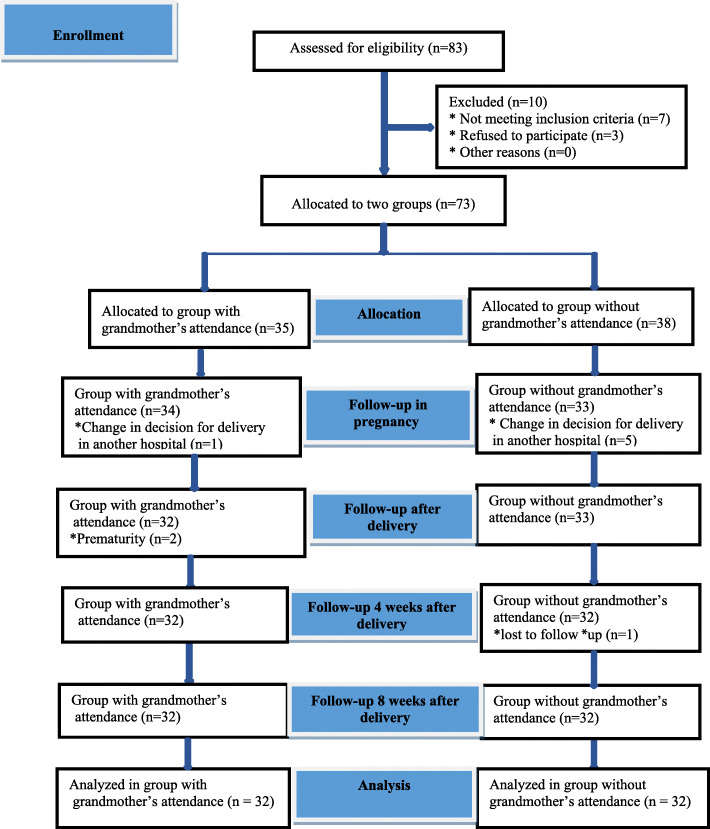
This quasi-experimental study was conducted on 64 primiparous women who referred to the Antenatal Clinic of Amiralmomenin Hospital, Tehran, Iran from June to December, 2018. Eligible pregnant women were allocated into two groups; either with and without grandmothers in attendance. Group assignments were determined according to the week the women had prenatal care at the hospital. All eligible women seen in the clinic during 1 week were assigned to one group and women who presented in the alternating week were assigned to the other group. In the education group with grandmothers in attendance, each woman participated in two prenatal education programs with her mother and one postpartum program approximately 3 h before discharge. In the other group, participating mothers attended breastfeeding education sessions without the grandmother's attendance. The participating mothers answered questions from the Breastfeeding Self-Efficacy Scale-Short Form (BSES-SF) at the time of the hospital discharge, and 4 and 8 weeks after delivery. Questions about the infants' feeding patterns were asked by telephone contact with the participating mothers from both groups at the same time periods.
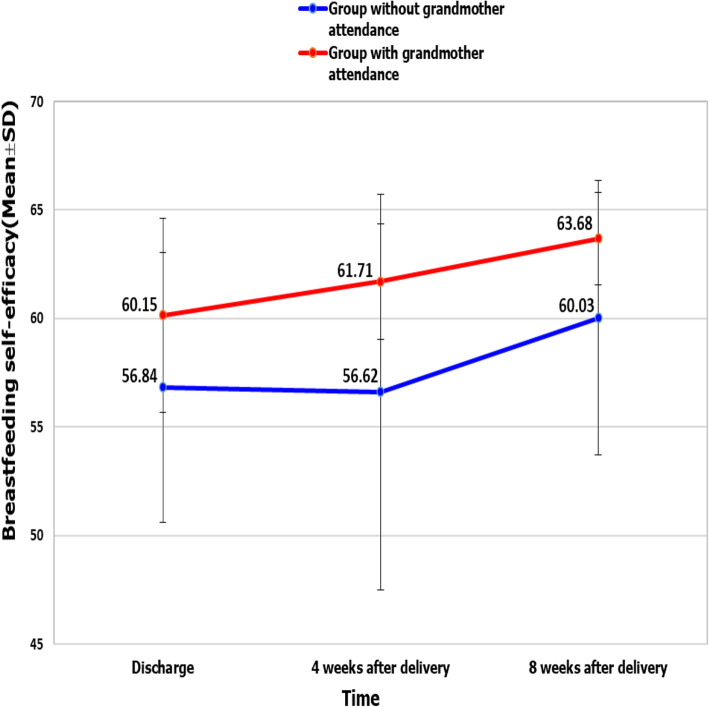
The mean BFSE scores were signficantly different between the groups with grandmothers and without grandmothers at the time of the hospital discharge (60.15 ± 4.47 vs. 56.84 ± 6.22, independent t-test; p = 0.017), and at 4 weeks (61.71 ± 2.66 vs. 56.62 ± 9.12, p = 0.004) and 8 weeks after delivery (63.68 ± 2.14 vs. 60.03 ± 6.32, p = 0.003). No significant difference existed in infant feeding patterns between the groups at the same time periods.
This study suggests that breastfeeding education with grandmothers' attendance is effective in improving the mothers' breastfeeding self-efficacy. A family-centered program should be considered in beastfeeding education for increasing of exclusive breastfeeding.
影响母乳喂养自我效能和专一性的最重要因素之一是家庭提供的母乳喂养支持。本研究的目的是确定对初产妇进行母乳喂养教育课程,有和没有祖母参加,对母乳喂养自我效能和婴儿喂养模式的影响。
这是一项准实验研究,于 2018 年 6 月至 12 月在伊朗德黑兰 Amiralmomenin 医院的产前诊所对 64 名初产妇进行。符合条件的孕妇被分为两组;有和没有祖母参加。组分配是根据孕妇在医院接受产前护理的周数确定的。在诊所就诊的所有符合条件的孕妇在一周内被分配到一组,在交替周就诊的孕妇被分配到另一组。在有祖母参加的教育组中,每位母亲与母亲一起参加两次产前教育课程,一次产后课程,大约在出院前 3 小时。在另一组中,参加的母亲在没有祖母参加的情况下参加母乳喂养教育课程。参加的母亲在出院时、分娩后 4 周和 8 周回答母乳喂养自我效能量表-短表(BSES-SF)的问题。从两组参加的母亲在同一时间通过电话询问婴儿的喂养模式。
有祖母和没有祖母的两组在出院时(60.15±4.47 vs. 56.84±6.22,独立 t 检验;p=0.017)、4 周(61.71±2.66 vs. 56.62±9.12,p=0.004)和 8 周后(63.68±2.14 vs. 60.03±6.32,p=0.003)的 BFSE 评分差异有统计学意义。在同一时间点,两组婴儿的喂养模式无显著差异。
本研究表明,有祖母参加的母乳喂养教育可有效提高母亲的母乳喂养自我效能。在母乳喂养教育中,应考虑以家庭为中心的方案,以增加纯母乳喂养率。