Systems Neurophysiology Group, Werner Reichardt Center for Integrative Neuroscience, University Tübingen Tübingen, Germany ; Department for Cognitive Neurology, Hertie Institute for Clinical Brain Research, University of Tübingen Tübingen, Germany.
Computational Neuroscience Group, Werner Reichardt Center for Integrative Neuroscience, University Tübingen Tübingen, Germany ; Graduate School for Neural and Behavioural Sciences, University Tübingen Tübingen, Germany.
Front Neural Circuits. 2013 Dec 5;7:190. doi: 10.3389/fncir.2013.00190. eCollection 2013.
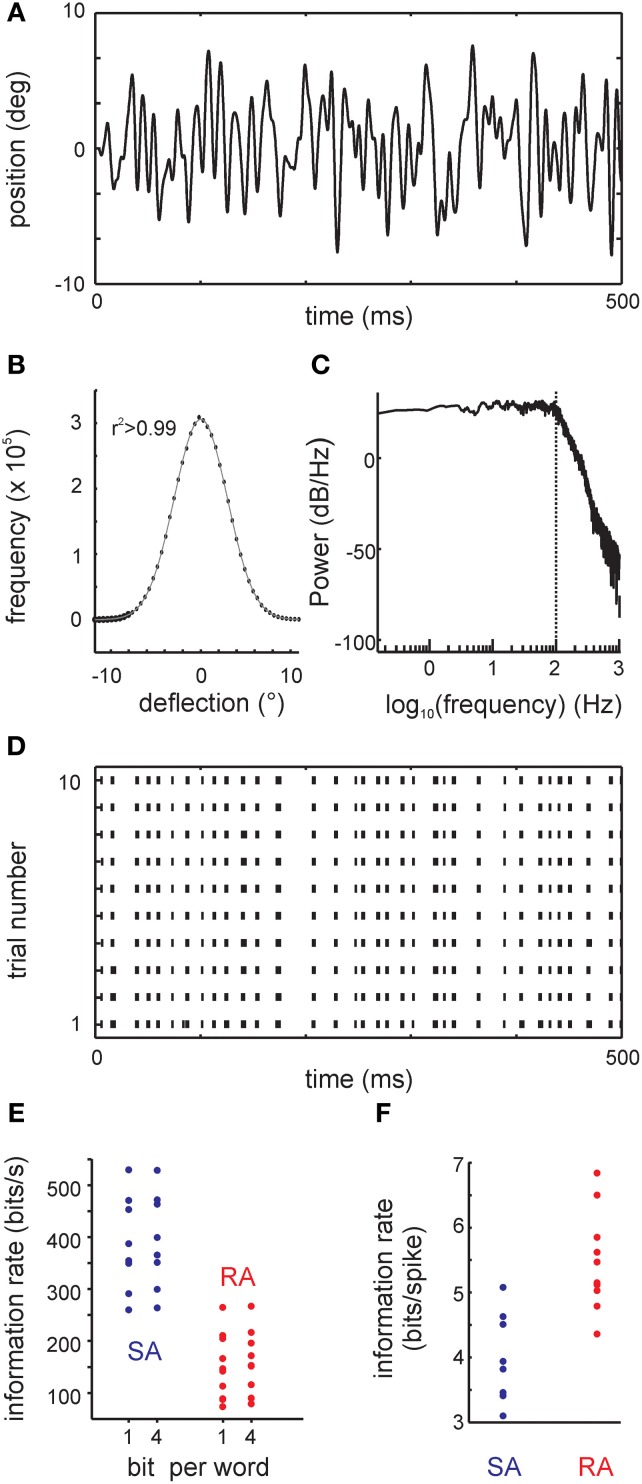
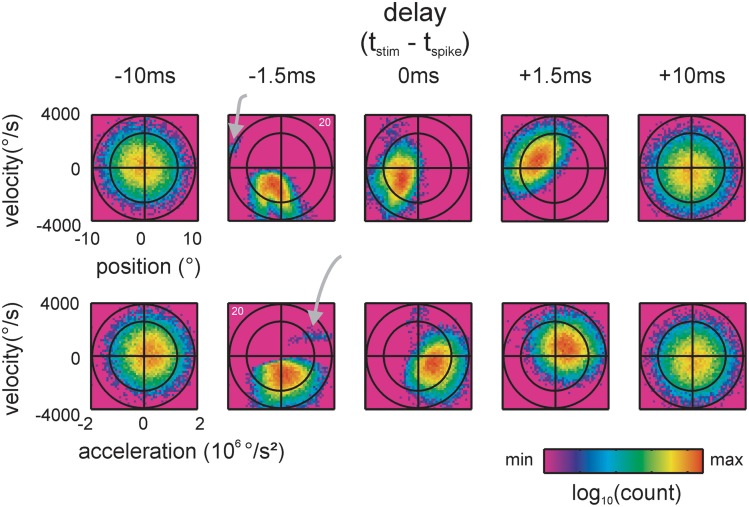
Sensory receptors determine the type and the quantity of information available for perception. Here, we quantified and characterized the information transferred by primary afferents in the rat whisker system using neural system identification. Quantification of "how much" information is conveyed by primary afferents, using the direct method (DM), a classical information theoretic tool, revealed that primary afferents transfer huge amounts of information (up to 529 bits/s). Information theoretic analysis of instantaneous spike-triggered kinematic stimulus features was used to gain functional insight on "what" is coded by primary afferents. Amongst the kinematic variables tested--position, velocity, and acceleration--primary afferent spikes encoded velocity best. The other two variables contributed to information transfer, but only if combined with velocity. We further revealed three additional characteristics that play a role in information transfer by primary afferents. Firstly, primary afferent spikes show preference for well separated multiple stimuli (i.e., well separated sets of combinations of the three instantaneous kinematic variables). Secondly, neurons are sensitive to short strips of the stimulus trajectory (up to 10 ms pre-spike time), and thirdly, they show spike patterns (precise doublet and triplet spiking). In order to deal with these complexities, we used a flexible probabilistic neuron model fitting mixtures of Gaussians to the spike triggered stimulus distributions, which quantitatively captured the contribution of the mentioned features and allowed us to achieve a full functional analysis of the total information rate indicated by the DM. We found that instantaneous position, velocity, and acceleration explained about 50% of the total information rate. Adding a 10 ms pre-spike interval of stimulus trajectory achieved 80-90%. The final 10-20% were found to be due to non-linear coding by spike bursts.
感觉受体决定了可用于感知的信息类型和数量。在这里,我们使用神经系统识别技术对大鼠胡须系统中的初级传入神经传递的信息进行了量化和特征描述。使用经典信息论工具——直接方法(DM)对“多少”信息进行量化,结果表明初级传入神经传递了大量的信息(高达 529 位/秒)。通过对即时的触发运动刺激特征的信息论分析,我们获得了对初级传入神经编码内容的功能见解。在所测试的运动变量中——位置、速度和加速度——初级传入神经的 spikes 对速度的编码效果最好。另外两个变量也有助于信息传递,但仅当与速度结合时才有效。我们进一步揭示了三个额外的特征,这些特征在初级传入神经的信息传递中发挥作用。首先,初级传入神经 spikes 对多个刺激(即三个瞬时运动变量的组合)具有明显偏好。其次,神经元对刺激轨迹的短片段敏感(高达 10 毫秒的前 spike 时间),第三,它们表现出 spike 模式(精确的双连发和三连发)。为了处理这些复杂性,我们使用了一种灵活的概率神经元模型,通过混合高斯分布对 spike 触发刺激分布进行拟合,该模型定量地捕获了上述特征的贡献,并使我们能够对 DM 指示的总信息率进行全面的功能分析。我们发现,瞬时位置、速度和加速度解释了总信息率的 50%左右。添加 10 毫秒的刺激轨迹前 spike 间隔可达到 80-90%。最后 10-20%的信息则归因于 spike 爆发的非线性编码。