Genome Science Division, Research Center for Advanced Science and Technology, The University of Tokyo Tokyo, Japan ; Department of Metabolic Care and Endocrine Surgery, Graduate School of Medicine, The University of Tokyo Tokyo, Japan.
Department of Metabolic Care and Endocrine Surgery, Graduate School of Medicine, The University of Tokyo Tokyo, Japan.
Front Genet. 2013 Dec 5;4:271. doi: 10.3389/fgene.2013.00271. eCollection 2013.
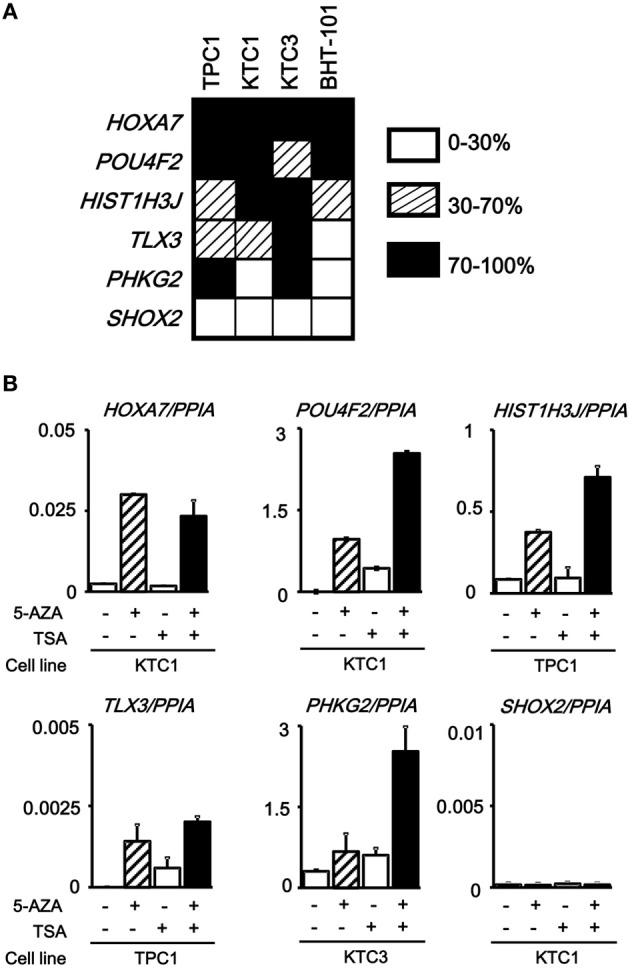
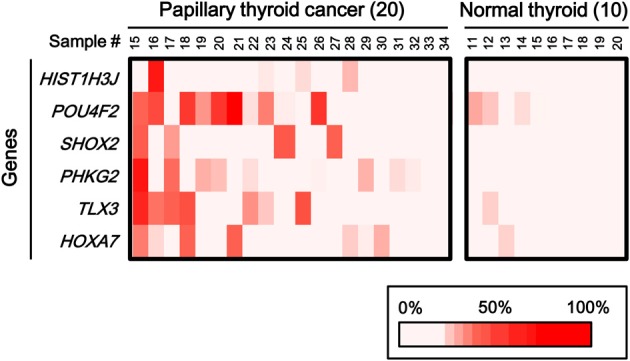
Cancer arises through accumulation of epigenetic and genetic alteration. Aberrant promoter methylation is a common epigenetic mechanism of gene silencing in cancer cells. We here performed genome-wide analysis of DNA methylation of promoter regions by Infinium HumanMethylation27 BeadChip, using 14 clinical papillary thyroid cancer samples and 10 normal thyroid samples. Among the 14 papillary cancer cases, 11 showed frequent aberrant methylation, but the other three cases showed no aberrant methylation at all. Distribution of the hypermethylation among cancer samples was non-random, which implied existence of a subset of preferentially methylated papillary thyroid cancer. Among 25 frequently methylated genes, methylation status of six genes (HIST1H3J, POU4F2, SHOX2, PHKG2, TLX3, HOXA7) was validated quantitatively by pyrosequencing. Epigenetic silencing of these genes in methylated papillary thyroid cancer cell lines was confirmed by gene re-expression following treatment with 5-aza-2'-deoxycytidine and trichostatin A, and detected by real-time RT-PCR. Methylation of these six genes was validated by analysis of additional 20 papillary thyroid cancer and 10 normal samples. Among the 34 cancer samples in total, 26 cancer samples with preferential methylation were significantly associated with mutation of BRAF/RAS oncogene (P = 0.04, Fisher's exact test). Thus, we identified new genes with frequent epigenetic hypermethylation in papillary thyroid cancer, two subsets of either preferentially methylated or hardly methylated papillary thyroid cancer, with a concomitant occurrence of oncogene mutation and gene methylation. These hypermethylated genes may constitute potential biomarkers for papillary thyroid cancer.
癌症是通过表观遗传和遗传改变的积累而产生的。异常启动子甲基化是癌细胞中基因沉默的常见表观遗传机制。我们在这里通过 Infinium HumanMethylation27 BeadChip 对启动子区域的 DNA 甲基化进行了全基因组分析,使用了 14 个临床甲状腺乳头状癌样本和 10 个正常甲状腺样本。在 14 个乳头状癌病例中,有 11 个表现出频繁的异常甲基化,但另外 3 个病例则完全没有异常甲基化。癌症样本中高甲基化的分布是非随机的,这意味着存在一个优先甲基化的乳头状甲状腺癌亚群。在 25 个经常甲基化的基因中,通过焦磷酸测序定量验证了 6 个基因(HIST1H3J、POU4F2、SHOX2、PHKG2、TLX3、HOXA7)的甲基化状态。在甲基化的甲状腺乳头状癌细胞系中,这些基因的表观遗传沉默通过用 5-氮杂-2'-脱氧胞苷和曲古抑菌素 A 处理后基因的重新表达得到证实,并通过实时 RT-PCR 检测。通过对另外 20 个甲状腺乳头状癌和 10 个正常样本的分析验证了这 6 个基因的甲基化。在总共 34 个癌症样本中,26 个具有优先甲基化的癌症样本与 BRAF/RAS 癌基因的突变显著相关(P = 0.04,Fisher 精确检验)。因此,我们在甲状腺乳头状癌中发现了新的具有频繁表观遗传高甲基化的基因,两个亚组分别为优先甲基化或几乎不甲基化的甲状腺乳头状癌,同时伴有癌基因的突变和基因的甲基化。这些高甲基化的基因可能构成甲状腺乳头状癌的潜在生物标志物。