
人类三叉神经节中神经元群体的特征及其与潜伏性单纯疱疹病毒1型感染的关联。
Characterization of neuronal populations in the human trigeminal ganglion and their association with latent herpes simplex virus-1 infection.
作者信息
Flowerdew Sarah E, Wick Desiree, Himmelein Susanne, Horn Anja K E, Sinicina Inga, Strupp Michael, Brandt Thomas, Theil Diethilde, Hüfner Katharina
机构信息
Department of Neurology, Klinikum Grosshadern, Ludwig-Maximilians University, Munich, Germany ; German Center for Vertigo and Balance Disorders, Ludwig-Maximilians University, Munich, Germany.
German Center for Vertigo and Balance Disorders, Ludwig-Maximilians University, Munich, Germany ; Institute of Anatomy, Department I, Ludwig-Maximilians University, Munich, Germany.
出版信息
PLoS One. 2013 Dec 19;8(12):e83603. doi: 10.1371/journal.pone.0083603. eCollection 2013.
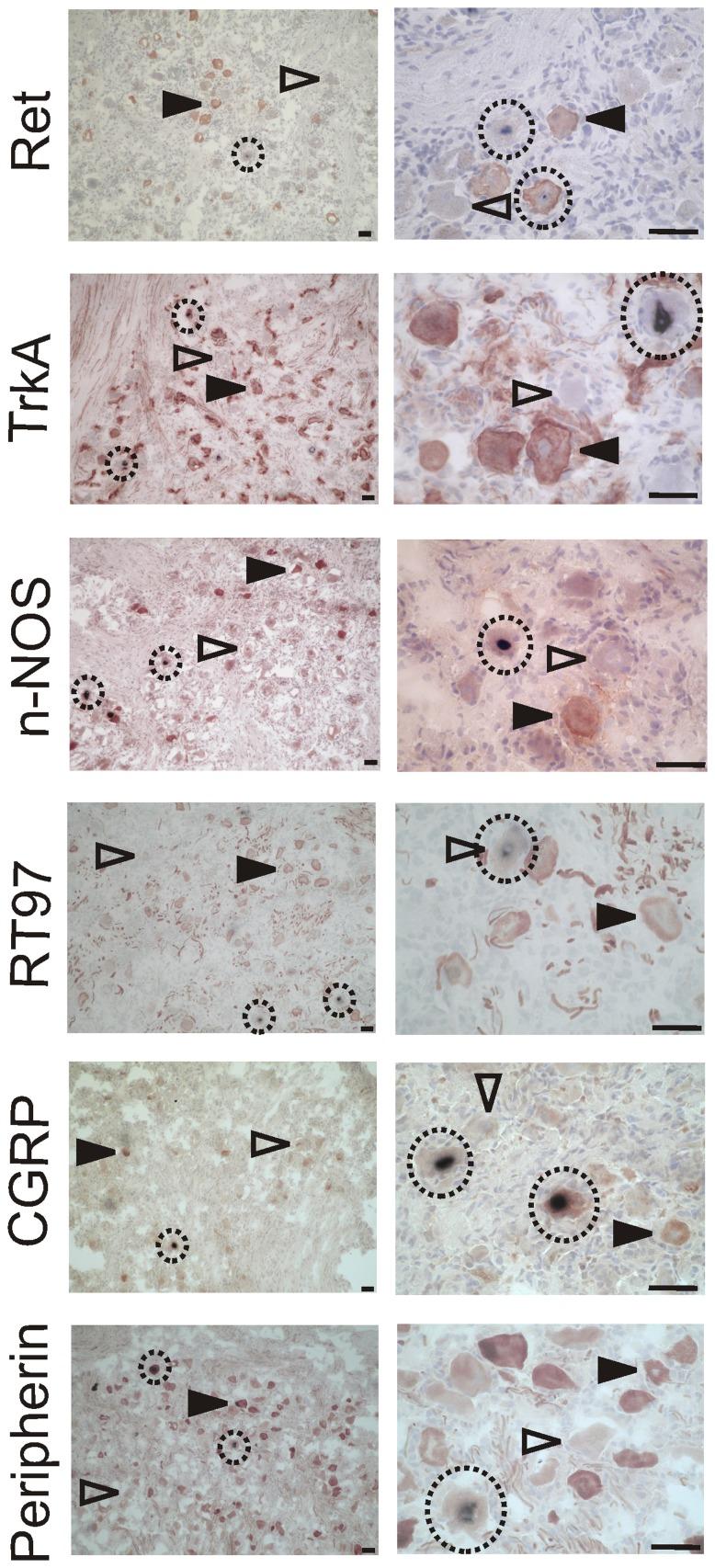
Following primary infection Herpes simplex virus-1 (HSV-1) establishes lifelong latency in the neurons of human sensory ganglia. Upon reactivation HSV-1 can cause neurological diseases such as facial palsy, vestibular neuritis or encephalitis. Certain populations of sensory neurons have been shown to be more susceptible to latent infection in the animal model, but this has not been addressed in human tissue. In the present study, trigeminal ganglion (TG) neurons expressing six neuronal marker proteins were characterized, based on staining with antibodies against the GDNF family ligand receptor Ret, the high-affinity nerve growth factor receptor TrkA, neuronal nitric oxide synthase (nNOS), the antibody RT97 against 200 kDa neurofilament, calcitonin gene-related peptide and peripherin. The frequencies of marker-positive neurons and their average neuronal sizes were assessed, with TrkA-positive (61.82%) neurons being the most abundant, and Ret-positive (26.93%) the least prevalent. Neurons positive with the antibody RT97 (1253 µm(2)) were the largest, and those stained against peripherin (884 µm(2)) were the smallest. Dual immunofluorescence revealed at least a 4.5% overlap for every tested marker combination, with overlap for the combinations TrkA/Ret, TrkA/RT97 and Ret/nNOS lower, and the overlap between Ret/CGRP being higher than would be expected by chance. With respect to latent HSV-1 infection, latency associated transcripts (LAT) were detected using in situ hybridization (ISH) in neurons expressing each of the marker proteins. In contrast to the mouse model, co-localization with neuronal markers Ret or CGRP mirrored the magnitude of these neuron populations, whereas for the other four neuronal markers fewer marker-positive cells were also LAT-ISH+. Ret and CGRP are both known to label neurons related to pain signaling.
初次感染后,单纯疱疹病毒1型(HSV-1)会在人类感觉神经节的神经元中建立终身潜伏感染。再次激活时,HSV-1可引发诸如面瘫、前庭神经炎或脑炎等神经系统疾病。在动物模型中,已证实某些感觉神经元群体更容易受到潜伏感染,但在人体组织中尚未对此进行研究。在本研究中,基于用针对胶质细胞源性神经营养因子(GDNF)家族配体受体Ret、高亲和力神经生长因子受体TrkA、神经元型一氧化氮合酶(nNOS)、抗200 kDa神经丝抗体RT97、降钙素基因相关肽和外周蛋白的抗体进行染色,对表达六种神经元标记蛋白的三叉神经节(TG)神经元进行了表征。评估了标记阳性神经元的频率及其平均神经元大小,其中TrkA阳性神经元(61.82%)最为丰富,Ret阳性神经元(26.93%)最为少见。RT97抗体阳性的神经元(1253 µm²)最大,而外周蛋白染色阳性的神经元(884 µm²)最小。双重免疫荧光显示,每种测试的标记组合至少有4.5%的重叠,TrkA/Ret、TrkA/RT97和Ret/nNOS组合的重叠较低,而Ret/CGRP组合之间的重叠高于偶然预期。关于潜伏性HSV-1感染,使用原位杂交(ISH)在表达每种标记蛋白的神经元中检测到了潜伏相关转录本(LAT)。与小鼠模型不同,与神经元标记Ret或CGRP的共定位反映了这些神经元群体的数量,而对于其他四种神经元标记,标记阳性细胞中LAT-ISH+的较少。已知Ret和CGRP都标记与疼痛信号传导相关的神经元。


 Zotero 插件