From the Investigational Intensive Care Unit (S.R., Y.Y., L.E.S., C.J., D.S.P., P.E.), Department of Anesthesiology, and Department of Pathology (R.A.C.), The University of Texas Medical Branch; and Shriners Hospital for Children (R.A.C., P.E.), Galveston, Texas; and Department of Anesthesiology, Intensive Care and Pain Medicine (S.R.), University of Muenster, Muenster, Germany.
J Trauma Acute Care Surg. 2014 Jan;76(1):126-33. doi: 10.1097/TA.0b013e3182ab0785.
Pulmonary coagulopathy has become an important therapeutic target in adult respiratory distress syndrome (ARDS). We hypothesized that combining intravenous recombinant human antithrombin (rhAT), nebulized heparin, and nebulized tissue plasminogen activator (TPA) more effectively improves pulmonary gas exchange compared with a single rhAT infusion, while maintaining the anti-inflammatory properties of rhAT in ARDS. Therefore, the present prospective, randomized experiment was conducted using an established ovine model.
Following burn and smoke inhalation injury (40% of total body surface area, third-degree flame burn, and 4 × 12 breaths of cold cotton smoke), 18 chronically instrumented sheep were randomly assigned to receive intravenous saline plus saline nebulization (control), intravenous rhAT (6 IU/kg/h) started 1 hour after injury plus saline nebulization (AT i.v.) or intravenous rhAT combined with nebulized heparin (10,000 IU every 4 hours, started 2 hours after injury), and nebulized TPA (2 mg every 4 hours, started 4 hours after injury) (triple therapy, n = 6 each). All animals were mechanically ventilated and fluid resuscitated according to standard protocols during the 48-hour study period.
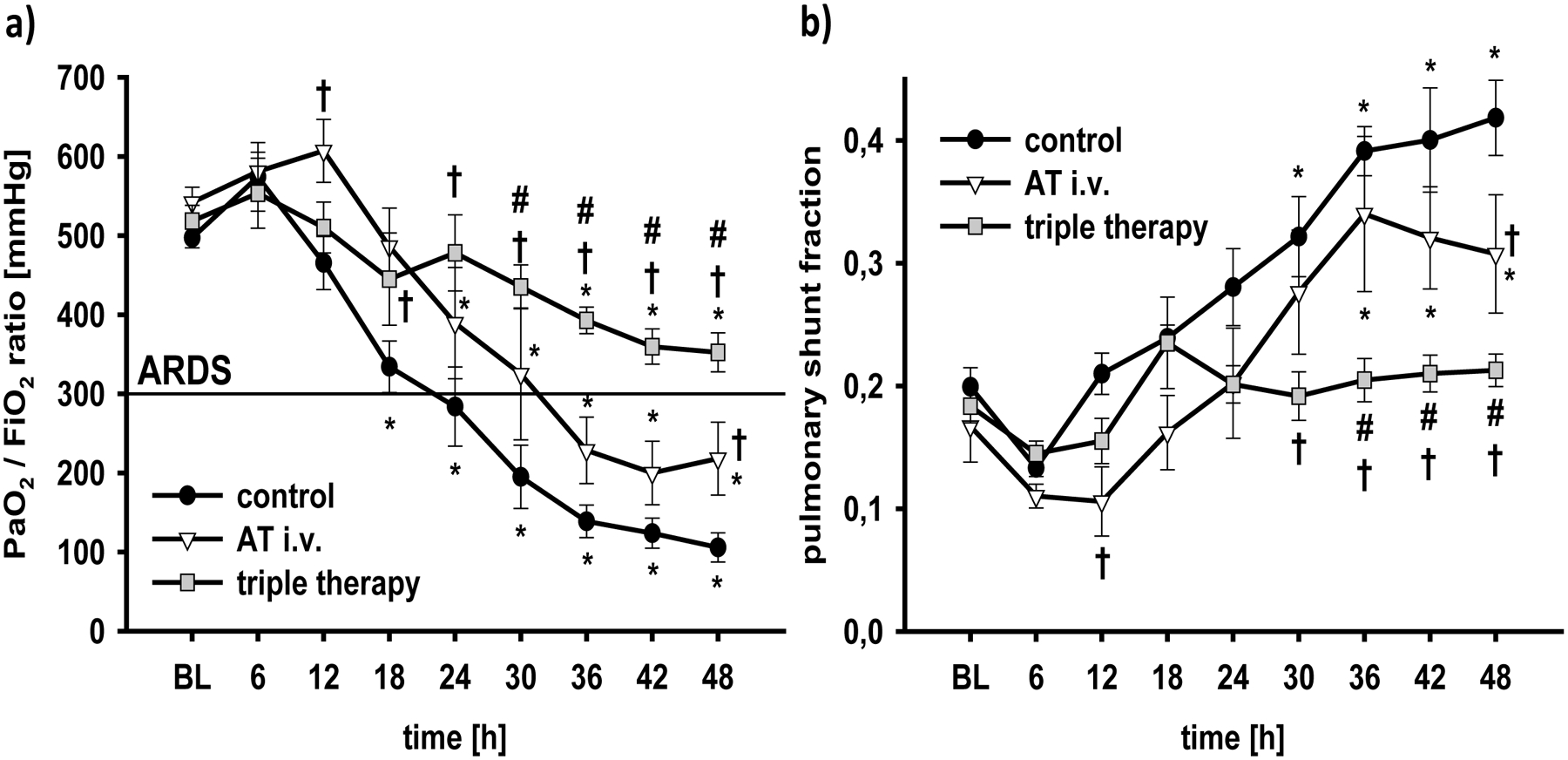
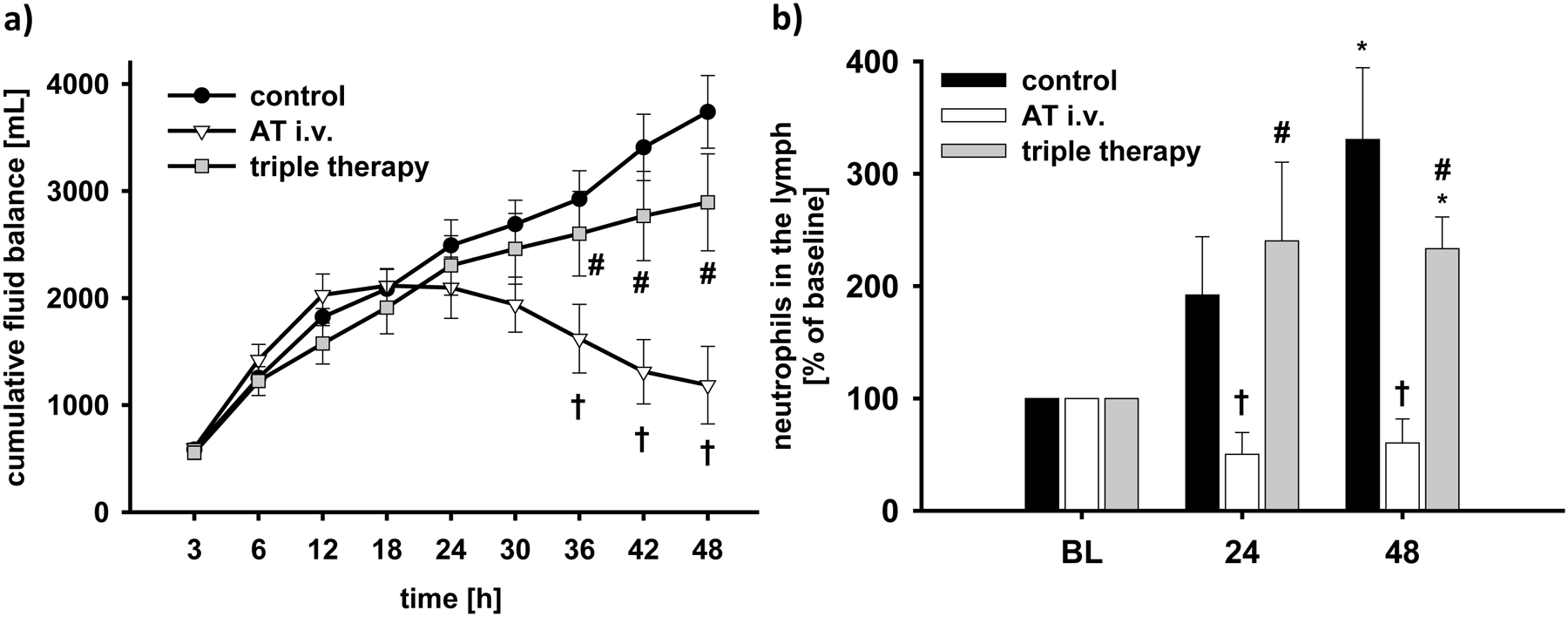
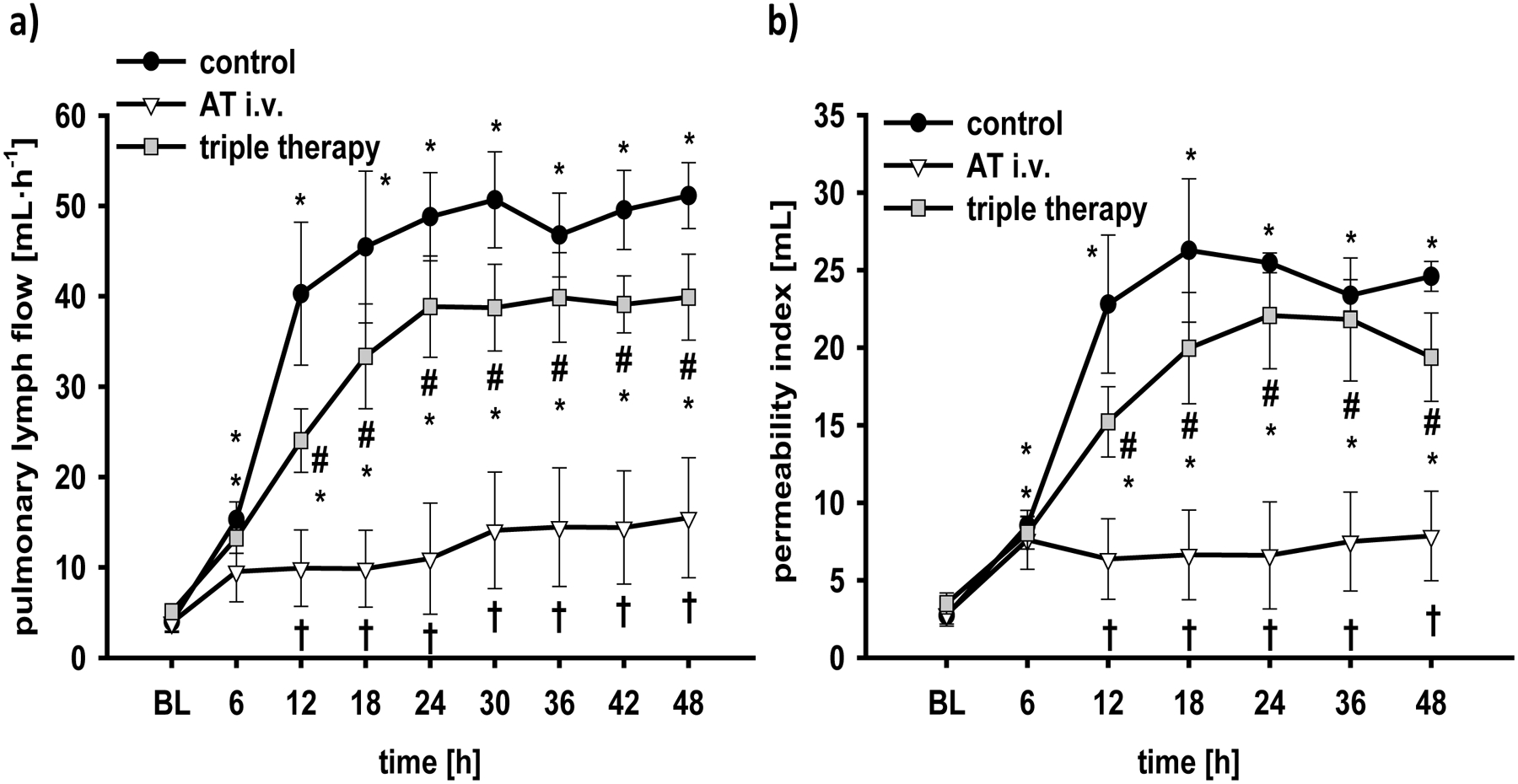
Both treatment approaches attenuated ARDS compared with control animals. Notably, triple therapy was associated with an improved PaO2/FiO2 ratio (p = 0.007), attenuated pulmonary obstruction (p = 0.02) and shunting (p = 0.025), as well as reduced ventilatory pressures (p < 0.05 each) versus AT i.v. at 48 hours. However, the anti-inflammatory effects of sole AT i.v., namely, the inhibition of neutrophil activation (neutrophil count in the lymph and pulmonary polymorphonuclear cells, p < 0.05 vs. control each), pulmonary transvascular fluid flux (lymph flow, p = 0.004 vs. control), and systemic vascular leakage (cumulative net fluid balance, p < 0.001 vs. control), were abolished in the triple therapy group.
Combining intravenous rhAT with nebulized heparin and nebulized TPA more effectively restores pulmonary gas exchange, but the anti-inflammatory effects of sole rhAT are abolished with the triple therapy. Interferences between the different anticoagulants may represent a potential explanation for these findings.
肺凝血障碍已成为成人呼吸窘迫综合征(ARDS)的一个重要治疗靶点。我们假设,与单次静脉注射重组人抗凝血酶(rhAT)相比,联合使用静脉注射 rhAT、雾化肝素和雾化组织纤溶酶原激活剂(tPA)更能有效改善肺气体交换,同时保持 rhAT 在 ARDS 中的抗炎特性。因此,本研究采用已建立的绵羊模型进行了前瞻性、随机实验。
在烧伤和吸入性损伤(40%的体表面积,三度火焰烧伤,4×12 次冷棉烟吸入)后,18 只接受慢性仪器检查的绵羊被随机分配接受静脉生理盐水加生理盐水雾化(对照组)、静脉 rhAT(6IU/kg/h)于损伤后 1 小时开始加生理盐水雾化(AT i.v.)或静脉 rhAT 联合雾化肝素(10000IU 每 4 小时,损伤后 2 小时开始)和雾化 tPA(2mg 每 4 小时,损伤后 4 小时开始)(三联治疗,每组 6 只)。在 48 小时的研究期间,所有动物均根据标准方案进行机械通气和液体复苏。
与对照组动物相比,两种治疗方法均能减轻 ARDS。值得注意的是,三联治疗组 PaO2/FiO2 比值改善(p = 0.007),肺阻塞(p = 0.02)和分流(p = 0.025)减轻,通气压力降低(p < 0.05 各),48 小时时 AT i.v.。然而,单独 AT i.v.的抗炎作用,即抑制中性粒细胞激活(淋巴和肺多形核细胞中的中性粒细胞计数,p < 0.05 与对照组),肺跨血管液体通量(淋巴流量,p = 0.004 与对照组)和全身血管渗漏(累积净液体平衡,p < 0.001 与对照组),在三联治疗组中被消除。
联合静脉注射 rhAT 与雾化肝素和雾化 tPA 更有效地恢复肺气体交换,但单独使用 rhAT 的抗炎作用在三联治疗中被消除。不同抗凝剂之间的相互干扰可能是这些发现的一个潜在解释。