Department of Clinical Therapeutics, University of Athens School of Medicine, Athens, Greece.
Health Qual Life Outcomes. 2013 Dec 26;11:217. doi: 10.1186/1477-7525-11-217.
Improvements in the clinical condition of patients with type 2 diabetes are often accompanied by improvements in health-related quality of life and other patient-reported outcomes (PROs), but data assessing injectable treatment initiation from the patient's perspective in routine clinical practice are lacking. We examined PROs in patients initiating injectable treatment in the CHOICE (CHanges to treatment and Outcomes in patients with type 2 diabetes initiating InjeCtablE therapy) study.
CHOICE was a 24-month, prospective observational study conducted in six European countries. Patients initiated exenatide twice daily (BID) or insulin based on a physician's clinical judgement. Clinical and PRO data were collected at baseline (injectable therapy initiation) and after approximately 3, 6, 12, 18 and 24 months. The two treatment cohorts had different baseline characteristics; therefore, no statistical comparisons of endpoints between main cohorts were conducted.
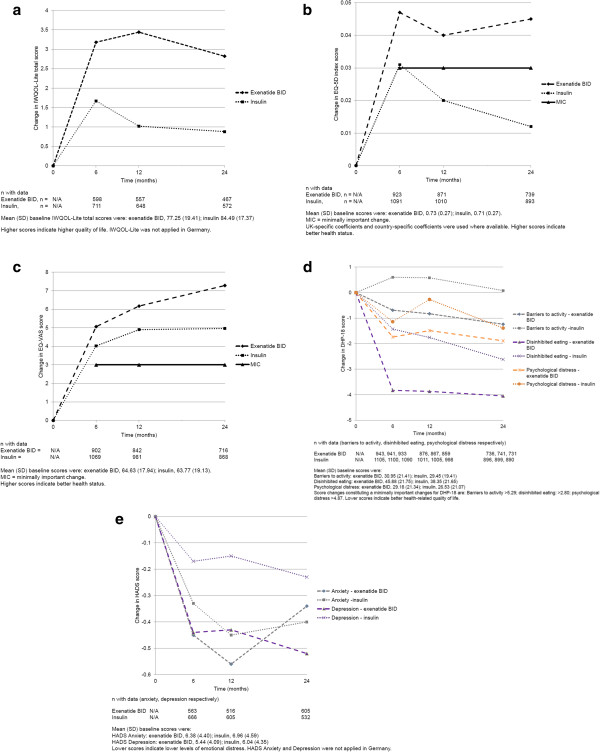
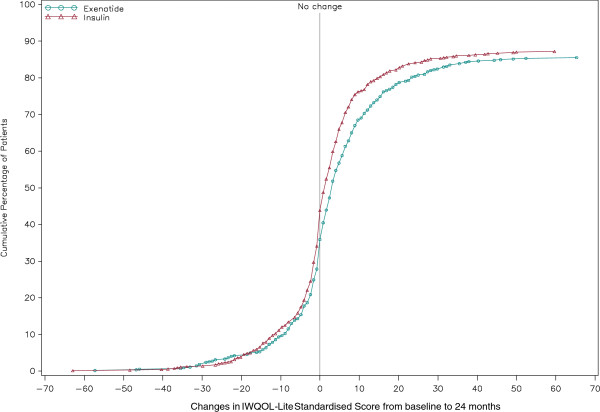
There were 2388 patients eligible for analysis (exenatide BID cohort, n = 1114; insulin cohort, n = 1274). Mean positive changes in Impact of Weight on Quality of Life-Lite (IWQOL-Lite) total score and EuroQoL5-Dimension (EQ-5D) index and visual analogue scale (VAS) scores were observed in both cohorts with most changes observed during the first 6 months after injectable therapy initiation. Patients who experienced weight loss (≥ 1 kg) at 24 months appeared to have higher mean improvements in IWQOL-Lite total score than did patients with weight gain or no weight change. Patients who met the composite clinical endpoint of glycated haemoglobin (HbA1c) <7.0%, no weight gain (≤ 1 kg) and no hypoglycaemia generally experienced higher mean improvements in EQ-5D index and VAS scores (compared with patients who did not meet this endpoint) and Diabetes Health Profile-18 scores (versus the main cohorts). High levels of missing data were observed for all PRO measures in both cohorts compared with those for clinical outcomes.
These data from a clinical practice study support those from clinical trials, suggesting that PROs are not adversely affected, and may be improved, by injectable therapy initiation. PRO data may aid appropriate treatment selection for individual patients.
ClinicalTrials.gov, NCT00635492.
2 型糖尿病患者的临床状况改善通常伴随着健康相关生活质量和其他患者报告结果(PROs)的改善,但缺乏从患者角度评估常规临床实践中起始注射治疗的数据。我们在 CHOICE(2 型糖尿病患者起始注射治疗的治疗改变和结局)研究中检查了起始注射治疗患者的 PRO。
CHOICE 是一项在六个欧洲国家进行的为期 24 个月的前瞻性观察研究。患者根据医生的临床判断起始每日两次给予艾塞那肽或胰岛素。在起始注射治疗时和大约 3、6、12、18 和 24 个月时收集临床和 PRO 数据。两个治疗队列具有不同的基线特征;因此,未对主要队列的终点进行统计学比较。
共有 2388 名患者符合分析条件(艾塞那肽 BID 队列,n=1114;胰岛素队列,n=1274)。两个队列的体重对生活质量影响简易量表(IWQOL-Lite)总分和欧洲五维健康量表(EQ-5D)指数和视觉模拟量表(VAS)评分均有阳性改善,大多数改善发生在起始注射治疗后 6 个月内。在 24 个月时体重减轻(≥1kg)的患者,IWQOL-Lite 总分的平均改善似乎高于体重增加或体重无变化的患者。达到糖化血红蛋白(HbA1c)<7.0%、体重无增加(≤1kg)和无低血糖的复合临床终点的患者,通常在 EQ-5D 指数和 VAS 评分(与未达到该终点的患者相比)和糖尿病健康状况问卷-18 评分(与主要队列相比)方面有更高的平均改善。与临床结局相比,两个队列的所有 PRO 测量均观察到大量缺失数据。
来自临床实践研究的数据支持临床试验结果,表明起始注射治疗不会对 PRO 产生不利影响,并且可能改善 PRO。PRO 数据可能有助于为个体患者选择适当的治疗方法。
ClinicalTrials.gov,NCT00635492。