Dittrich Sabine, Castonguay-Vanier Josée, Moore Catrin E, Thongyoo Narongchai, Newton Paul N, Paris Daniel H
Lao-Oxford-Mahosot Hospital-Wellcome Trust Research Unit (LOMWRU), Microbiology Laboratory, Mahosot Hospital, Vientiane, Lao People's Democratic Republic.
J Clin Microbiol. 2014 Mar;52(3):832-8. doi: 10.1128/JCM.02786-13. Epub 2013 Dec 26.
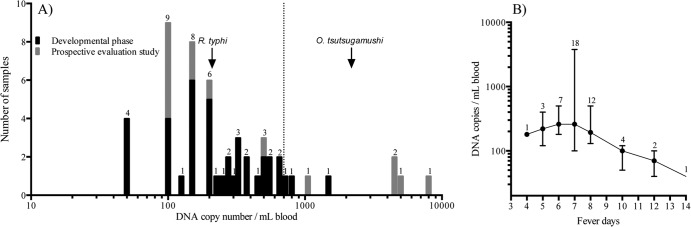
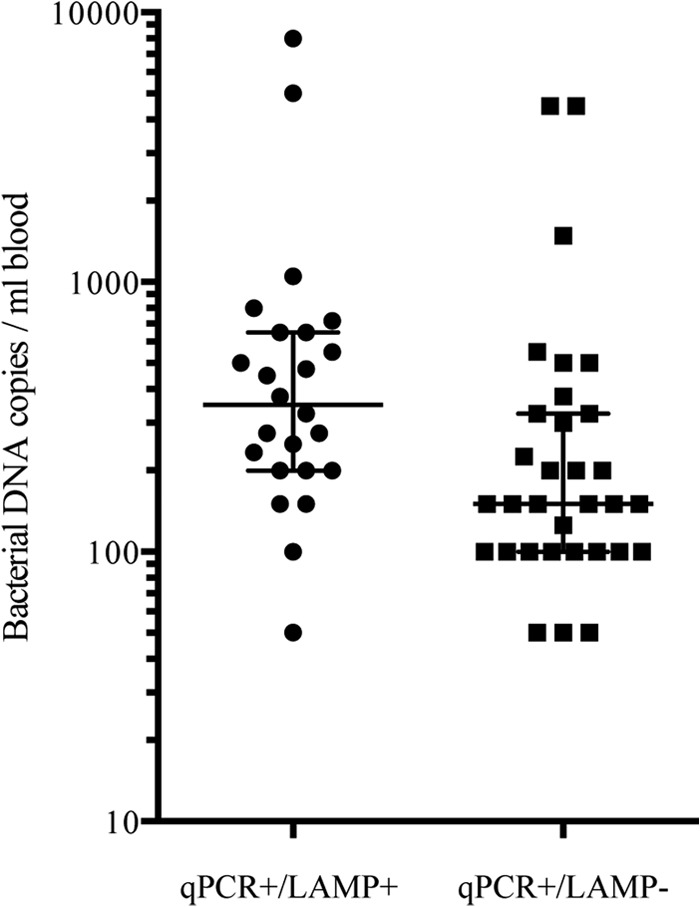
Murine typhus is a flea-borne disease of worldwide distribution caused by Rickettsia typhi. Although treatment with tetracycline antibiotics is effective, treatment is often misguided or delayed due to diagnostic difficulties. As the gold standard immunofluorescence assay is imperfect, we aimed to develop and evaluate a loop-mediated isothermal amplification (LAMP) assay. LAMP assays have the potential to fulfill the WHO ASSURED criteria (affordable, sensitive, specific, user friendly, robust and rapid, equipment free, deliverable to those who need them) for diagnostic methodologies, as they can detect pathogen-derived nucleic acid with low technical expenditure. The LAMP assay was developed using samples of bacterial isolates (n=41), buffy coat specimens from R. typhi PCR-positive Lao patients (n=42), and diverse negative controls (n=47). The method was then evaluated prospectively using consecutive patients with suspected scrub typhus or murine typhus (n=266). The limit of detection was ∼40 DNA copies/LAMP reaction, with an analytical sensitivity of <10 DNA copies/reaction based on isolate dilutions. Despite these low cutoffs, the clinical sensitivity was disappointing, with 48% (95% confidence interval [95% CI], 32.5 to 62.7%) (specificity, 100% [95% CI, 100 to 100%]) in the developmental phase and 33% (95% CI, 9.2 to 56.8%) (specificity, 98.5% [95% CI, 97.0% to 100%]) in the prospective study. This low diagnostic accuracy was attributed to low patient R. typhi bacterial loads (median, 210 DNA copies/ml blood; interquartile range, 130 to 500). PCR-positive but LAMP-negative samples demonstrated significantly lower bacterial loads than LAMP-positive samples. Our findings highlight the diagnostic challenges for diseases with low pathogen burdens and emphasize the need to integrate pathogen biology with improved template production for assay development strategies.
鼠型斑疹伤寒是一种由伤寒立克次体引起的、通过跳蚤传播且分布于全球的疾病。尽管使用四环素类抗生素治疗有效,但由于诊断困难,治疗往往被误导或延误。由于作为金标准的免疫荧光检测并不完美,我们旨在开发并评估一种环介导等温扩增(LAMP)检测方法。LAMP检测有潜力满足世界卫生组织对诊断方法的ASSURED标准(价格可承受、灵敏、特异、用户友好、稳健且快速、无需设备、可提供给有需要的人),因为它们能够以较低的技术成本检测病原体衍生的核酸。使用细菌分离株样本(n = 41)、来自伤寒立克次体PCR阳性老挝患者的血沉棕黄层样本(n = 42)以及多种阴性对照(n = 47)开发了LAMP检测方法。然后,使用连续的疑似恙虫病或鼠型斑疹伤寒患者(n = 266)对该方法进行前瞻性评估。检测限为每LAMP反应约40个DNA拷贝,基于分离株稀释,分析灵敏度为每反应<10个DNA拷贝。尽管这些临界值较低,但临床灵敏度令人失望,在开发阶段为48%(95%置信区间[95%CI],32.5至62.7%)(特异性为100%[95%CI,100至100%]),在前瞻性研究中为33%(95%CI,9.2至56.8%)(特异性为98.5%[95%CI,97.0%至100%])。这种低诊断准确性归因于患者的伤寒立克次体细菌载量较低(中位数为210个DNA拷贝/毫升血液;四分位间距为130至500)。PCR阳性但LAMP阴性的样本显示出的细菌载量明显低于LAMP阳性样本。我们的研究结果突出了病原体负担低的疾病的诊断挑战,并强调了将病原体生物学与改进的模板制备相结合以制定检测开发策略的必要性。