Edgar J Christopher, Chen Yu-Han, Lanza Matthew, Howell Breannan, Chow Vivian Y, Heiken Kory, Liu Song, Wootton Cassandra, Hunter Michael A, Huang Mingxiong, Miller Gregory A, Cañive José M
The Children's Hospital of Philadelphia and University of Pennsylvania, Philadelphia, PA, USA.
The University of New Mexico School of Medicine, Department of Psychiatry, Center for Psychiatric Research, Albuquerque, NM, USA ; New Mexico Raymond G. Murphy VA Healthcare System, Psychiatry Research, Albuquerque, NM, USA.
Neuroimage Clin. 2013 Nov 22;4:122-9. doi: 10.1016/j.nicl.2013.11.004. eCollection 2014.
Although brain rhythms depend on brain structure (e.g., gray and white matter), to our knowledge associations between brain oscillations and structure have not been investigated in healthy controls (HC) or in individuals with schizophrenia (SZ). Observing function-structure relationships, for example establishing an association between brain oscillations (defined in terms of amplitude or phase) and cortical gray matter, might inform models on the origins of psychosis. Given evidence of functional and structural abnormalities in primary/secondary auditory regions in SZ, the present study examined how superior temporal gyrus (STG) structure relates to auditory STG low-frequency and 40 Hz steady-state activity. Given changes in brain activity as a function of age, age-related associations in STG oscillatory activity were also examined.
Thirty-nine individuals with SZ and 29 HC were recruited. 40 Hz amplitude-modulated tones of 1 s duration were presented. MEG and T1-weighted sMRI data were obtained. Using the sources localizing 40 Hz evoked steady-state activity (300 to 950 ms), left and right STG total power and inter-trial coherence were computed. Time-frequency group differences and associations with STG structure and age were also examined.
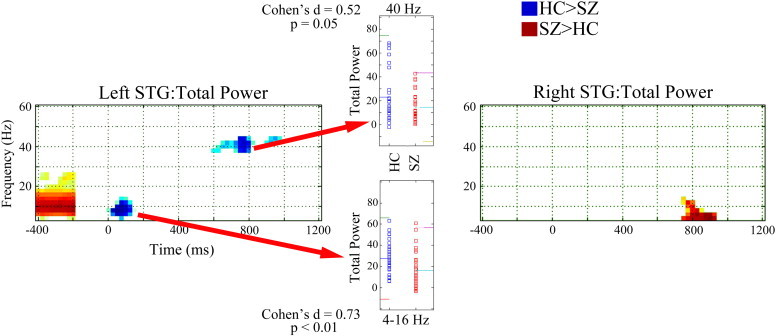
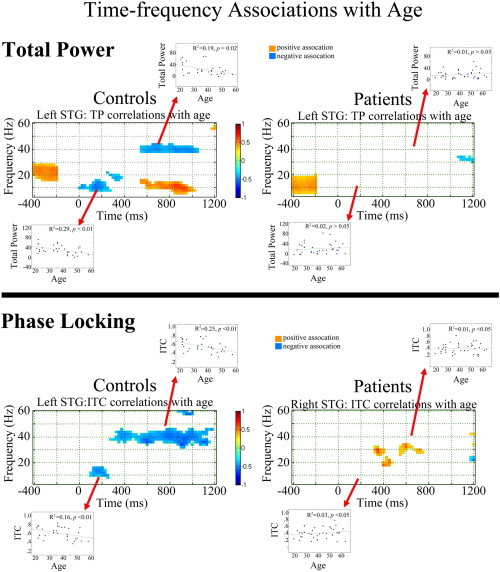
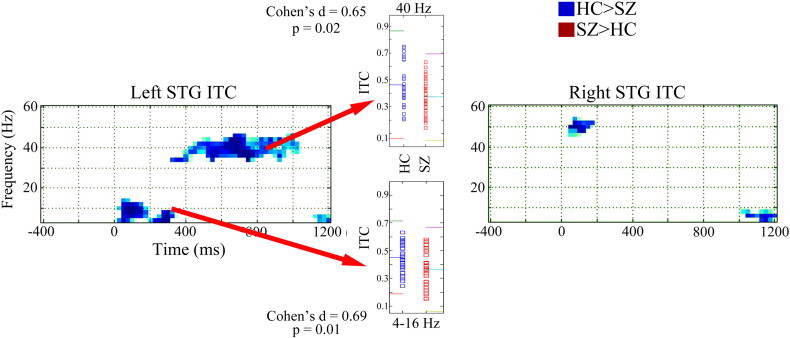
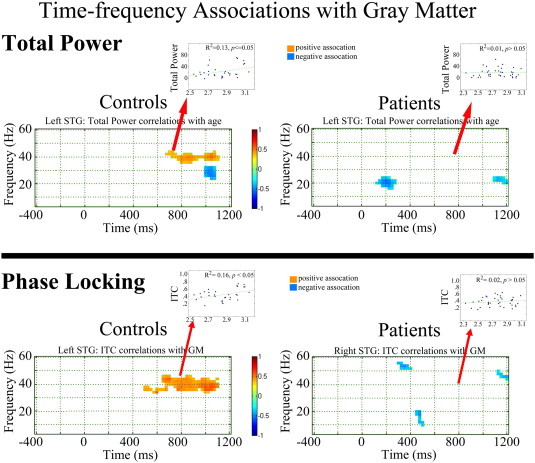
Decreased total power and inter-trial coherence in SZ were observed in the left STG for initial post-stimulus low-frequency activity (~ 50 to 200 ms, ~ 4 to 16 Hz) as well as 40 Hz steady-state activity (~ 400 to 1000 ms). Left STG 40 Hz total power and inter-trial coherence were positively associated with left STG cortical thickness in HC, not in SZ. Left STG post-stimulus low-frequency and 40 Hz total power were positively associated with age, again only in controls.
Left STG low-frequency and steady-state gamma abnormalities distinguish SZ and HC. Disease-associated damage to STG gray matter in schizophrenia may disrupt the age-related left STG gamma-band function-structure relationships observed in controls.
尽管脑节律依赖于脑结构(如灰质和白质),但据我们所知,尚未在健康对照者(HC)或精神分裂症患者(SZ)中研究脑振荡与结构之间的关联。观察功能-结构关系,例如建立脑振荡(根据振幅或相位定义)与皮质灰质之间的关联,可能为精神病起源的模型提供信息。鉴于SZ患者初级/次级听觉区域存在功能和结构异常的证据,本研究考察了颞上回(STG)结构与听觉STG低频和40赫兹稳态活动之间的关系。鉴于脑活动随年龄变化,还考察了STG振荡活动中与年龄相关的关联。
招募了39名SZ患者和29名HC。呈现持续1秒的40赫兹调幅音。获取了脑磁图(MEG)和T1加权结构磁共振成像(sMRI)数据。使用定位40赫兹诱发稳态活动(300至950毫秒)的源,计算左右STG的总功率和试次间相干性。还考察了时频组差异以及与STG结构和年龄的关联。
在SZ患者中,观察到左侧STG在刺激后初始低频活动(约50至200毫秒,约4至16赫兹)以及40赫兹稳态活动(约400至1000毫秒)时总功率和试次间相干性降低。在HC中,左侧STG 40赫兹总功率和试次间相干性与左侧STG皮质厚度呈正相关,而在SZ中则不然。左侧STG刺激后低频和40赫兹总功率与年龄呈正相关,同样仅在对照组中如此。
左侧STG低频和稳态γ异常区分了SZ患者和HC。精神分裂症中与疾病相关的STG灰质损伤可能破坏了对照组中观察到的与年龄相关的左侧STGγ波段功能-结构关系。