Williams Adam, Smith Julia R, Allaway David, Harris Pat, Liddell Susan, Mobasheri Ali
Arthritis Res Ther. 2013;15(6):R223. doi: 10.1186/ar4424.
Arthritic diseases are characterized by the degradation of collagenous and noncollagenous extracellular matrix (ECM) components in articular cartilage. The increased expression and activity of matrix metalloproteinases (MMPs) is partly responsible for cartilage degradation. This study used proteomics to identify inflammatory proteins and catabolic enzymes released in a serum-free explant model of articular cartilage stimulated with the pro-inflammatory cytokine interleukin 1β (IL-1β). Western blotting was used to quantify the release of selected proteins in the presence or absence of the cyclooxygenase-2 specific nonsteroidal pro-inflammatory drug carprofen.
Cartilage explant cultures were established by using metacarpophalangeal joints from horses euthanized for purposes other than research. Samples were treated as follows: no treatment (control), IL-1β (10 ng/ml), carprofen (100 μg/ml), and carprofen (100 μg/ml) + IL-1β (10 ng/ml). Explants were incubated (37°C, 5% CO2) over twelve day time courses. High-throughput nano liquid chromatography/mass spectrometry/mass spectrometry uncovered candidate proteins for quantitative western blot analysis. Proteoglycan loss was assessed by using the dimethylmethylene blue (DMMB) assay, which measures the release of sulfated glycosaminoglycans (GAGs).
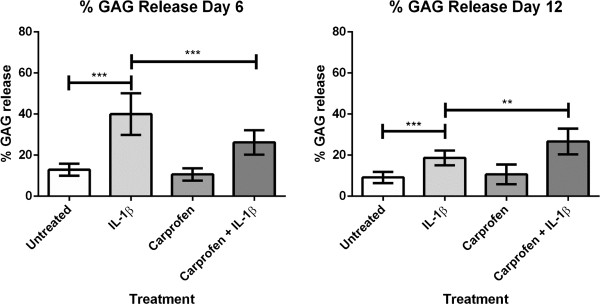
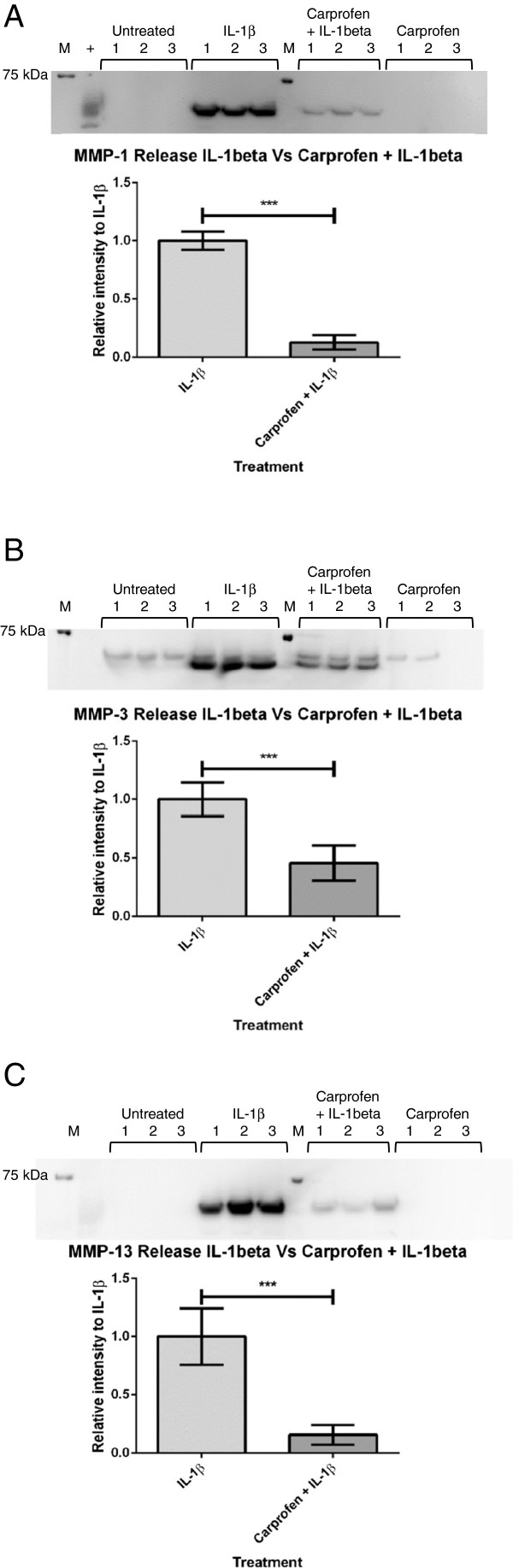
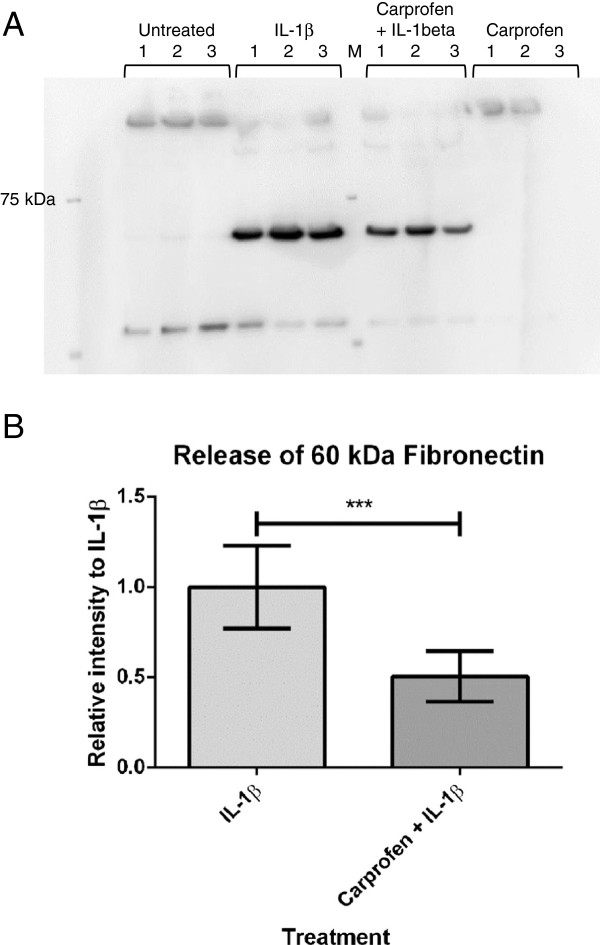
Mass spectrometry identified MMP-1, -3, -13, and the ECM constituents thrombospondin-1 (TSP-1) and fibronectin-1 (FN1). IL-1β stimulation increased the release of all three MMPs. IL-1β also stimulated the fragmentation of FN1 and increased chondrocyte cell death (as assessed by β-actin release). Addition of carprofen significantly decreased MMP release and the appearance of a 60 kDa fragment of FN1 without causing any detectable cytotoxicity to chondrocytes. DMMB assays suggested that carprofen initially inhibited IL-1β-induced GAG release, but this effect was transient. Overall, during the two time courses, GAG release was 58.67% ± 10.91% (SD) for IL-1β versus 52.91% ± 9.35% (SD) with carprofen + IL-1β.
Carprofen exhibits beneficial anti-inflammatory and anti-catabolic effects in vitro without causing any detectable cytotoxicity. Combining proteomics with this explant model provides a sensitive screening system for anti-inflammatory compounds.
关节炎性疾病的特征是关节软骨中胶原和非胶原细胞外基质(ECM)成分的降解。基质金属蛋白酶(MMPs)表达和活性的增加是软骨降解的部分原因。本研究使用蛋白质组学来鉴定在促炎细胞因子白细胞介素1β(IL-1β)刺激的关节软骨无血清外植体模型中释放的炎症蛋白和分解代谢酶。使用蛋白质印迹法在存在或不存在环氧化酶-2特异性非甾体类抗炎药卡洛芬的情况下定量选定蛋白质的释放。
通过使用因非研究目的而安乐死的马的掌指关节建立软骨外植体培养物。样品处理如下:不处理(对照)、IL-1β(10 ng/ml)、卡洛芬(100 μg/ml)以及卡洛芬(100 μg/ml)+ IL-1β(10 ng/ml)。外植体在(37°C,5% CO2)条件下孵育12天。高通量纳米液相色谱/质谱/质谱分析揭示了用于蛋白质印迹定量分析的候选蛋白质。使用二甲基亚甲基蓝(DMMB)测定法评估蛋白聚糖损失,该方法测量硫酸化糖胺聚糖(GAGs)的释放。
质谱鉴定出MMP-1、-3、-13以及ECM成分血小板反应蛋白-1(TSP-1)和纤连蛋白-1(FN1)。IL-1β刺激增加了所有三种MMP的释放。IL-1β还刺激了FN1的片段化并增加了软骨细胞死亡(通过β-肌动蛋白释放评估)。添加卡洛芬显著降低了MMP的释放以及FN1 60 kDa片段的出现,且未对软骨细胞造成任何可检测到的细胞毒性。DMMB测定表明卡洛芬最初抑制IL-1β诱导的GAG释放,但这种作用是短暂的。总体而言,在两个时间进程中,IL-1β组的GAG释放为58.67% ± 10.91%(标准差),而卡洛芬 + IL-1β组为52.91% ± 9.35%(标准差)。
卡洛芬在体外表现出有益的抗炎和抗分解代谢作用,且未引起任何可检测到的细胞毒性。将蛋白质组学与该外植体模型相结合为抗炎化合物提供了一个灵敏的筛选系统。