Department of Social Policy, London School of Economics & Political Science, Houghton St., London WC2A 2AE, UK.
Department of Social Policy, London School of Economics & Political Science, Houghton St., London WC2A 2AE, UK.
Soc Sci Med. 2014 Mar;105(100):140-8. doi: 10.1016/j.socscimed.2013.11.018. Epub 2013 Nov 19.
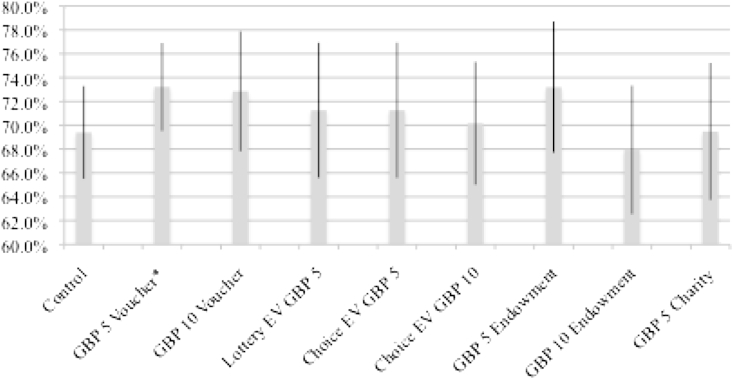
Financial incentives have been used in a variety of settings to motivate behaviors that might not otherwise be undertaken. They have been highlighted as particularly useful in settings that require a single behavior, such as appointment attendance or vaccination. They also have differential effects based on socioeconomic status in some applications (e.g. smoking). To further investigate these claims, we tested the effect of providing different types of non-cash financial incentives on the return rates of chlamydia specimen samples amongst 16-24 year-olds in England. In 2011 and 2012, we ran a two-stage randomized experiment involving 2988 young people (1489 in Round 1 and 1499 in Round 2) who requested a chlamydia screening kit from Freetest.me, an online and text screening service run by Preventx Limited. Participants were randomized to control, or one of five types of financial incentives in Round 1 or one of four financial incentives in Round 2. We tested the effect of five types of incentives on specimen sample return; reward vouchers of differing values, charity donation, participation in a lottery, choices between a lottery and a voucher and including vouchers of differing values in the test kit prior to specimen return. Financial incentives of any type, did not make a significant difference in the likelihood of specimen return. The more deprived individuals were, as calculated using Index of Multiple Deprivation (IMD), the less likely they were to return a sample. The extent to which incentive structures influenced sample return was not moderated by IMD score. Non-cash financial incentives for chlamydia testing do not seem to affect the specimen return rate in a chlamydia screening program where test kits are requested online, mailed to requestors and returned by mail. They also do not appear more or less effective in influencing test return depending on deprivation level.
经济激励措施已在各种情况下被用于激励那些原本不会发生的行为。在需要单一行为的情况下,例如预约就诊或接种疫苗,这些激励措施尤其有用。在某些应用中(例如吸烟),它们也会根据社会经济地位产生不同的影响。为了进一步研究这些说法,我们测试了在英格兰向 16-24 岁年轻人提供不同类型的非现金经济激励对衣原体标本回收率的影响。在 2011 年和 2012 年,我们进行了一项两阶段随机试验,涉及 2988 名年轻人(第一轮 1489 名,第二轮 1499 名),他们从 Freetest.me 申请了衣原体筛查试剂盒,这是由 Preventx Limited 运营的在线和短信筛查服务。参与者在第一轮中随机分配到对照组或五种经济激励中的一种,或在第二轮中随机分配到四种经济激励中的一种。我们测试了五种激励措施对标本样本回收率的影响;不同价值的奖励券、慈善捐赠、参与抽奖、在抽奖和优惠券之间进行选择以及在标本返还前在测试套件中包含不同价值的优惠券。任何类型的经济激励都没有显著影响标本返还的可能性。根据综合多维贫困指数(IMD)计算,越贫困的人,返还样本的可能性越低。激励结构对样本返还的影响程度不受 IMD 得分的调节。在通过在线请求、邮寄给请求者并通过邮件返还的衣原体筛查计划中,针对衣原体检测的非现金经济激励似乎不会影响标本的返还率。它们也不会根据贫困程度的不同而更加有效或无效。