West China School of Public Health, Sichuan University, Chengdu, People's Republic of China ; Human Body Function Laboratory, Chengdu University of Technology, Chengdu, People's Republic of China.
Division of Pulmonary Diseases, State Key Laboratory of Biotherapy of China and Department of Respiratory Medicine, West China Hospital of Sichuan University, Chengdu, People's Republic of China.
Onco Targets Ther. 2013 Dec 10;7:5-12. doi: 10.2147/OTT.S54547. eCollection 2013.
The -159C/T polymorphism in the cluster of differentiation (CD)14 gene has been extensively studied for an association with cancer; however, results from replication studies have been inconclusive. The aim of this study was to perform a comprehensive assessment of the possible association between the -159C/T polymorphism in the CD14 gene and cancer risk, by meta-analysis.
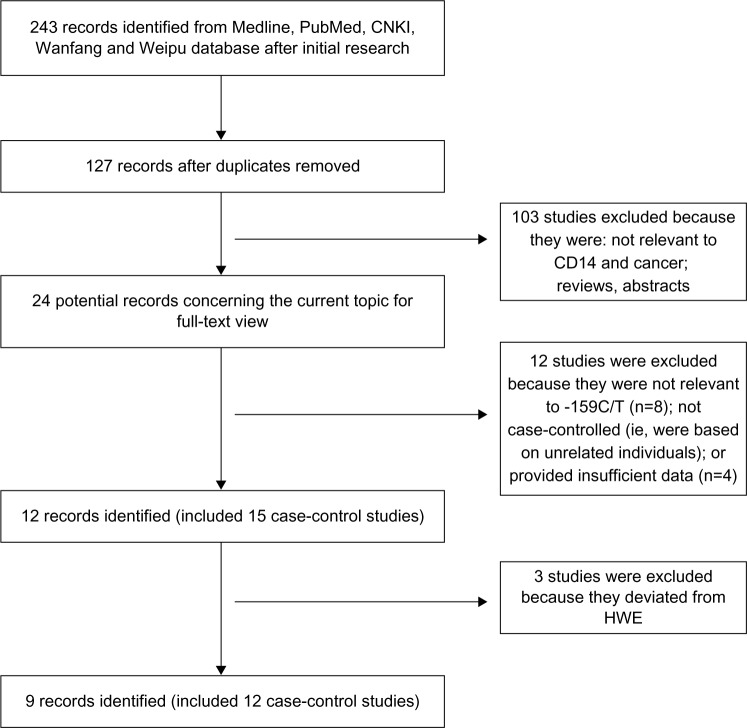
We searched in PubMed, Embase, and other databases, covering all case-control studies on the possible association between CD14 -159C/T gene polymorphism and cancer risk. Data were extracted and statistical analyses were performed using RevMan 5.0 and STATA 12.0 software.
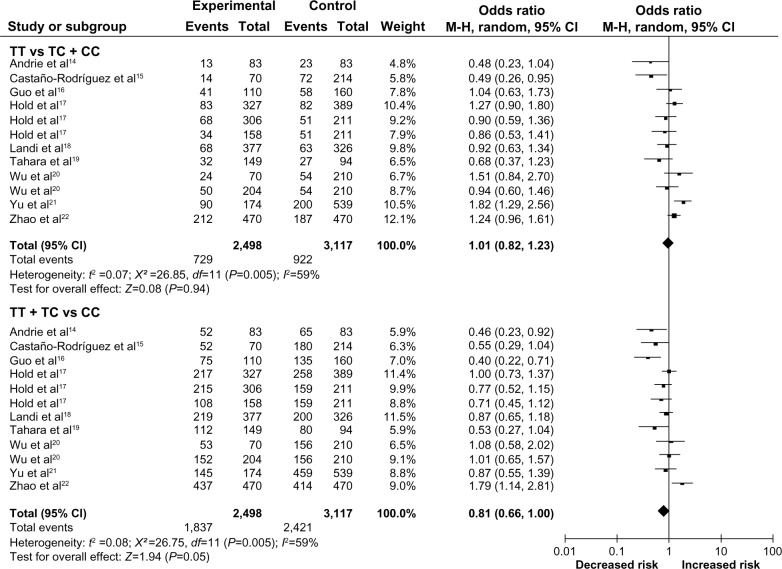
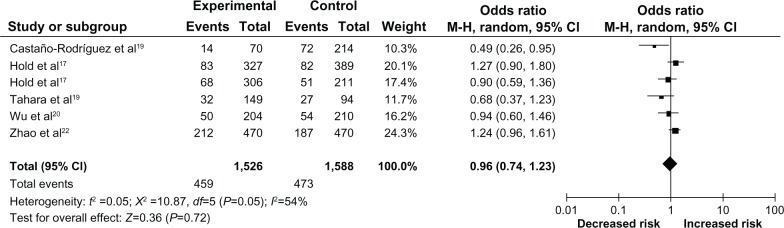
A total of 12 case-control studies met our inclusion criteria, including 2,498 cases and 2,696 controls. The combined analysis indicated that the CD14 -159C/T gene polymorphism didn't confer risk for cancer - the recessive model (TT versus (vs) CT + CC), showed odds ratio (OR) =1.01, 95% confidence interval (CI) =0.82-1.23 (P=0.94), while the dominant model (TT + TC vs CC) showed OR =0.81, 95% CI =0.66-1.00 (P=0.05). A subgroup analysis by ethnicity showed that the cancer risk associated with CD14 -159C/T gene polymorphism was significantly decreased among Caucasians for the TC + TT vs CC comparison (OR =0.83, 95% CI =0.70-0.98 [P=0.03]). The subgroup analysis by cancer type suggested that the CD14 -159C/T gene polymorphism was not associated with gastric cancer risk.
The evidence from the present meta-analysis did not support the CD14 -159C/T gene polymorphism as a genetic risk factor for cancer. Further studies on different cancer types and ethnicities are needed to validate our findings.
分化群(CD)14 基因的-159C/T 多态性已被广泛研究与癌症的关联;然而,复制研究的结果尚无定论。本研究的目的是通过荟萃分析,全面评估 CD14 基因-159C/T 多态性与癌症风险之间的可能关联。
我们在 PubMed、Embase 和其他数据库中进行了搜索,涵盖了所有关于 CD14-159C/T 基因多态性与癌症风险之间可能关联的病例对照研究。使用 RevMan 5.0 和 STATA 12.0 软件提取数据并进行统计分析。
共有 12 项符合纳入标准的病例对照研究,包括 2498 例病例和 2696 例对照。合并分析表明,CD14-159C/T 基因多态性与癌症风险无关-隐性模型(TT 与 CT+CC),比值比(OR)=1.01,95%置信区间(CI)=0.82-1.23(P=0.94),而显性模型(TT+TC 与 CC)显示 OR=0.81,95%CI=0.66-1.00(P=0.05)。按种族进行的亚组分析表明,CD14-159C/T 基因多态性与癌症风险的关联在高加索人中显著降低,TC+TT 与 CC 相比(OR=0.83,95%CI=0.70-0.98[P=0.03])。按癌症类型进行的亚组分析表明,CD14-159C/T 基因多态性与胃癌风险无关。
本荟萃分析的证据不支持 CD14-159C/T 基因多态性作为癌症的遗传危险因素。需要对不同的癌症类型和种族进行进一步的研究来验证我们的发现。