Li Chunhui, Ren Nan, Wen Ximao, Zhou Pengcheng, Huang Xun, Gong Ruie, Lv Yixin, Feng Li, Wu Hongman, Liu Zhenru, Fu Chenchao, Huang Xin, Li Jie, Chen Yuhua, Zeng Cui, Zuo Shuangyan, Xiong Xinrui, Xu Xiuhua, Wu Anhua
Infection Control Center, Xiangya Hospital, Central South University, Changsha, China.
PLoS One. 2013 Dec 23;8(12):e82785. doi: 10.1371/journal.pone.0082785. eCollection 2013.
The abuse of antimicrobials is a serious concern in China. Several measures have been taken to improve the rational use of antimicrobials, including the establishment of a national surveillance network for antimicrobial use. This study describes the dynamic changes in antimicrobial use in China between 2001 and 2010, with the scope of identifying targets to improve the prescription of antimicrobials.
Five point prevalence surveys were performed in hospitals across mainland China in 2001, 2003, 2005, 2008, and 2010. All inpatients who were admitted for at least 24 hours were included in the study. Details regarding antimicrobial use by these patients and the collection of samples for bacterial culture from inpatients administered therapeutic antimicrobials were recorded.
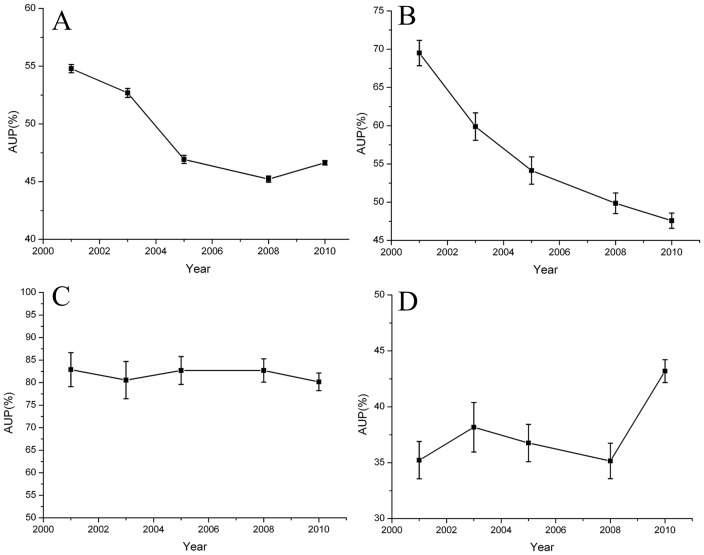
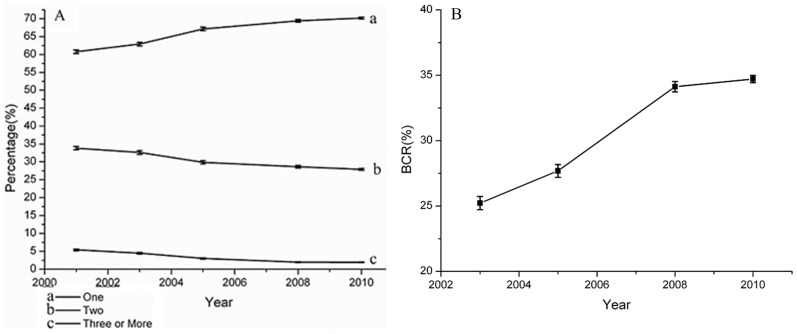
The surveys encompassed tertiary hospitals from all 31 provinces of mainland China. Antimicrobial use prevalence decreased from 54.79% in 2001 to 46.63% in 2010. While this decline was observed in most hospital departments, antimicrobial use remained stable or increased in others. Antimicrobial use prevalence was relatively high in the Pediatrics departments and general intensive care units, whereas it was lower in the Obstetrics (Neonatal group) departments in each survey. The proportion of patients administered a single antimicrobial increased from 60.78% in 2001 to 70.16% in 2010, while the proportion of administration of two or more antimicrobials declined. The bacterial culture rate increased from 25.22% in 2003 to 34.71% in 2010. Antimicrobial use prevalence (47.96% vs 46.16%), bacterial culture rate (36.40% vs 34.19%), and the proportion of administration of a single antimicrobial (71.41% vs 67.33%) were higher in teaching hospitals than in nonteaching hospitals in 2010.
Although measures for enhancing the rational use of antimicrobials have been effective, further improvements are required. The findings from this study can promote such improvements.
抗菌药物滥用在中国是一个严重问题。已采取多项措施来促进抗菌药物的合理使用,包括建立全国抗菌药物使用监测网络。本研究描述了2001年至2010年期间中国抗菌药物使用的动态变化,旨在确定改善抗菌药物处方的目标。
于2001年、2003年、2005年、2008年和2010年在中国大陆的医院进行了五次现患率调查。所有住院至少24小时的患者均纳入研究。记录了这些患者的抗菌药物使用详情以及对接受治疗性抗菌药物治疗的住院患者进行细菌培养样本的采集情况。
调查涵盖了中国大陆31个省份的三级医院。抗菌药物使用现患率从2001年的54.79%降至2010年的46.63%。虽然大多数医院科室出现了这种下降情况,但其他科室的抗菌药物使用保持稳定或有所增加。在每次调查中,儿科和综合重症监护病房的抗菌药物使用现患率相对较高,而产科(新生儿组)科室的现患率较低。使用单一抗菌药物的患者比例从2001年的60.78%增至2010年的70.16%,而使用两种或更多种抗菌药物的比例则有所下降。细菌培养率从2003年的25.22%增至2010年的34.71%。2010年,教学医院的抗菌药物使用现患率(47.96%对46.16%)、细菌培养率(36.40%对34.19%)以及使用单一抗菌药物的比例(71.41%对67.33%)均高于非教学医院。
尽管加强抗菌药物合理使用的措施已见成效,但仍需进一步改进。本研究结果可推动此类改进。