Department of Biomedical Sciences, Chang Gung University, Taoyuan, Taiwan ; Graduate Institute of Biomedical Sciences, College of Medicine, Chang Gung University, Taoyuan, Taiwan ; Chang Gung Molecular Medicine Research Center, Chang Gung University, Taoyuan, Taiwan.
Genomic Research Branch, Division of Neuroscience and Behavioral Sciences, National Institute of Mental Health, NIH, Bethesda, Maryland, United States of America ; Department of Gastroenterology, Johns Hopkins Medical School, Baltimore, Maryland, United States of America.
PLoS One. 2013 Dec 23;8(12):e83034. doi: 10.1371/journal.pone.0083034. eCollection 2013.
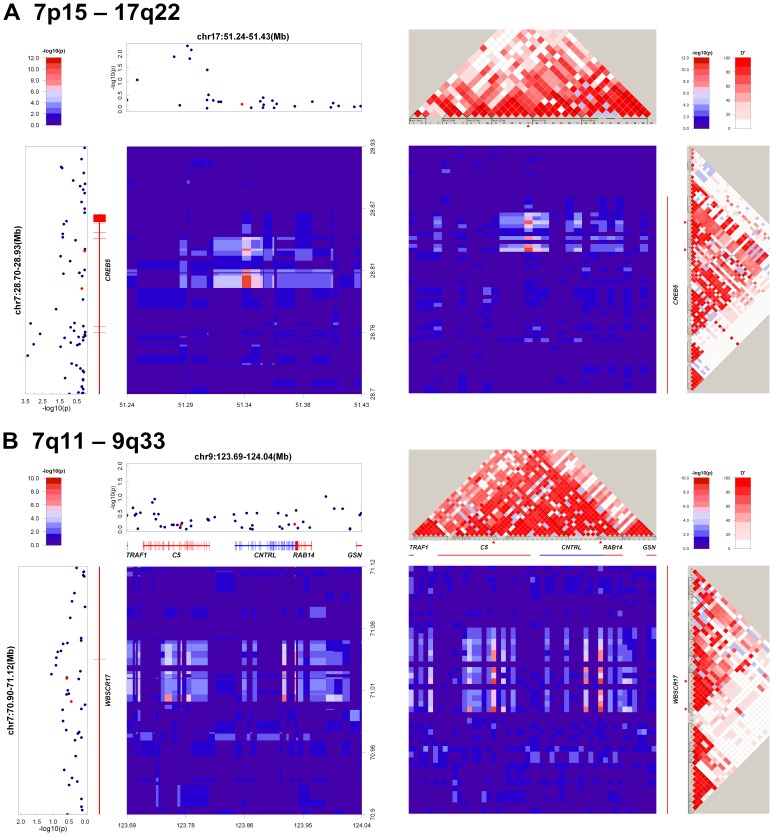
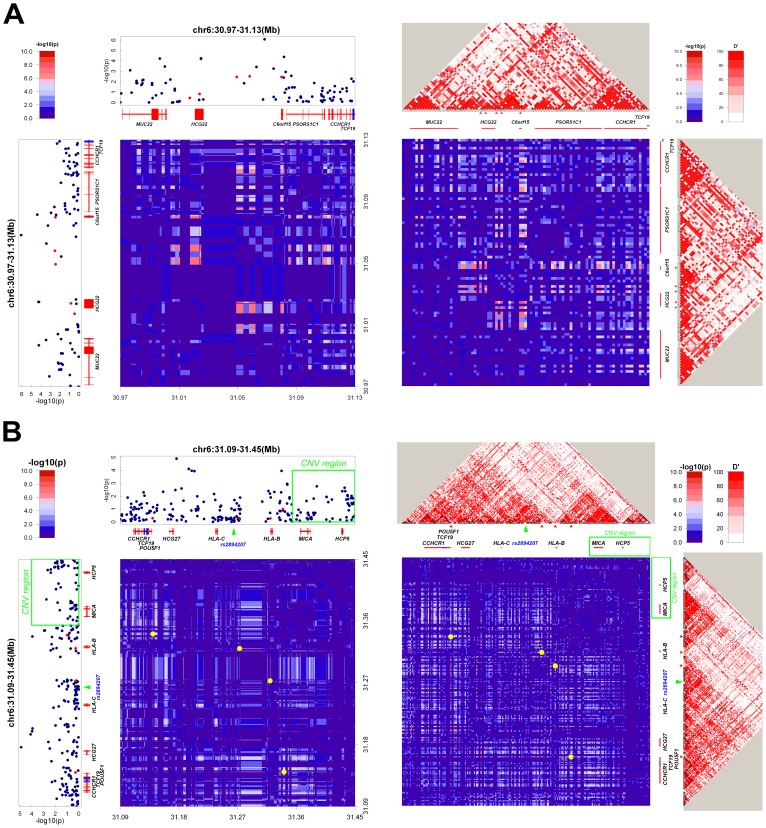
This study is the first to use genome-wide association study (GWAS) data to evaluate the multidimensional genetic architecture underlying nasopharyngeal cancer. Since analysis of data from GWAS confirms a close and consistent association between elevated risk for nasopharyngeal carcinoma (NPC) and major histocompatibility complex class 1 genes, our goal here was to explore lesser effects of gene-gene interactions. We conducted an exhaustive genome-wide analysis of GWAS data of NPC, revealing two-locus interactions occurring between single nucleotide polymorphisms (SNPs), and identified a number of suggestive interaction loci which were missed by traditional GWAS analyses. Although none of the interaction pairs we identified passed the genome-wide Bonferroni-adjusted threshold for significance, using independent GWAS data from the same population (Stage 2), we selected 66 SNP pairs in 39 clusters with P<0.01. We identified that in several chromosome regions, multiple suggestive interactions group to form a block-like signal, effectively reducing the rate of false discovery. The strongest cluster of interactions involved the CREB5 gene and a SNP rs1607979 on chromosome 17q22 (P = 9.86×10(-11)) which also show trans-expression quantitative loci (eQTL) association in Chinese population. We then detected a complicated cis-interaction pattern around the NPC-associated HLA-B locus, which is immediately adjacent to copy-number variations implicated in male susceptibility for NPC. While it remains to be seen exactly how and to what degree SNP-SNP interactions such as these affect susceptibility for nasopharyngeal cancer, future research on these questions holds great promise for increasing our understanding of this disease's genetic etiology, and possibly also that of other gene-related cancers.
这项研究首次利用全基因组关联研究(GWAS)数据评估鼻咽癌多维遗传结构。由于对 GWAS 数据的分析证实了鼻咽癌(NPC)风险升高与主要组织相容性复合体 1 类基因之间密切且一致的关联,因此我们的目标是探索基因-基因相互作用的较小影响。我们对 NPC 的 GWAS 数据进行了详尽的全基因组分析,揭示了单核苷酸多态性(SNP)之间发生的两基因座相互作用,并鉴定了许多提示性的相互作用位点,这些位点被传统的 GWAS 分析所遗漏。尽管我们鉴定的相互作用对没有一个通过全基因组 Bonferroni 校正的显著阈值,但使用来自同一人群的独立 GWAS 数据(第 2 阶段),我们在 39 个簇中选择了 66 对 SNP,P<0.01。我们发现,在几个染色体区域,多个提示性相互作用聚集形成块状信号,有效地降低了假发现率。最强的相互作用簇涉及 CREB5 基因和位于 17q22 染色体上的 SNP rs1607979(P = 9.86×10(-11)),它们在中国人群中也表现出转录数量性状基因座(eQTL)关联。然后,我们在 NPC 相关 HLA-B 基因座周围检测到一个复杂的顺式相互作用模式,该模式紧邻涉及 NPC 男性易感性的拷贝数变异。虽然这些 SNP-SNP 相互作用如何以及在多大程度上影响鼻咽癌易感性仍有待观察,但对这些问题的未来研究有望增加我们对这种疾病遗传病因的理解,也可能对其他与基因相关的癌症有所了解。