Albrecht Anne, Thiere Marlen, Bergado-Acosta Jorge Ricardo, Poranzke Janine, Müller Bettina, Stork Oliver
Department of Genetics & Molecular Neurobiology, Institute of Biology, Otto-von-Guericke University Magdeburg, Magdeburg, Germany.
Department of Genetics & Molecular Neurobiology, Institute of Biology, Otto-von-Guericke University Magdeburg, Magdeburg, Germany ; Center for Behavioural Brain Science, Magdeburg, Germany.
PLoS One. 2013 Dec 20;8(12):e84668. doi: 10.1371/journal.pone.0084668. eCollection 2013.
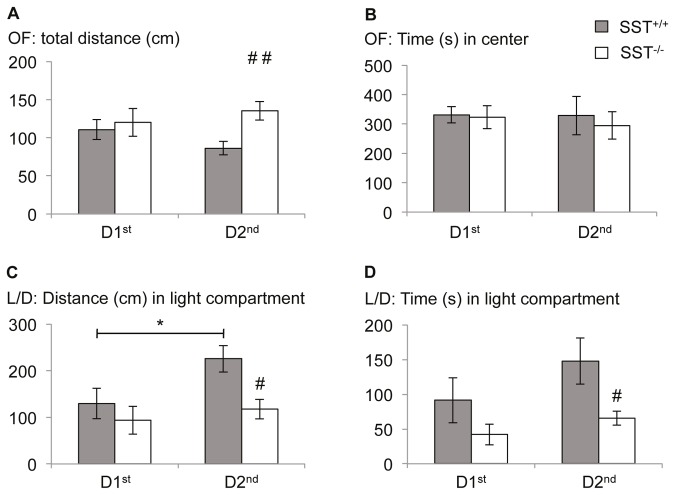
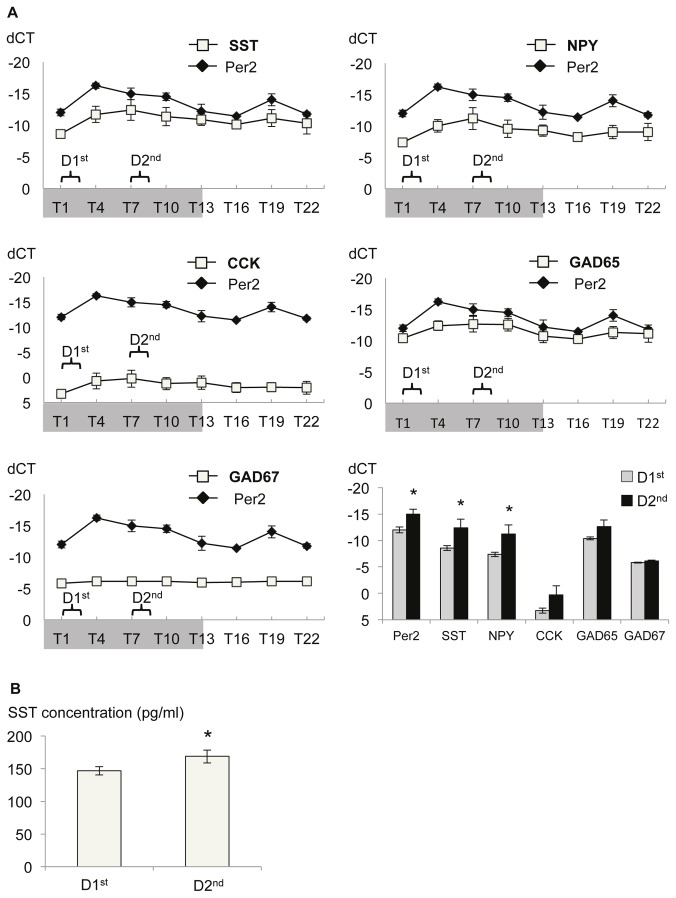
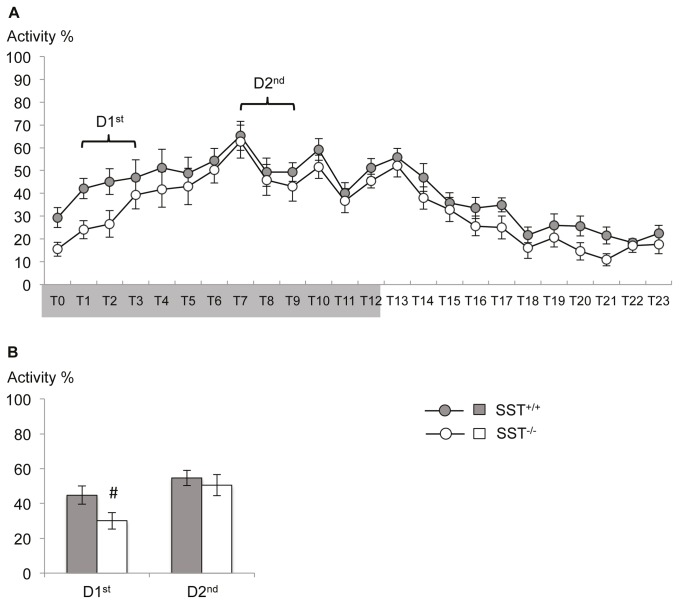
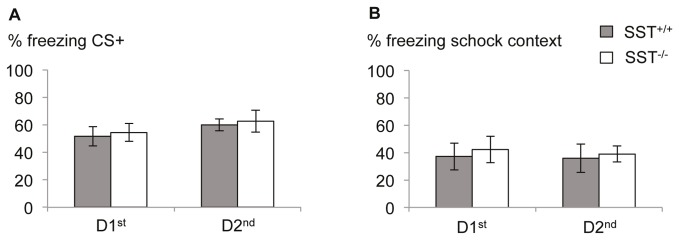
Pharmacological evidence suggests that the neuropeptide somatostatin (SST) exerts anxiolytic action via the amygdala, but findings concerning the putative role of endogenous SST in the regulation of emotional responses are contradictory. We hypothesized that an endogenous regulation of SST expression over the course of the day may determine its function and tested both SST gene expression and the behavior of SST knock out (SST⁻/⁻) mice in different aversive tests in relation to circadian rhythm. In an open field and a light/dark avoidance test, SST⁻/⁻ mice showed significant hyperactivity and anxiety-like behavior during the second, but not during the first half of the active phase, failing to show the circadian modulation of behavior that was evident in their wild type littermates. Behavioral differences occurred independently of changes of intrinsically motivated activity in the home cage. A circadian regulation of SST mRNA and protein expression that was evident in the basolateral complex of the amygdala of wild type mice may provide a neuronal substrate for the observed behavior. However, fear memory towards auditory cue or the conditioning context displayed neither a time- nor genotype-dependent modulation. Together this indicates that SST, in a circadian manner and putatively via its regulation of expression in the amygdala, modulates behavior responding to mildly aversive conditions in mice.
药理学证据表明,神经肽生长抑素(SST)通过杏仁核发挥抗焦虑作用,但关于内源性SST在情绪反应调节中假定作用的研究结果相互矛盾。我们假设,一天中SST表达的内源性调节可能决定其功能,并在与昼夜节律相关的不同厌恶测试中,对SST基因表达和SST基因敲除(SST⁻/⁻)小鼠的行为进行了测试。在旷场试验和明暗回避试验中,SST⁻/⁻小鼠在活跃期的后半段表现出明显的多动和焦虑样行为,但在活跃期的前半段则没有,未能表现出其野生型同窝小鼠中明显的昼夜行为调节。行为差异与笼内自发活动的变化无关。野生型小鼠杏仁核基底外侧复合体中明显的SST mRNA和蛋白质表达的昼夜调节可能为观察到的行为提供了神经元基础。然而,对听觉线索或条件化环境的恐惧记忆既没有表现出时间依赖性也没有表现出基因型依赖性调节。综合来看,这表明SST以昼夜节律的方式,并可能通过其对杏仁核表达的调节,调节小鼠对轻度厌恶条件的行为反应。