Lückerath Katharina, Lapa Constantin, Spahmann Annika, Jörg Gerhard, Samnick Samuel, Rosenwald Andreas, Einsele Herrmann, Knop Stefan, Buck Andreas K
University Wuerzburg, Medical Center, Department of Nuclear Medicine, Wuerzburg, Germany.
University Wuerzburg, Institut of Pathology, Wuerzburg, Germany.
PLoS One. 2013 Dec 23;8(12):e84840. doi: 10.1371/journal.pone.0084840. eCollection 2013.
Multiple myeloma is a hematologic malignancy originating from clonal plasma cells. Despite effective therapies, outcomes are highly variable suggesting marked disease heterogeneity. The role of functional imaging for therapeutic management of myeloma, such as positron emission tomography with 2-deoxy-2-[¹⁸F]fluoro-D-glucose (¹⁸F-FDG-PET), remains to be determined. Although some studies already suggested a prognostic value of ¹⁸F-FDG-PET, more specific tracers addressing hallmarks of myeloma biology, e.g. paraprotein biosynthesis, are needed. This study evaluated the amino acid tracers L-methyl-[¹¹C]-methionine (¹¹C-MET) and [¹⁸F]-fluoroethyl-L-tyrosine ((¹⁸F-Fet) for their potential to image myeloma and to characterize tumor heterogeneity.
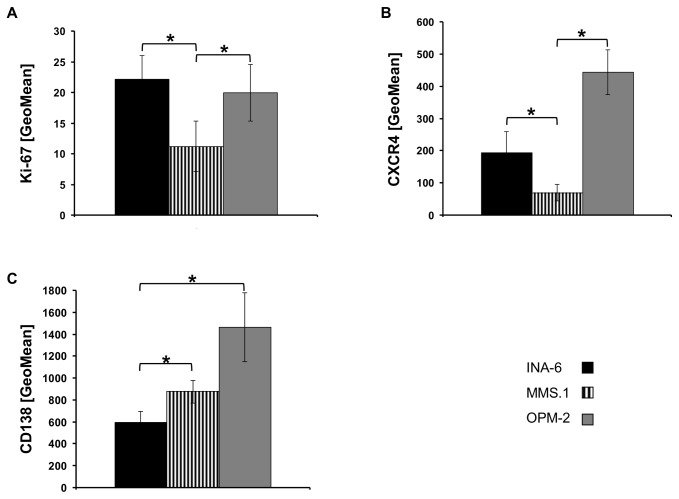
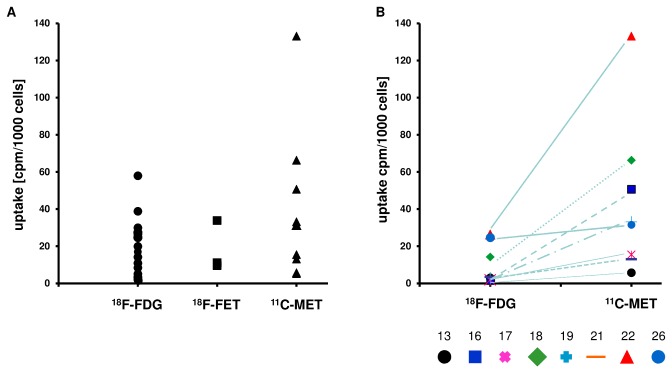
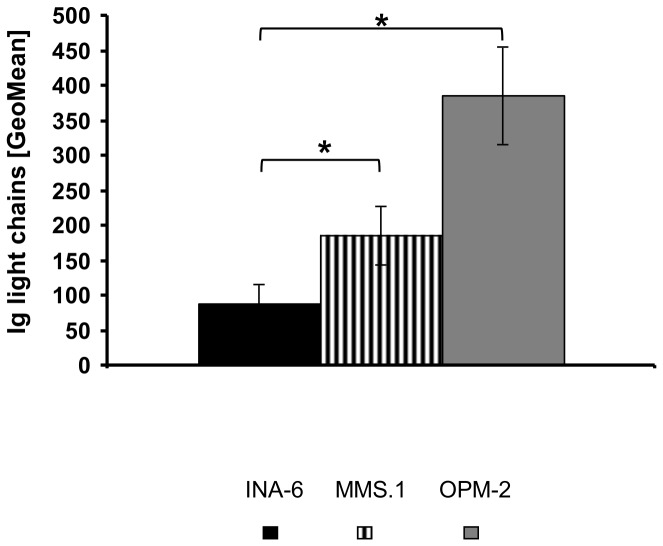
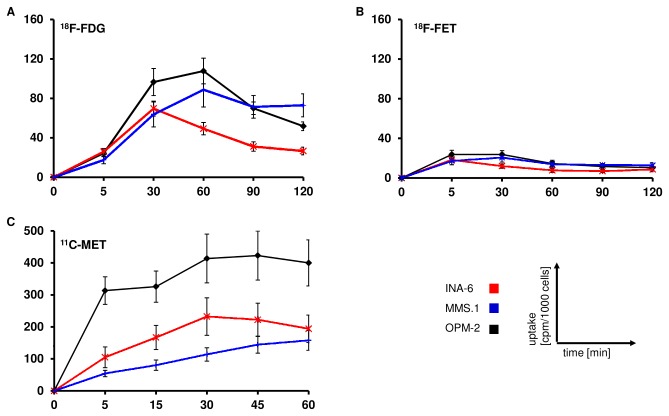
To study the utility of ¹¹C-MET, ¹⁸F-Fet and ¹⁸F-FDG for myeloma imaging, time activity curves were compared in various human myeloma cell lines (INA-6, MM1.S, OPM-2) and correlated to cell-biological characteristics, such as marker gene expression and immunoglobulin levels. Likewise, patient-derived CD138⁺ plasma cells were characterized regarding uptake and biomedical features.
Using myeloma cell lines and patient-derived CD138⁺ plasma cells, we found that the relative uptake of ¹¹C-MET exceeds that of ¹⁸F-FDG 1.5- to 5-fold and that of ¹⁸F-Fet 7- to 20-fold. Importantly, ¹¹C-MET uptake significantly differed between cell types associated with worse prognosis (e.g. t(4;14) in OPM-2 cells) and indolent ones and correlated with intracellular immunoglobulin light chain and cell surface CD138 and CXCR4 levels. Direct comparison of radiotracer uptake in primary samples further validated the superiority of ¹¹C-MET.
These data suggest that ¹¹C-MET might be a versatile biomarker for myeloma superior to routine functional imaging with ¹⁸F-FDG regarding diagnosis, risk stratification, prognosis and discrimination of tumor subtypes.
多发性骨髓瘤是一种起源于克隆性浆细胞的血液系统恶性肿瘤。尽管有有效的治疗方法,但治疗结果差异很大,这表明疾病存在显著的异质性。功能成像在骨髓瘤治疗管理中的作用,如正电子发射断层扫描与2-脱氧-2-[¹⁸F]氟-D-葡萄糖(¹⁸F-FDG-PET),仍有待确定。虽然一些研究已经表明¹⁸F-FDG-PET具有预后价值,但需要更特异性的示踪剂来针对骨髓瘤生物学的特征,例如副蛋白生物合成。本研究评估了氨基酸示踪剂L-甲基-[¹¹C]-蛋氨酸(¹¹C-MET)和[¹⁸F]-氟乙基-L-酪氨酸(¹⁸F-Fet)对骨髓瘤成像及表征肿瘤异质性的潜力。
为研究¹¹C-MET、¹⁸F-Fet和¹⁸F-FDG用于骨髓瘤成像的效用,比较了它们在各种人骨髓瘤细胞系(INA-6、MM1.S、OPM-2)中的时间-活性曲线,并与细胞生物学特征相关联,如标记基因表达和免疫球蛋白水平。同样,对源自患者的CD138⁺浆细胞的摄取和生物医学特征进行了表征。
使用骨髓瘤细胞系和源自患者的CD138⁺浆细胞,我们发现¹¹C-MET的相对摄取量比¹⁸F-FDG高1.5至5倍,比¹⁸F-Fet高7至20倍。重要的是,¹¹C-MET摄取在与预后较差相关的细胞类型(如OPM-2细胞中的t(4;14))和惰性细胞类型之间存在显著差异,并且与细胞内免疫球蛋白轻链以及细胞表面CD138和CXCR4水平相关。对原代样本中放射性示踪剂摄取的直接比较进一步证实了¹¹C-MET的优越性。
这些数据表明,¹¹C-MET可能是一种通用的骨髓瘤生物标志物,在诊断、风险分层、预后以及肿瘤亚型鉴别方面优于¹⁸F-FDG的常规功能成像。