Lenhard Miriam, Heublein Sabine, Kunert-Keil Christiane, Vrekoussis Thomas, Lomba Isabel, Ditsch Nina, Mayr Doris, Friese Klaus, Jeschke Udo
Department of Obstetrics and Gynecology, Ludwig-Maximilians-University Munich, Campus Grosshadern, Marchioninistr, 15, 81377 Munich, Germany.
BMC Cancer. 2013 Dec 30;13:616. doi: 10.1186/1471-2407-13-616.
Knowledge on immunosuppressive factors in the pathogenesis of endometrial cancer is scarce. The aim of this study was to assess Glycodelin (Gd) and its immunosuppressive isoform Glycodelin A (GdA) in endometrial cancer tissue and to analyze its impact on clinical and pathological features and patient outcome.
292 patients diagnosed and treated for endometrial cancer were included. Patient characteristics, histology and follow-up data were available. Gd and GdA was determined by immunohistochemistry and in situ hybridization was performed for Gd mRNA.
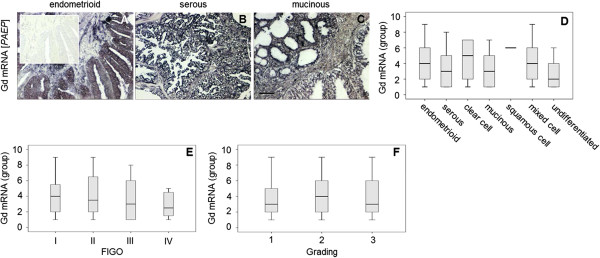
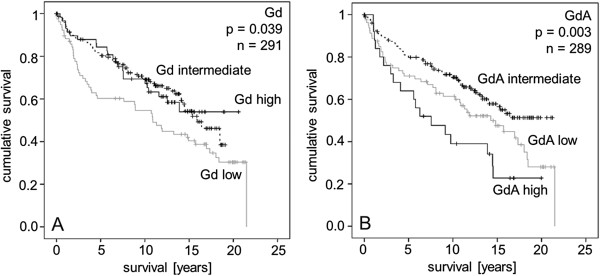
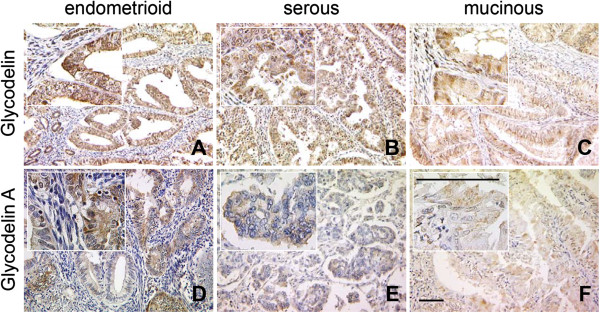
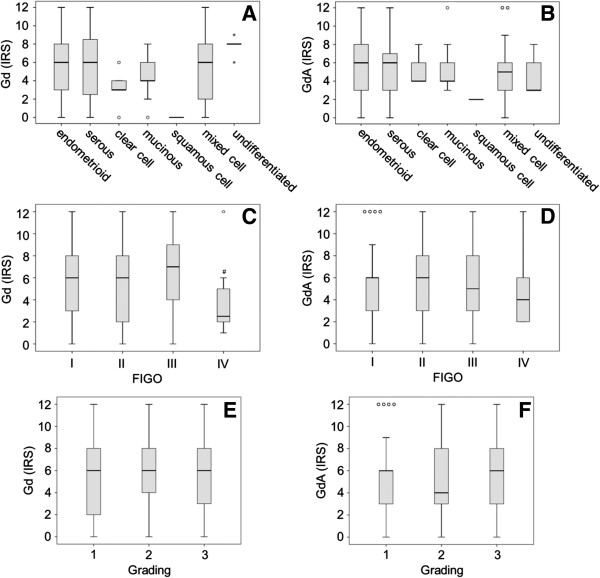
Endometrial cancer shows intermediate (52.2%) or high (20.6%) expression for Gd in 72.8%, and GdA in 71.6% (intermediate 62.6%, high 9.0%) of all cases. The glycosylation dependent staining of GdA is tumour specific and correlates with the peptide-specific Gd staining though neither of the two is associated with estrogen receptor, progesterone receptor or clinic-pathological features. Also Gd protein positively correlates with Gd mRNA as quantified by in situ hybridization. Gd positive cases have a favourable prognosis (p = 0.039), while GdA positive patients have a poor outcome (p = 0.003). Cox-regression analysis proofed GdA to be an independent prognostic marker for patient survival (p = 0.002), besides tumour stage, grade and the concomitant diagnosis of hypertension.
Gd and GdA are commonly expressed in endometrial cancer tissue and seem to be of relevance in tumourigenesis. They differ not only in glycosylation but also in their biological activity, since only GdA holds prognostic significance for a poor overall survival in endometrial cancer patients. This finding might be explained by GdAs immunosuppressive capacity.
关于子宫内膜癌发病机制中免疫抑制因子的知识尚少。本研究旨在评估子宫内膜癌组织中的糖蛋白140(Gd)及其免疫抑制亚型糖蛋白140A(GdA),并分析其对临床病理特征及患者预后的影响。
纳入292例经诊断并接受治疗的子宫内膜癌患者。获取患者特征、组织学及随访数据。通过免疫组织化学法测定Gd和GdA,并对Gd mRNA进行原位杂交检测。
在所有病例中,72.8%的子宫内膜癌显示Gd呈中度(52.2%)或高度(20.6%)表达,71.6%显示GdA呈中度(62.6%)或高度(9.0%)表达。GdA的糖基化依赖性染色具有肿瘤特异性,且与肽特异性Gd染色相关,尽管两者均与雌激素受体、孕激素受体或临床病理特征无关。此外,原位杂交定量显示Gd蛋白与Gd mRNA呈正相关。Gd阳性病例预后良好(p = 0.039),而GdA阳性患者预后较差(p = 0.003)。Cox回归分析证明,除肿瘤分期、分级及同时诊断的高血压外,GdA是患者生存的独立预后标志物(p = 0.002)。
Gd和GdA在子宫内膜癌组织中普遍表达,似乎与肿瘤发生相关。它们不仅在糖基化方面存在差异,而且在生物学活性方面也不同,因为只有GdA对子宫内膜癌患者总体生存不良具有预后意义。这一发现可能由GdA的免疫抑制能力来解释。