Baum Klaus, Telford Richard D, Cunningham Ross B
Trainingsinstitut Prof Baum, Köln, Germany.
College of Medicine, Biology, and Environment, Australian National University, Canberra, ACT, Australia.
Open Access J Sports Med. 2013 May 6;4:109-15. doi: 10.2147/OAJSM.S41706. eCollection 2013.
Runners are prone to delayed onset muscle soreness (DOMS) during long distance training. This especially holds for unaccustomed training volumes at moderate to high intensities. We investigated the effects of a marine oil complex, PCSO-524®, derived from the New Zealand green-lipped mussel (formulated as Lyprinol® and Omega XL®) on DOMS after a 30 km training run.
Initially, peak oxygen uptake of 32 distance runners (4 female, 28 male; median age 45 years, range 28-53) was measured on a treadmill with a 1.5 km hour(-1) increase every 4 minutes starting from 8.5 km hour(-1). At least 1-week after this initial test, they participated in a 30 km road run at a speed corresponding to about 70% of their individual peak oxygen uptake on a flat terrain. Before and after (0, 24, and 48 hours) the run, blood concentration of creatine kinase (CK) were measured and pain sensation was determined (pain scale from 0 = no pain to 10 = extremely painful). Runners were then matched in pairs based on maximal CK and peak oxygen uptake, and allocated randomly into two different groups. One group was supplemented with 400 mg per day of PCSO-524® for 11 weeks, the other group with an olive oil placebo. After that period, CK and pain sensations were remeasured following a second 30 km run at the same speed and on the same terrain.
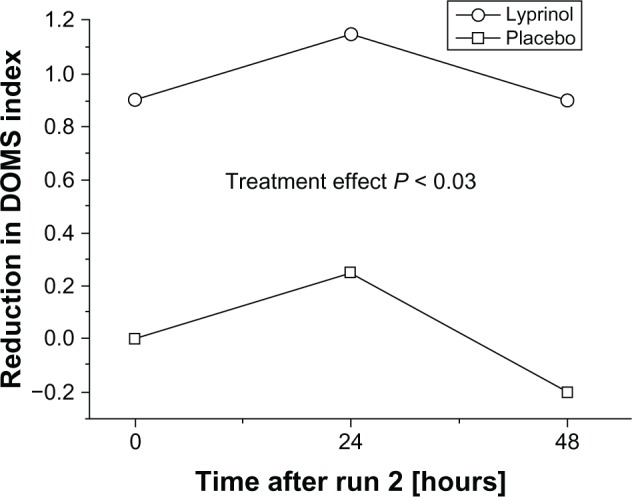
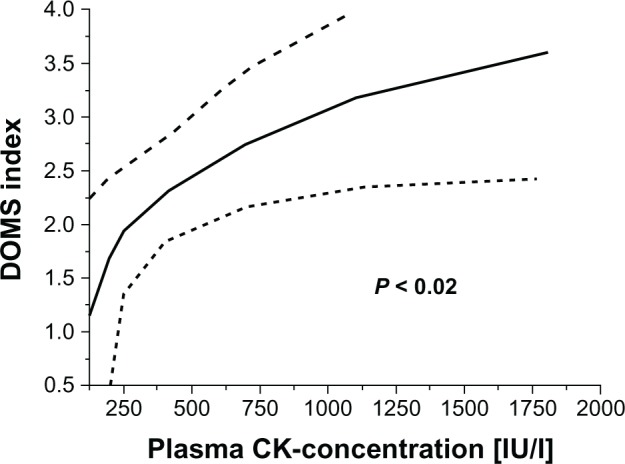
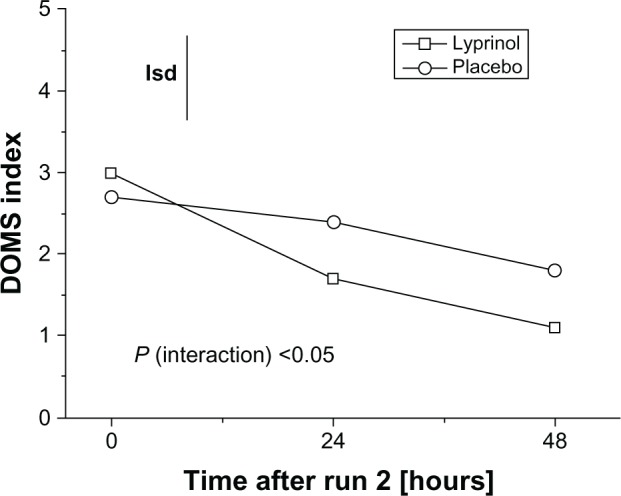
The general pattern of soreness in the PCSO-524® supplemented group was reduced by 1.1 units (standard error 0.41) compared to the placebo (P < 0.05), the effects being greater in lesser trained runners (P < 0.05). CK levels were positively associated with pain sensation (P < 0.05), but trends toward lower CK in the PCSO-524® group, which were also more pronounced in the lesser trained runners, were not statistically significant.
Pain sensations experienced by distance runners following a 30 km run were reduced by supplementation with the marine oil complex PCSO-524®, an effect which was greater in lesser trained runners.
长跑运动员在长距离训练期间容易出现延迟性肌肉酸痛(DOMS)。在进行中等至高强度的不习惯的训练量时尤其如此。我们研究了一种源自新西兰绿唇贻贝的海洋油复合物PCSO-524®(制成Lyprinol®和Omega XL®)对30公里训练跑后DOMS的影响。
最初,对32名长跑运动员(4名女性,28名男性;年龄中位数45岁,范围28 - 53岁)进行峰值摄氧量测量,在跑步机上从8.5公里/小时开始,每4分钟速度增加1.5公里/小时。在初次测试至少1周后,他们在平坦地形上以约为其个人峰值摄氧量70%的速度参加30公里的路跑。在跑步前(0小时)、后(24小时和48小时)测量肌酸激酶(CK)的血液浓度,并确定疼痛感觉(疼痛量表从0 = 无疼痛到10 = 极其疼痛)。然后根据最大CK和峰值摄氧量将跑步者配对,并随机分为两个不同的组。一组每天补充400毫克PCSO-524®,持续11周,另一组补充橄榄油安慰剂。在该时间段后,以相同速度和相同地形进行第二次30公里跑步后,再次测量CK和疼痛感觉。
与安慰剂组相比,补充PCSO-524®组的酸痛总体模式降低了1.1个单位(标准误0.41)(P < 0.05),在训练较少的跑步者中效果更明显(P < 0.05)。CK水平与疼痛感觉呈正相关(P < 0.05),但PCSO-524®组中CK有降低趋势,在训练较少的跑步者中也更明显,但无统计学意义。
补充海洋油复合物PCSO-524®可减轻长跑运动员30公里跑步后的疼痛感觉,在训练较少的跑步者中效果更显著。