Ten Haaf Dominique S M, Flipsen Martin A, Horstman Astrid M H, Timmerman Hans, Steegers Monique A H, de Groot Lisette C P G M, Eijsvogels Thijs M H, Hopman Maria T E
Department of Physiology, Radboud Institute for Health Sciences, Radboud University Medical Center, 6525 XZ Nijmegen, The Netherlands.
FrieslandCampina, 3811 LP Amersfoort, The Netherlands.
Nutrients. 2021 Mar 5;13(3):858. doi: 10.3390/nu13030858.
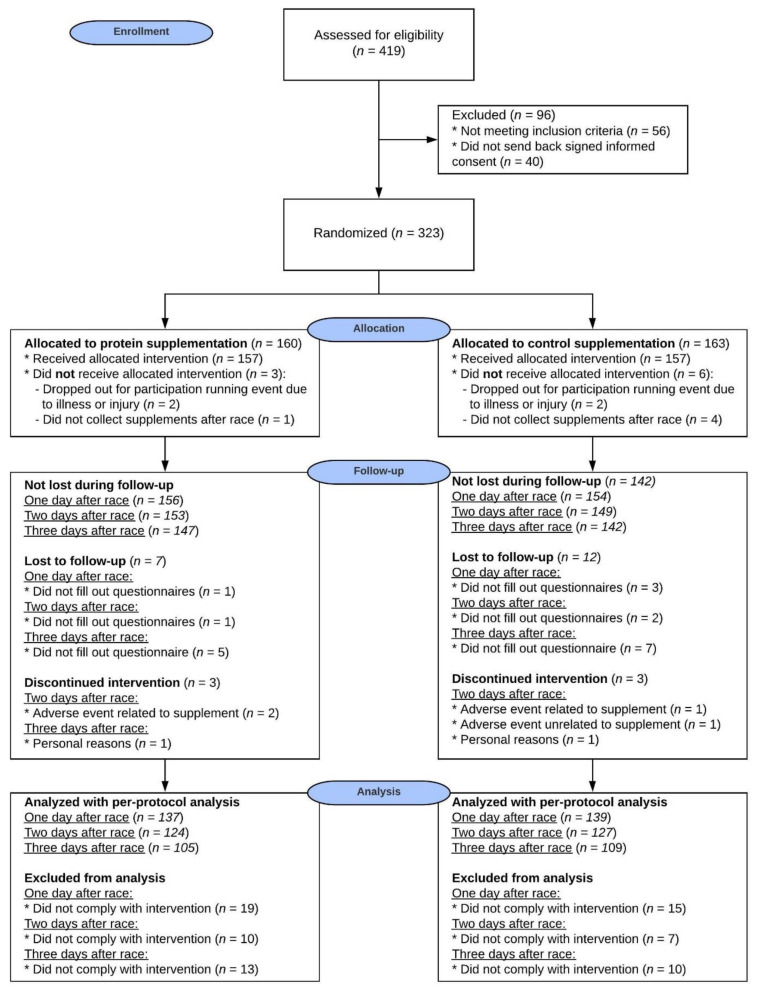
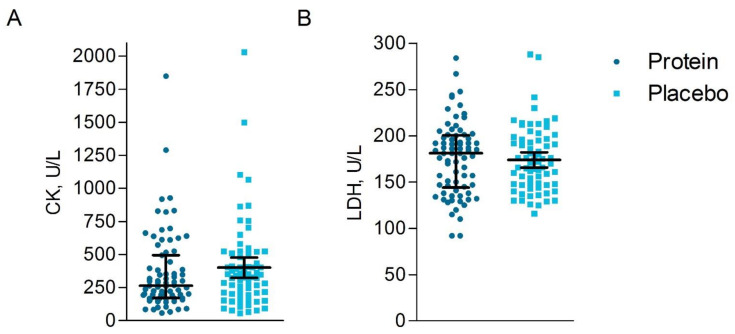
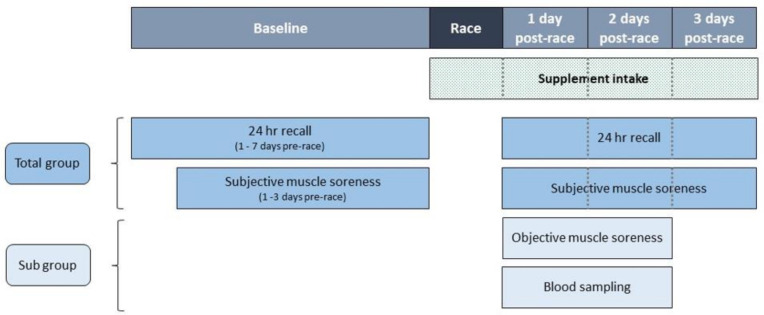
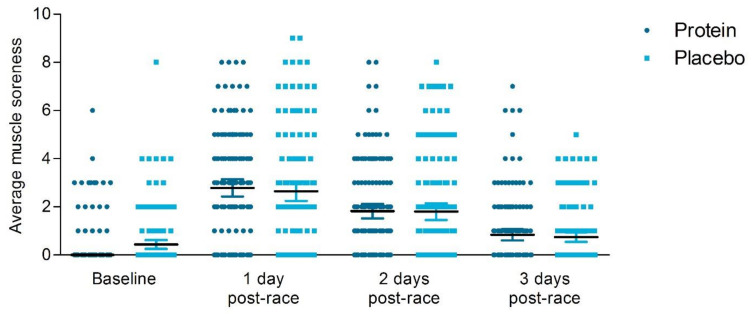
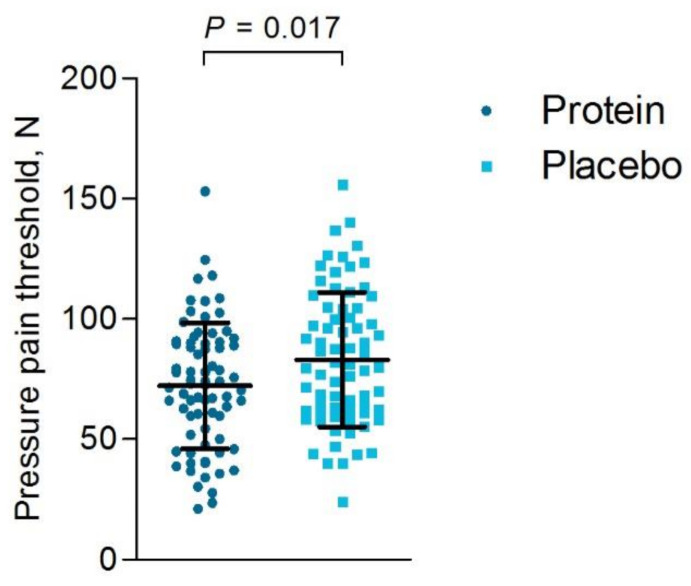
We assessed whether a protein supplementation protocol could attenuate running-induced muscle soreness and other muscle damage markers compared to iso-caloric placebo supplementation. A double-blind randomized controlled trial was performed among 323 recreational runners (age 44 ± 11 years, 56% men) participating in a 15-km road race. Participants received milk protein or carbohydrate supplementation, for three consecutive days post-race. Habitual protein intake was assessed using 24 h recalls. Race characteristics were determined and muscle soreness was assessed with the Brief Pain Inventory at baseline and 1-3 days post-race. In a subgroup ( = 149) muscle soreness was measured with a strain gauge algometer and creatine kinase (CK) and lactate dehydrogenase (LDH) concentrations were measured. At baseline, no group-differences were observed for habitual protein intake (protein group: 79.9 ± 26.5 g/d versus placebo group: 82.0 ± 26.8 g/d, = 0.49) and muscle soreness (protein: 0.45 ± 1.08 versus placebo: 0.44 ± 1.14, = 0.96). Subjects completed the race with a running speed of 12 ± 2 km/h. With the Intention-to-Treat analysis no between-group differences were observed in reported muscle soreness. With the per-protocol analysis, however, the protein group reported higher muscle soreness 24 h post-race compared to the placebo group (2.96 ± 2.27 versus 2.46 ± 2.38, = 0.039) and a lower pressure muscle pain threshold in the protein group compared to the placebo group (71.8 ± 30.0 N versus 83.9 ± 27.9 N, = 0.019). No differences were found in concentrations of CK and LDH post-race between groups. Post-exercise protein supplementation is not more preferable than carbohydrate supplementation to reduce muscle soreness or other damage markers in recreational athletes with mostly a sufficient baseline protein intake running a 15-km road race.
我们评估了与等热量的安慰剂补充剂相比,蛋白质补充方案是否能减轻跑步引起的肌肉酸痛和其他肌肉损伤指标。在323名参加15公里公路赛的业余跑步者(年龄44±11岁,56%为男性)中进行了一项双盲随机对照试验。参与者在赛后连续三天接受乳清蛋白或碳水化合物补充剂。使用24小时回忆法评估习惯性蛋白质摄入量。确定比赛特征,并在基线和赛后1至3天使用简明疼痛量表评估肌肉酸痛。在一个亚组(n = 149)中,用应变片式痛觉计测量肌肉酸痛,并测量肌酸激酶(CK)和乳酸脱氢酶(LDH)浓度。在基线时,习惯性蛋白质摄入量(蛋白质组:79.9±26.5克/天,安慰剂组:82.0±26.8克/天,P = 0.49)和肌肉酸痛(蛋白质组:0.45±1.08,安慰剂组:0.44±1.14,P = 0.96)在各组之间未观察到差异。受试者以12±2公里/小时的速度完成比赛。意向性分析显示,在报告的肌肉酸痛方面,各组之间未观察到差异。然而,根据符合方案分析,蛋白质组在赛后24小时报告的肌肉酸痛高于安慰剂组(2.96±2.27对2.46±2.38,P = 0.039),并且蛋白质组的压力性肌肉疼痛阈值低于安慰剂组(71.8±30.0牛顿对83.9±27.9牛顿,P = 0.019)。赛后各组之间的CK和LDH浓度没有差异。对于大多数基线蛋白质摄入量充足的业余运动员,在参加15公里公路赛后,运动后补充蛋白质在减轻肌肉酸痛或其他损伤指标方面并不比补充碳水化合物更可取。