Orsini Caitlin A, Yan Chen, Maren Stephen
Department of Psychology, University of Michigan Ann Arbor, MI, USA.
Program in Neurosciences and Mental Health, Hospital for Sick Children Toronto, ON, Canada.
Front Behav Neurosci. 2013 Dec 13;7:199. doi: 10.3389/fnbeh.2013.00199. eCollection 2013.
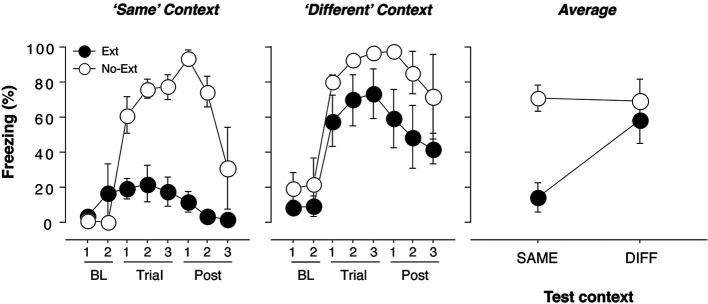
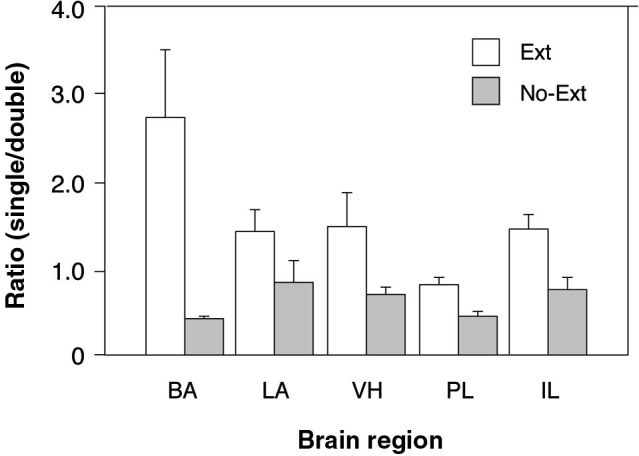
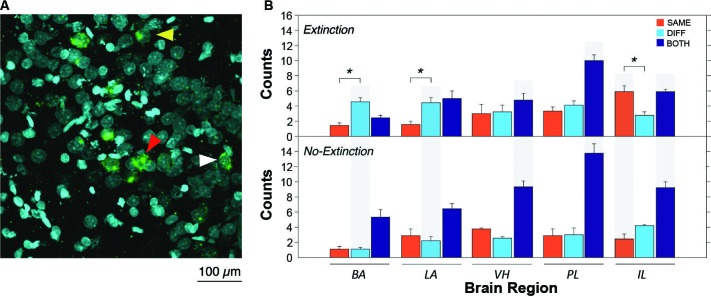
After fear conditioning, presenting the conditioned stimulus (CS) alone yields a context-specific extinction memory; fear is suppressed in the extinction context, but renews in any other context. The context-dependence of extinction is mediated by a brain circuit consisting of the hippocampus, prefrontal cortex (PFC) and amygdala. In the present work, we sought to determine at what level of this circuit context-dependent representations of the CS emerge. To explore this question, we used cellular compartment analysis of temporal activity by fluorescent in situ hybridization (catFISH). This method exploits the intracellular expression profile of the immediate early gene (IEG), Arc, to visualize neuronal activation patterns to two different behavioral experiences. Rats were fear conditioned in one context and extinguished in another; 24 h later, they were sequentially exposed to the CS in the extinction context and another context. Control rats were also tested in each context, but were never extinguished. We assessed Arc mRNA expression within the basal amygdala (BA), lateral amygdala (LA), ventral hippocampus (VH), prelimbic cortex (PL) and infralimbic cortex (IL). We observed that the sequential retention tests induced context-dependent patterns of Arc expression in the BA, LA, and IL of extinguished rats; this was not observed in non-extinguished controls. In general, non-extinguished animals had proportionately greater numbers of non-selective (double-labeled) neurons than extinguished animals. Collectively, these findings suggest that extinction learning results in pattern separation, particularly within the BA, in which unique neuronal ensembles represent fear memories after extinction.
恐惧条件反射后,单独呈现条件刺激(CS)会产生特定情境的消退记忆;在消退情境中恐惧被抑制,但在任何其他情境中都会恢复。消退的情境依赖性由海马体、前额叶皮质(PFC)和杏仁核组成的脑回路介导。在本研究中,我们试图确定在该回路的哪个水平上出现CS的情境依赖性表征。为了探究这个问题,我们使用了荧光原位杂交(catFISH)进行细胞区室时间活动分析。这种方法利用即刻早期基因(IEG)Arc的细胞内表达谱,来可视化神经元对两种不同行为经历的激活模式。大鼠在一种情境中进行恐惧条件反射,在另一种情境中进行消退训练;24小时后,它们在消退情境和另一种情境中依次接触CS。对照大鼠也在每种情境中进行测试,但从未进行消退训练。我们评估了基底杏仁核(BA)、外侧杏仁核(LA)、腹侧海马体(VH)、前边缘皮质(PL)和下边缘皮质(IL)内的Arc mRNA表达。我们观察到,连续保留测试在消退大鼠的BA、LA和IL中诱导了Arc表达的情境依赖性模式;在未消退的对照中未观察到这种情况。一般来说,未消退的动物比消退的动物有比例更高的非选择性(双标记)神经元。总的来说,这些发现表明消退学习导致模式分离,特别是在BA内,其中独特的神经元群落在消退后代表恐惧记忆。