Centre for Family Medicine, Karolinska Institutet, Stockholm, Sweden.
Eur J Psychotraumatol. 2013 Dec 27;4. doi: 10.3402/ejpt.v4i0.21892. eCollection 2013.
After disaster, physical symptoms are common although seldom recognized due to lack of knowledge of the course of symptoms and relation to more studied psychological symptoms.
This study aimed to investigate the change in the reporting of different physical symptoms after a disaster, including possible factors for change, and whether psychological symptoms predict physical symptoms reporting at a later point in time.
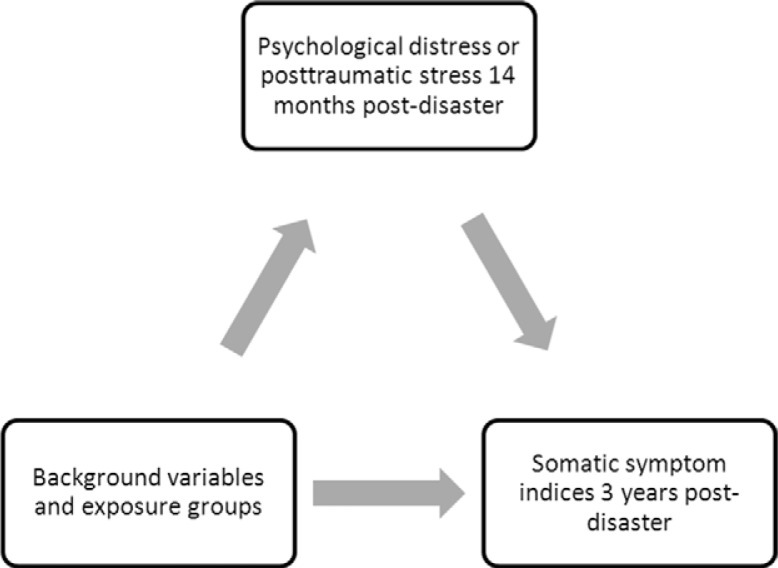
A longitudinal study of citizens of Stockholm who survived the 2004 Indian Ocean tsunami. A total of 1,101 participants completed questionnaires on somatic symptoms, general distress, posttraumatic stress, exposure, and demographic details 14 months and 3 years after the disaster. Physical symptoms occurring daily or weekly during the last year were investigated in four symptom indices: neurological, cardiorespiratory, gastrointestinal, and musculoskeletal. We used generalized estimating equations (GEE) analysis to determine odds ratios for a change in symptoms, and pathway analysis to predict the influence of psychological symptoms on physical symptoms.
There was a general decrease of reporting in all physical symptom indices except the musculoskeletal symptom index. The change in the neurological symptom index showed the strongest association with exposure, and for women. General distress and posttraumatic stress at 14 months postdisaster predicted physical symptoms at 3 years.
Physical symptoms were predicted by psychological symptoms at an earlier time point, but in a considerable proportion of respondents, physical symptoms existed independently from psychological symptoms. Physicians should be observant on the possible connection of particular pseudoneurological symptoms with prior adversities.
灾难后,尽管由于缺乏对症状过程和与更研究的心理症状的关系的了解,常见的是身体症状,但很少被识别。
本研究旨在调查灾难后不同身体症状报告的变化,包括可能的变化因素,以及心理症状是否可以预测稍后时间的身体症状报告。
对 2004 年印度洋海啸中幸存的斯德哥尔摩市民进行的一项纵向研究。共有 1101 名参与者在灾难发生后 14 个月和 3 年内完成了关于躯体症状、一般困扰、创伤后应激、暴露和人口统计学细节的问卷。在四个症状指数中调查了过去一年中每天或每周发生的身体症状:神经系统、心肺、胃肠道和肌肉骨骼。我们使用广义估计方程(GEE)分析来确定症状变化的优势比,并用路径分析预测心理症状对身体症状的影响。
除肌肉骨骼症状指数外,所有身体症状指数的报告均普遍下降。神经系统症状指数的变化与暴露和女性的关联最强。灾难后 14 个月的一般困扰和创伤后应激预测了 3 年后的身体症状。
身体症状可由更早时间点的心理症状预测,但在相当一部分受访者中,身体症状独立于心理症状存在。医生应该注意特定的拟神经系统症状与先前逆境之间的可能联系。