Immunology Department, Noguchi Memorial Institute for Medical Research, College of Health Sciences, University of Ghana, Legon, Accra, Ghana ; Department of Animal Biology and Conservation Science, University of Ghana, Legon, Accra, Ghana.
Immunology Department, Noguchi Memorial Institute for Medical Research, College of Health Sciences, University of Ghana, Legon, Accra, Ghana.
PLoS One. 2013 Dec 27;8(12):e84181. doi: 10.1371/journal.pone.0084181. eCollection 2013.
Cerebral malaria (CM) is responsible for most of the malaria-related deaths in children in sub-Saharan Africa. Although, not well understood, the pathogenesis of CM involves parasite and host factors which contribute to parasite sequestration through cytoadherence to the vascular endothelium. Cytoadherence to brain microvasculature is believed to involve host endothelial receptor, CD54 or intercellular adhesion molecule (ICAM)-1, while other receptors such as CD36 are generally involved in cytoadherence of parasites in other organs. We therefore investigated the contributions of host ICAM-1 expression and levels of antibodies against ICAM-1 binding variant surface antigen (VSA) on parasites to the development of CM.
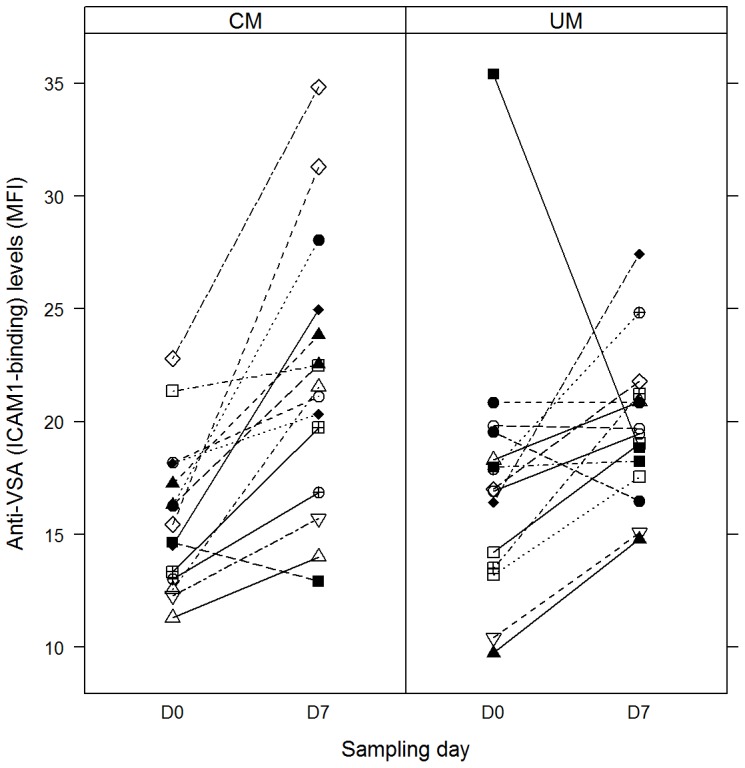
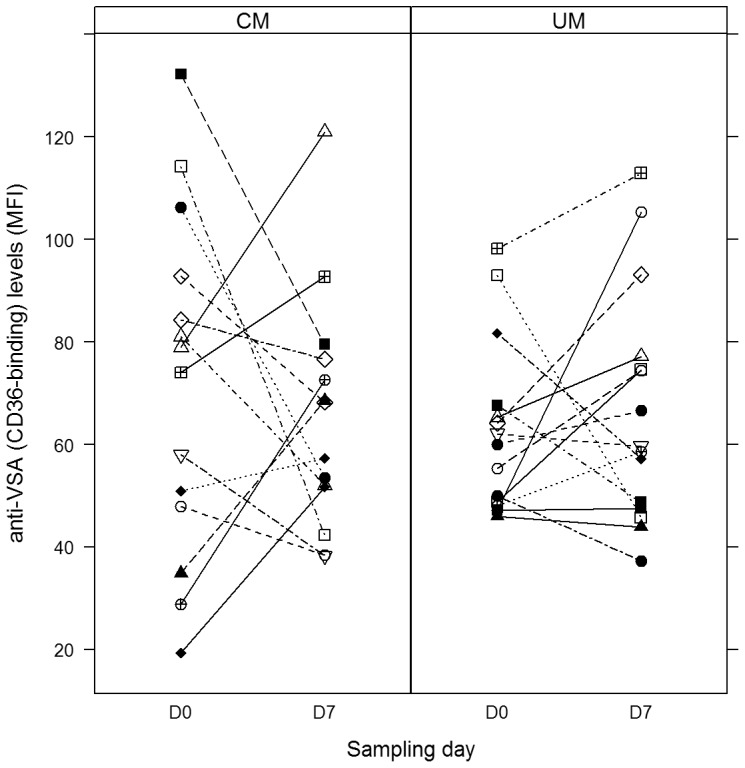
METHODOLOGY/PRINCIPAL FINDINGS: Paediatric malaria patients, 0.5 to 13 years were recruited and grouped into CM and uncomplicated malaria (UM) patients, based on well defined criteria. Standardized ELISA protocol was used to measure soluble ICAM-1 (sICAM-1) levels from acute plasma samples. Levels of IgG to CD36- or ICAM-1-binding VSA were measured by flow cytometry during acute and convalescent states. Wilcoxon sign rank-test analysis to compare groups revealed association between sICAM-1 levels and CM (p<0.0037). Median levels of antibodies to CD36-binding VSA were comparable in the two groups at the time of admission and 7 days after treatment was initiated (p>0.05). Median levels of antibodies to CD36-binding VSAs were also comparable between acute and convalescent samples within any patient group. Median levels of antibodies to ICAM-1-binding VSAs were however significantly lower at admission time than during recovery in both groups.
CONCLUSIONS/SIGNIFICANCE: High levels of sICAM-1 were associated with CM, and the sICAM-1 levels may reflect expression levels of the membrane bound form. Anti-VSA antibody levels to ICAM-binding parasites was more strongly associated with both UM and CM than antibodies to CD36 binding parasites. Thus, increasing host sICAM-1 levels were associated with CM whilst antibodies to parasite expressing non-ICAM-1-binding VSAs were not.
在撒哈拉以南非洲地区,脑型疟疾(CM)是导致大多数儿童疟疾相关死亡的原因。虽然其发病机制尚未得到充分理解,但 CM 的发病机制涉及寄生虫和宿主因素,这些因素通过细胞黏附作用导致寄生虫在血管内皮上的隔离。据信,细胞黏附作用涉及宿主内皮细胞受体 CD54 或细胞间黏附分子(ICAM)-1,而其他受体如 CD36 通常参与寄生虫在其他器官中的细胞黏附作用。因此,我们研究了宿主 ICAM-1 表达水平和针对寄生虫上的 ICAM-1 结合变异表面抗原(VSA)的抗体水平对 CM 发病的影响。
方法/主要发现:招募了 0.5 至 13 岁的儿科疟疾患者,并根据明确的标准将其分为 CM 和无并发症疟疾(UM)患者。使用标准化 ELISA 方案从急性血浆样本中测量可溶性 ICAM-1(sICAM-1)水平。在急性和恢复期使用流式细胞术测量针对 CD36 或 ICAM-1 结合 VSA 的 IgG 水平。Wilcoxon 符号秩检验分析显示 sICAM-1 水平与 CM 之间存在关联(p<0.0037)。在治疗开始时和治疗开始后 7 天,两组患者的 CD36 结合 VSA 抗体水平相当(p>0.05)。在任何患者组中,急性和恢复期样本之间的 CD36 结合 VSA 抗体水平也相当。然而,在两组患者中,ICAM-1 结合 VSA 抗体水平在入院时明显低于恢复期。
结论/意义:高水平的 sICAM-1 与 CM 相关,sICAM-1 水平可能反映了膜结合形式的表达水平。与针对 CD36 结合寄生虫的抗体相比,针对表达非 ICAM-1 结合 VSA 的寄生虫的抗体与 UM 和 CM 的相关性更强。因此,宿主 sICAM-1 水平的增加与 CM 相关,而针对寄生虫表达非 ICAM-1 结合 VSA 的抗体则不相关。