Christensen Anders S, Linnet Troels E, Borg Mikael, Boomsma Wouter, Lindorff-Larsen Kresten, Hamelryck Thomas, Jensen Jan H
Department of Chemistry, University of Copenhagen, Copenhagen, Denmark.
Structural Biology and NMR Laboratory, Department of Biology, University of Copenhagen, Copenhagen, Denmark.
PLoS One. 2013 Dec 31;8(12):e84123. doi: 10.1371/journal.pone.0084123. eCollection 2013.
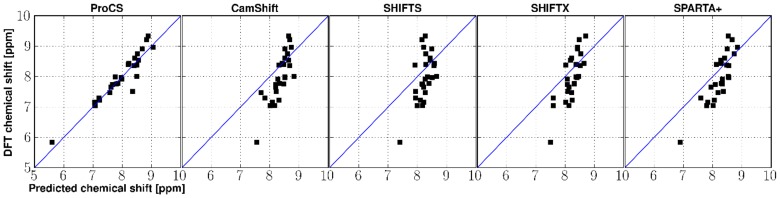
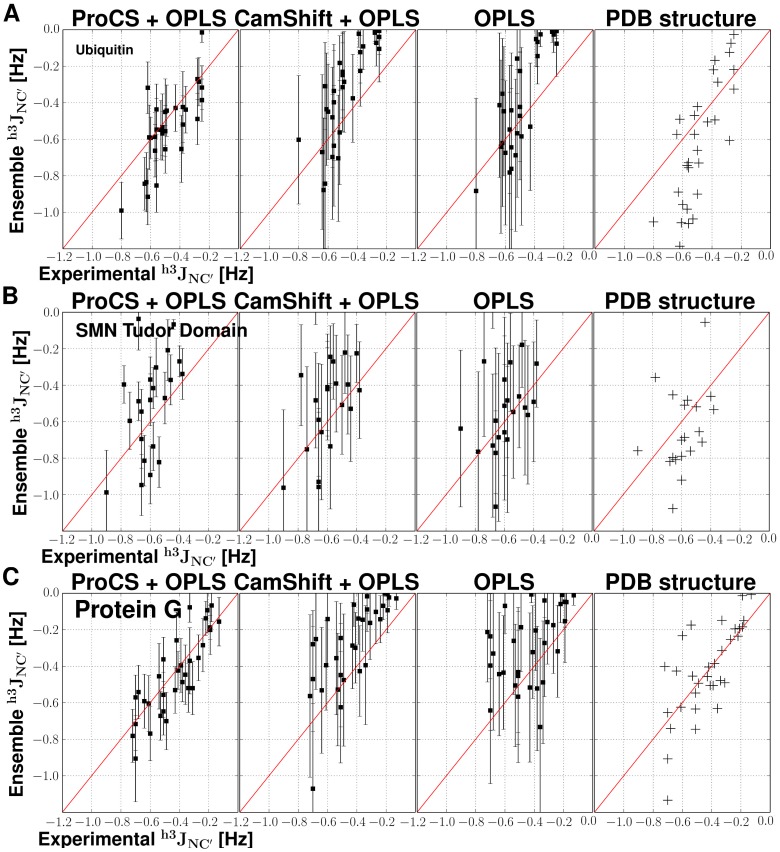
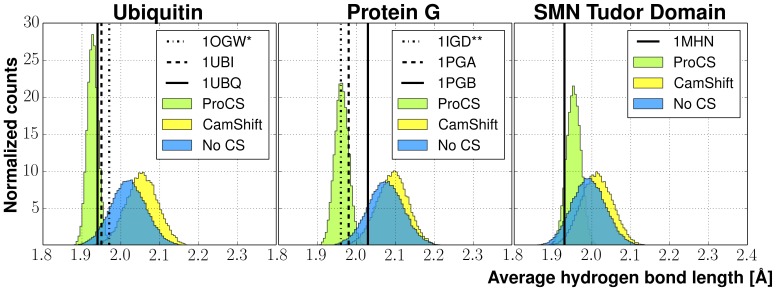
We present the ProCS method for the rapid and accurate prediction of protein backbone amide proton chemical shifts--sensitive probes of the geometry of key hydrogen bonds that determine protein structure. ProCS is parameterized against quantum mechanical (QM) calculations and reproduces high level QM results obtained for a small protein with an RMSD of 0.25 ppm (r = 0.94). ProCS is interfaced with the PHAISTOS protein simulation program and is used to infer statistical protein ensembles that reflect experimentally measured amide proton chemical shift values. Such chemical shift-based structural refinements, starting from high-resolution X-ray structures of Protein G, ubiquitin, and SMN Tudor Domain, result in average chemical shifts, hydrogen bond geometries, and trans-hydrogen bond ((h3)J(NC')) spin-spin coupling constants that are in excellent agreement with experiment. We show that the structural sensitivity of the QM-based amide proton chemical shift predictions is needed to obtain this agreement. The ProCS method thus offers a powerful new tool for refining the structures of hydrogen bonding networks to high accuracy with many potential applications such as protein flexibility in ligand binding.
我们提出了ProCS方法,用于快速准确地预测蛋白质主链酰胺质子的化学位移——这是决定蛋白质结构的关键氢键几何结构的敏感探针。ProCS是根据量子力学(QM)计算进行参数化的,对于一个小蛋白质,它能重现通过QM计算得到的高水平结果,均方根偏差为0.25 ppm(r = 0.94)。ProCS与PHAISTOS蛋白质模拟程序相连接,并用于推断反映实验测量的酰胺质子化学位移值的统计蛋白质系综。从蛋白质G、泛素和SMN Tudor结构域的高分辨率X射线结构出发,这种基于化学位移的结构优化,得到的平均化学位移、氢键几何结构和反式氢键((h3)J(NC'))自旋 - 自旋耦合常数与实验结果高度吻合。我们表明,基于QM的酰胺质子化学位移预测的结构敏感性是获得这种一致性所必需的。因此,ProCS方法为高精度优化氢键网络结构提供了一个强大的新工具,具有许多潜在应用,如蛋白质在配体结合中的灵活性。