Department of Microbiology, College of Medicine, The Catholic University of Korea, Seoul, Republic of Korea.
Department of Food and Animal Biotechnology, Department of Agricultural Biotechnology, Center for Agricultural Biomaterials, and Research Institute for Agriculture and Life Sciences, Seoul National University, Seoul, Republic of Korea.
PLoS One. 2013 Dec 31;8(12):e85063. doi: 10.1371/journal.pone.0085063. eCollection 2013.
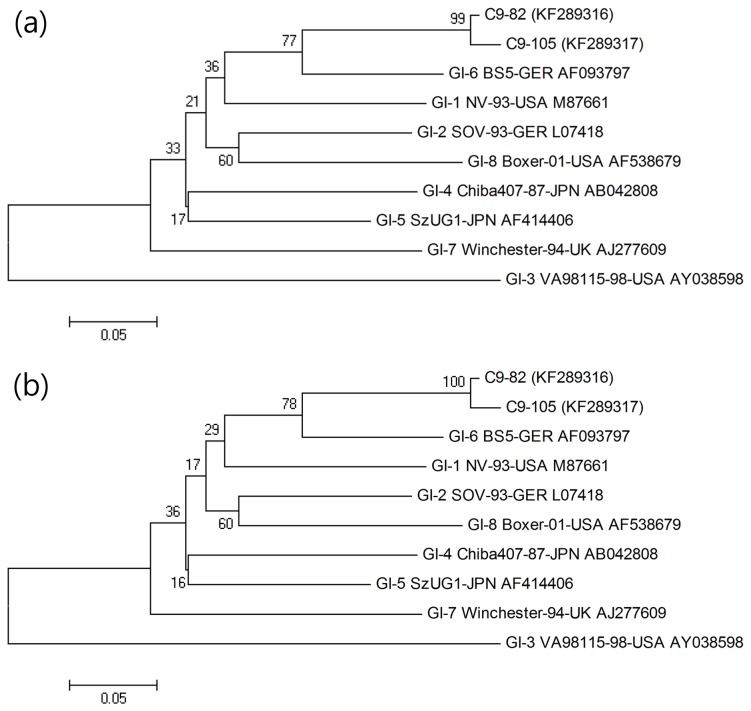
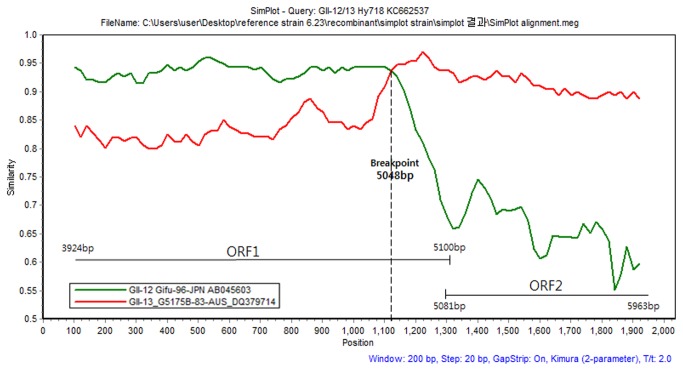
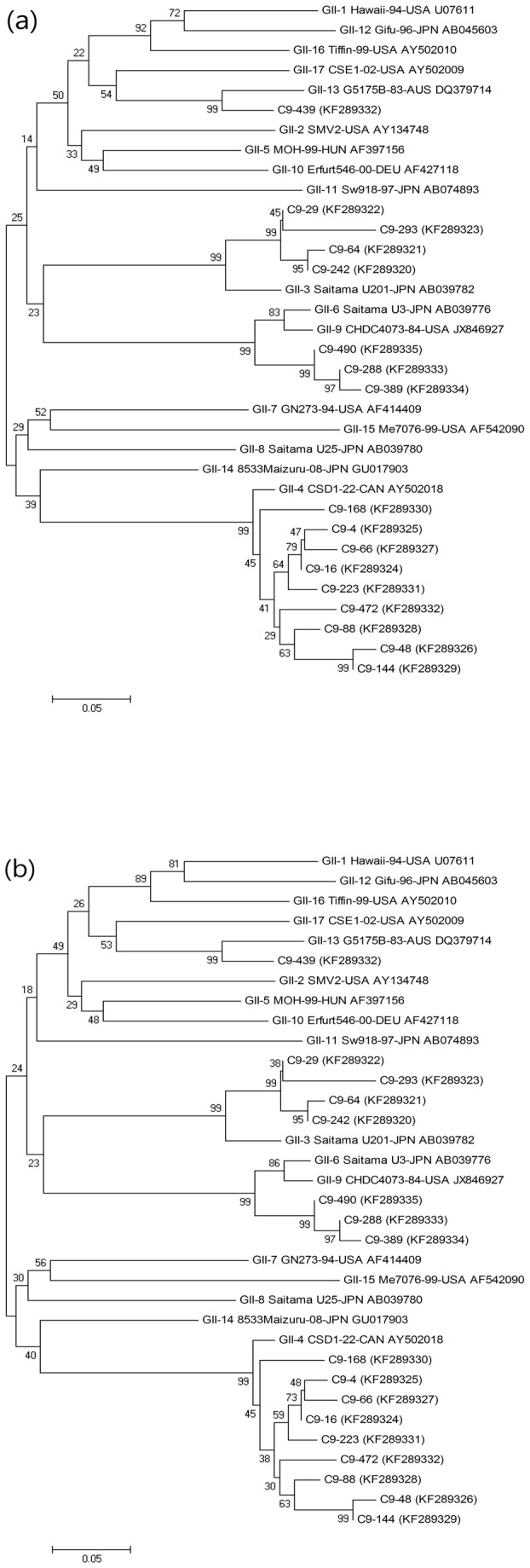
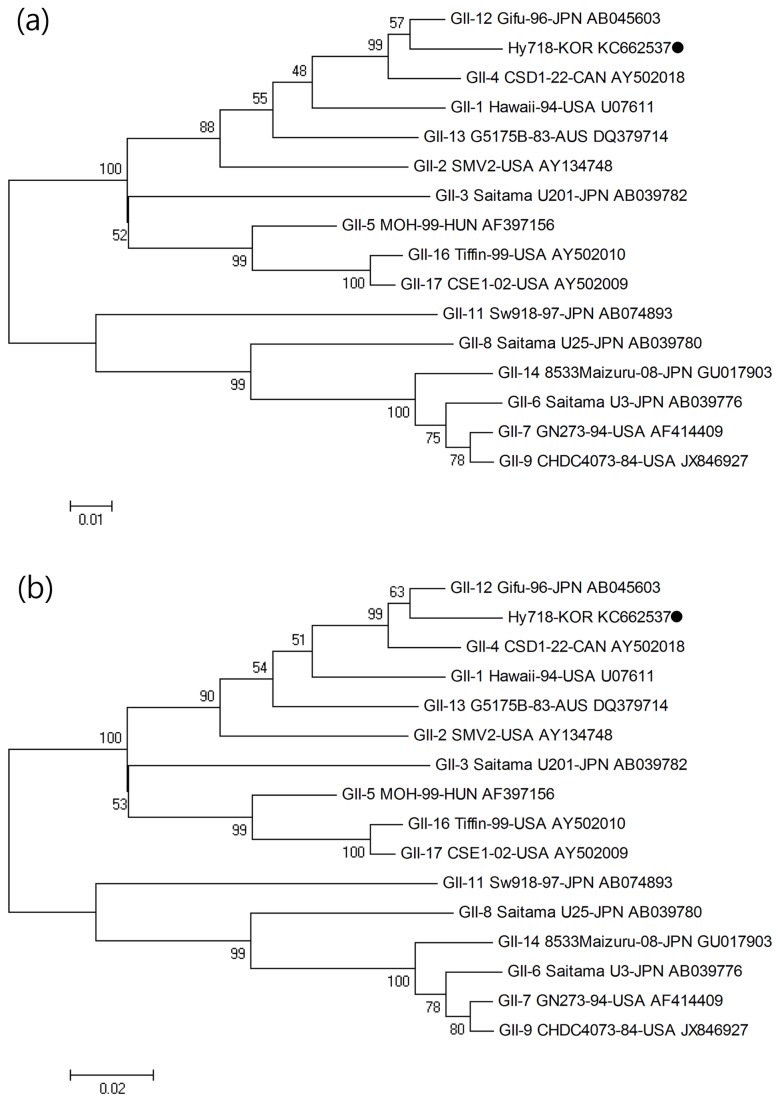
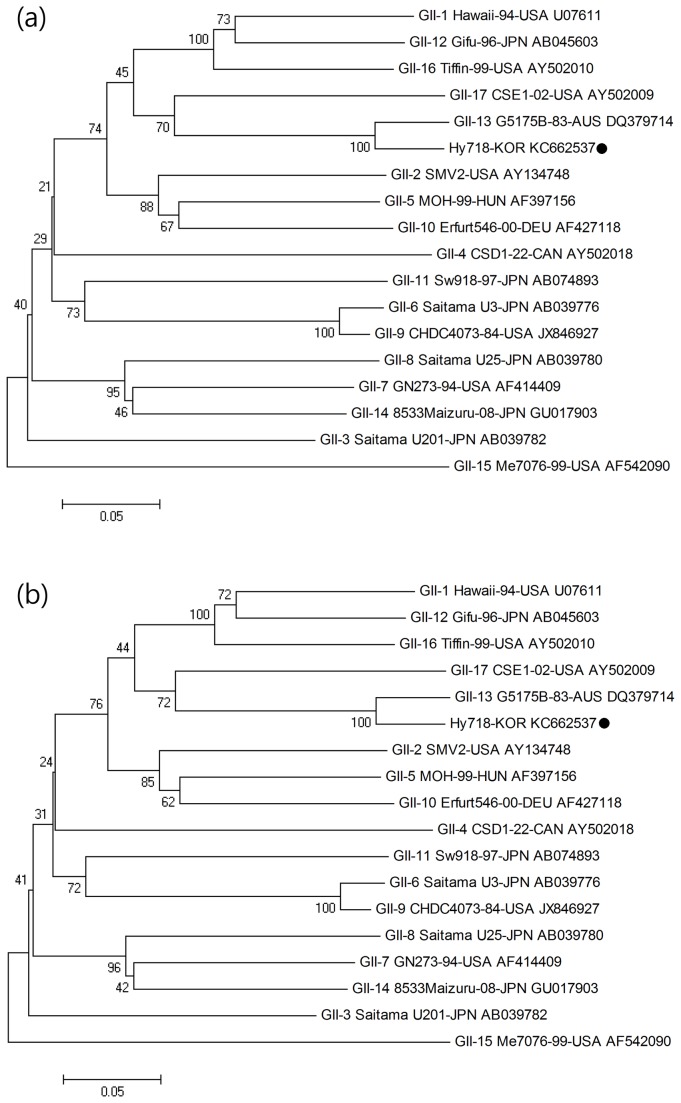
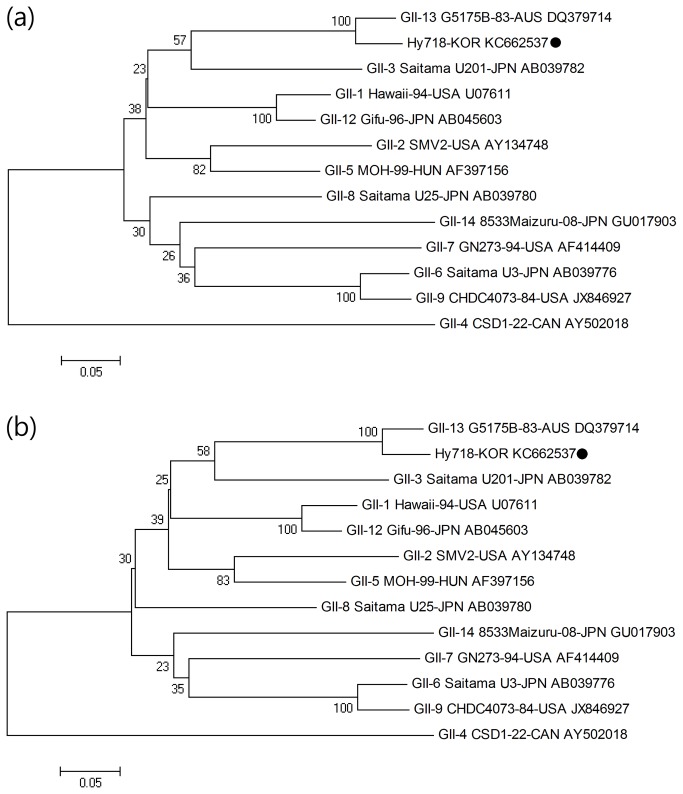
Norovirus (NoV) genogroups I and II are frequently recognized as the main causes of acute gastroenteritis and outbreaks of non-bacterial foodborne diseases. Furthermore, variants and recombinant strains of this virus are continuously emerging worldwide. The aim of this study was to identify NoV strains and to investigate and characterize rare genotypes. Stool samples (n = 500) were collected from patients with symptoms of acute gastroenteritis in Korea between December 2004 and November 2007. For analysis of the samples, rapid genotype screening was performed using reverse transcriptase-polymerase chain reaction. Full sequencing, using a newly designed set of 12 primers, revealed GII-12/13 strain. The partial sequence of GII-12/13 strain was compared with published NoV (GII-1 - 14) sequences targeting RdRp and capsid regions using phylogenetic analysis with the SimPlot program, which could evaluate recombination breakpoints. SimPlot analysis was also performed with the strain GII-12/Gifu-96/JPN (AB045603) for the RdRp region and with GII-13/G5175B-83/AUS(DQ379714) for the capsid region. NoV was detected in 19 of the 500 stool samples (3.8%). Genogroup GII-4 was found most frequently (n = 9, 1.8%), followed by GII-3 (n = 4, 0.8%), GII-6 (n = 3, 0.6%), GI-6 (n = 2, 0.4%), and GII-12/13 (n = 1, 0.2%). Importantly, we identified a novel NoV recombinant strain, C9-439 (KF289337), indicating potential risks, which suggested that, recombination occurred in the region between open reading frames 1 and 2 of the GII-12/13 strain and that breakpoints occurred in the polymerase region.
诺如病毒(NoV)基因组 I 和 II 通常被认为是急性肠胃炎和非细菌性食源性疾病暴发的主要原因。此外,该病毒的变异体和重组株在全球范围内不断出现。本研究旨在鉴定 NoV 株,并调查和表征罕见基因型。2004 年 12 月至 2007 年 11 月,从韩国患有急性肠胃炎症状的患者中采集了 500 份粪便样本。使用逆转录聚合酶链反应(RT-PCR)进行快速基因型筛选分析样本。使用新设计的 12 对引物进行全长测序,揭示了 GII-12/13 株。使用 SimPlot 程序对 GII-12/13 株的 RdRp 和衣壳区部分序列与已发表的 NoV(GII-1-14)序列进行了基于系统进化的比较分析,该程序可以评估重组断点。还对 GII-12/Gifu-96/JPN(AB045603)的 RdRp 区和 GII-13/G5175B-83/AUS(DQ379714)的衣壳区的 GII-12/13 株进行了 SimPlot 分析。在 500 份粪便样本中检测到 19 份(3.8%)NoV。最常发现的是基因组 GII-4(n = 9,1.8%),其次是 GII-3(n = 4,0.8%)、GII-6(n = 3,0.6%)、GI-6(n = 2,0.4%)和 GII-12/13(n = 1,0.2%)。重要的是,我们鉴定了一种新的 NoV 重组株 C9-439(KF289337),提示存在潜在风险,这表明重组发生在 GII-12/13 株的开放阅读框 1 和 2 之间的区域,并且在聚合酶区域发生了断点。