Xiamen Center for Disease Control and Prevention, Xiamen, Fujian Province, China.
PLoS One. 2013 May 8;8(5):e63327. doi: 10.1371/journal.pone.0063327. Print 2013.
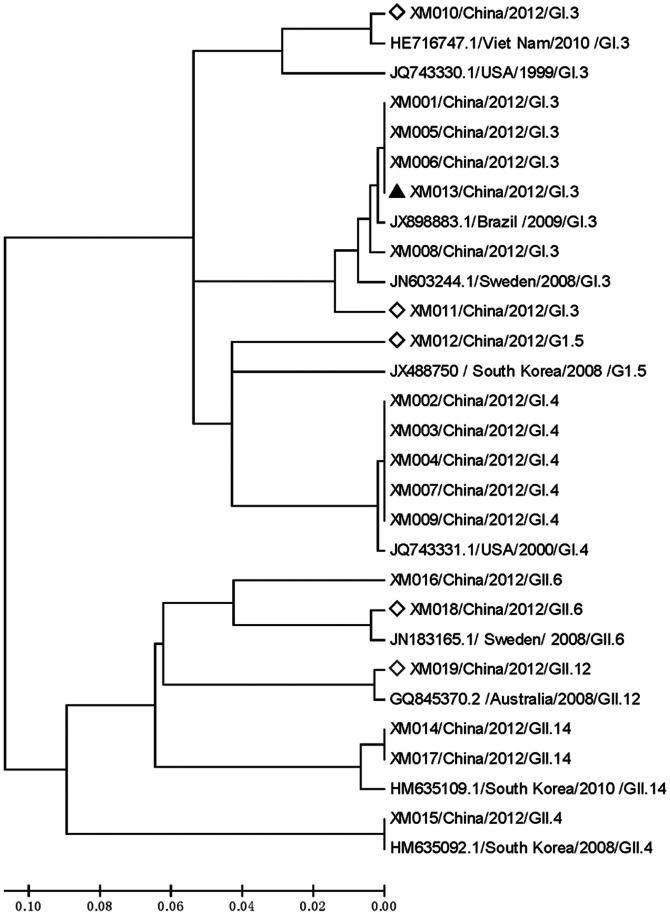
Noroviruses (NoV) have been recognized as an important pathogen associated with acute gastroenteritis worldwide during the past three decades. In the spring of 2012, a series of foodborne outbreaks in tourist groups were reported to Xiamen Center for Disease Control and Prevention, Xiamen, Fujian province, China. Among a total of 268 tourists in 7 groups, the prevalence rate of acute gastroenteritis was 16.0% (43/268). Twenty-three feces or anal swabs were collected for laboratory tests of causative agents, no bacterial pathogen was identified, while 22 of them were positive for NoV RNA. In addition, thirteen NoV fragments were recovered from positive specimens and sequenced, belonging to five genotypes such as GI.3, GI.4, GII.4, GII.6, and GII.14, respectively. However, NoV fragments obtained from locally infected patients showed distinct genotypes. Therefore, epidemiological investigation and laboratory analyses demonstrated that the serial foodborne NoV outbreaks in tourists were co-infection of multiple genotypes induced acute gastroenteritis linked to a restaurant.
诺如病毒(NoV)在过去三十年中已被确认为与全球急性肠胃炎相关的重要病原体。2012 年春季,中国福建省厦门市疾病预防控制中心接到了一系列旅游团食源性暴发事件的报告。在总共 7 个组的 268 名游客中,急性肠胃炎的患病率为 16.0%(43/268)。采集了 23 份粪便或肛拭子进行病原体的实验室检测,未鉴定出细菌病原体,而其中 22 份 NoV RNA 呈阳性。此外,从阳性标本中回收了 13 个 NoV 片段并进行测序,分别属于 GI.3、GI.4、GII.4、GII.6 和 GII.14 等 5 种基因型。然而,从本地感染患者中获得的 NoV 片段显示出明显不同的基因型。因此,流行病学调查和实验室分析表明,游客中的一系列食源性诺如病毒暴发是由餐厅引起的多种基因型共同感染导致的急性肠胃炎。