Department of Cancer Studies and Molecular Medicine, University of Leicester, Leicester Royal Infirmary , Leicester, United Kingdom.
Anal Chem. 2014 Feb 18;86(4):1972-9. doi: 10.1021/ac403901t. Epub 2014 Jan 27.
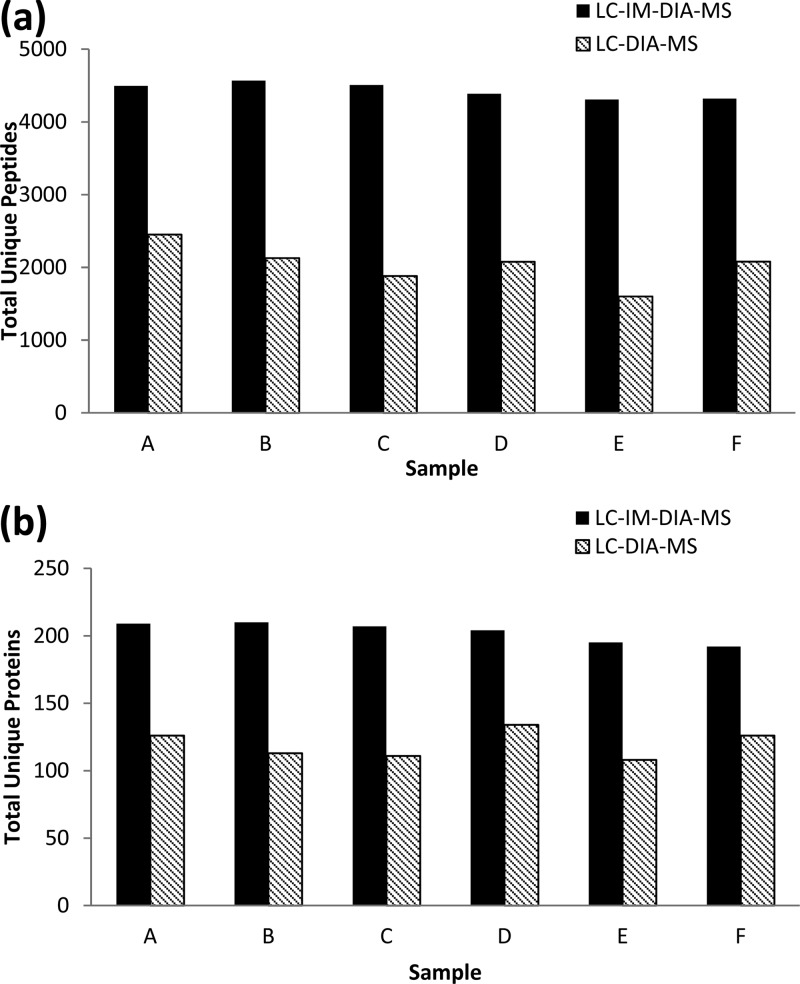
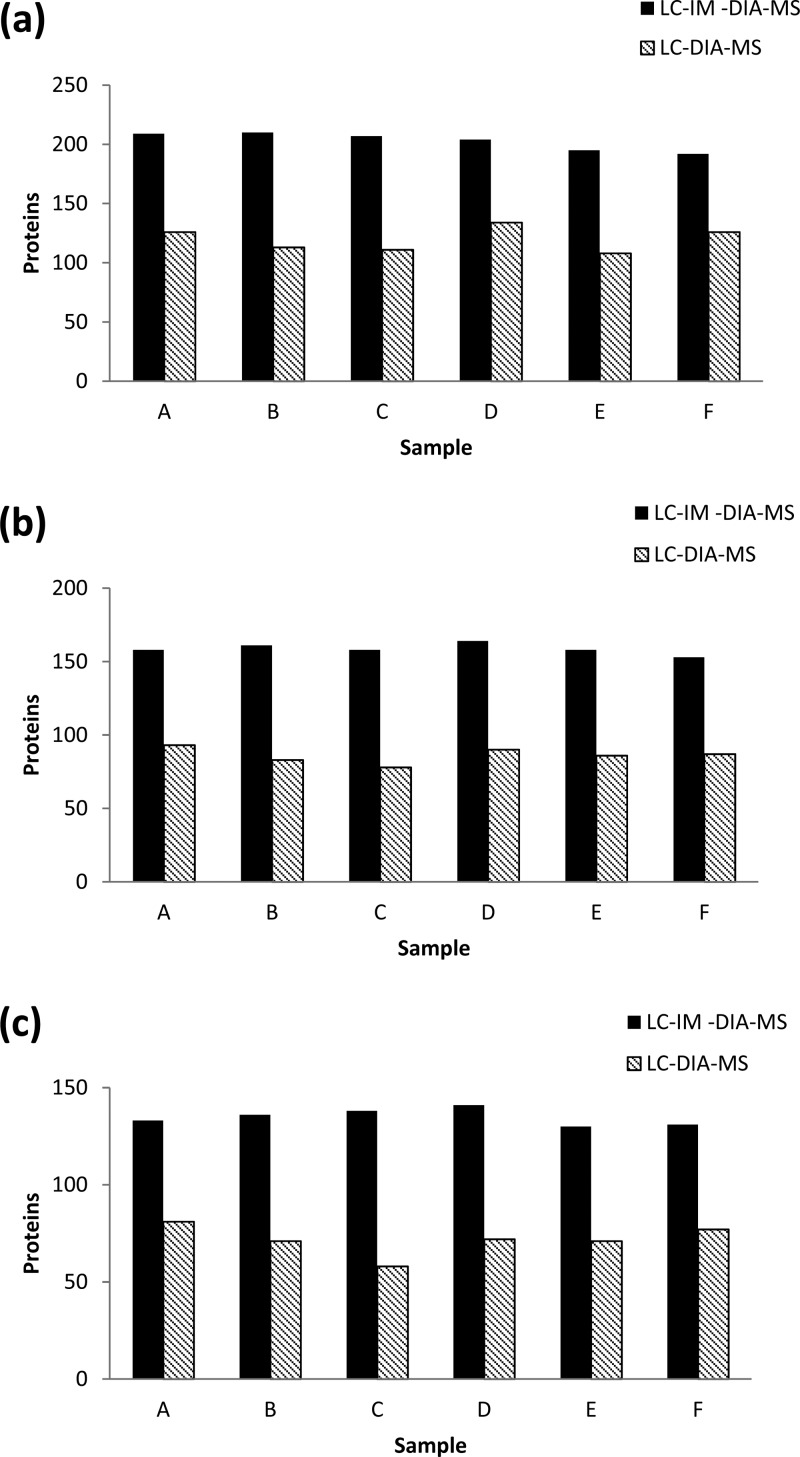
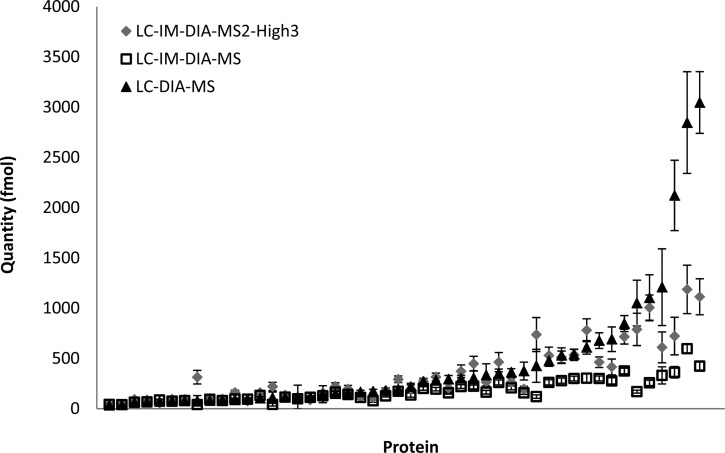
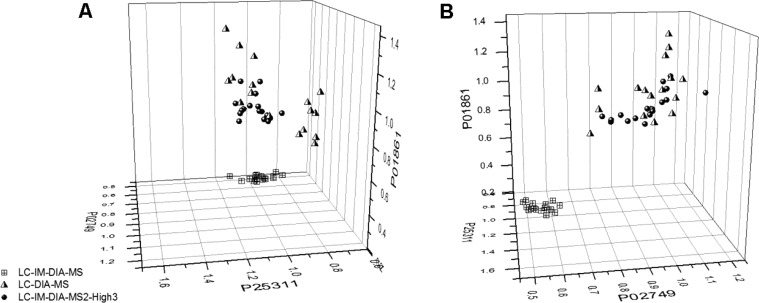
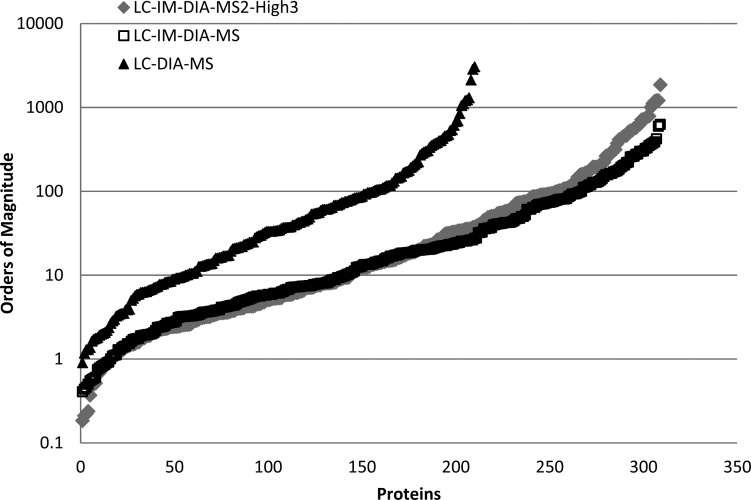
Discovery of protein biomarkers in clinical samples necessitates significant prefractionation prior to liquid chromatography-mass spectrometry (LC-MS) analysis. Integrating traveling wave ion mobility spectrometry (TWIMS) enables in-line gas phase separation which when coupled with nanoflow liquid chromatography and data independent acquisition tandem mass spectrometry, confers significant advantages to the discovery of protein biomarkers by improving separation and inherent sensitivity. Incorporation of TWIMS leads to a packet of concentrated ions which ultimately provides a significant improvement in sensitivity. As a consequence of ion packeting, when present at high concentrations, accurate quantitation of proteins can be affected due to detector saturation effects. Human plasma was analyzed in triplicate using liquid-chromatography data independent acquisition mass spectrometry (LC-DIA-MS) and using liquid-chromatography ion-mobility data independent acquisition mass spectrometry (LC-IM-DIA-MS). The inclusion of TWIMS was assessed for the effect on sample throughput, data integrity, confidence of protein and peptide identification, and dynamic range. The number of identified proteins is significantly increased by an average of 84% while both the precursor and product mass accuracies are maintained between the modalities. Sample dynamic range is also maintained while quantitation is achieved for all but the most abundant proteins by incorporating a novel data interpretation method that allows accurate quantitation to occur. This additional separation is all achieved within a workflow with no discernible deleterious effect on throughput. Consequently, TWIMS greatly enhances proteome coverage and can be reliably used for quantification when using an alternative product ion quantification strategy. Using TWIMS in biomarker discovery in human plasma is thus recommended.
在进行液相色谱-质谱(LC-MS)分析之前,需要对临床样本中的蛋白质生物标志物进行大量的预分级。集成 traveling wave ion mobility spectrometry(TWIMS)可以实现在线气相分离,当与纳流液相色谱和数据非依赖性采集串联质谱相结合时,通过改善分离和固有灵敏度,TWIMS 为蛋白质生物标志物的发现带来了显著优势。TWIMS 的采用会导致离子包的形成,从而最终显著提高灵敏度。由于离子包的形成,如果存在高浓度的离子,可能会由于检测器饱和效应而影响蛋白质的准确定量。使用液相色谱数据非依赖性采集质谱(LC-DIA-MS)和液相色谱离子淌度数据非依赖性采集质谱(LC-IM-DIA-MS)对人类血浆进行了三重分析。评估了 TWIMS 对样品通量、数据完整性、蛋白质和肽鉴定的置信度以及动态范围的影响。通过 TWIMS 的采用,平均可将鉴定到的蛋白质数量增加 84%,而两种模式下的前体和产物质量精度都得以保持。通过采用一种新的数据解释方法,在可实现定量的情况下,也保持了样品动态范围,即使对于最丰富的蛋白质,也可以实现定量。所有这些额外的分离都是在一个工作流程中实现的,对通量没有明显的不利影响。因此,TWIMS 极大地提高了蛋白质组的覆盖率,并且当使用替代的产物离子定量策略时,可以可靠地用于定量。因此,建议在人类血浆的生物标志物发现中使用 TWIMS。