Department of Chemical and Biomolecular Engineering, University of California, Los Angeles, 420 Westwood Plaza, Los Angeles, CA 90095 (USA).
Chembiochem. 2014 Jan 24;15(2):233-42. doi: 10.1002/cbic.201300687. Epub 2014 Jan 7.
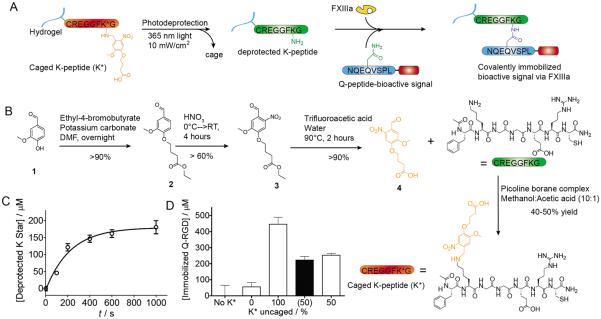
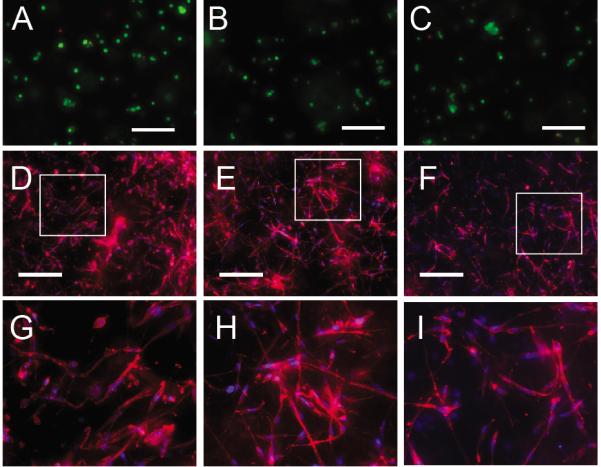
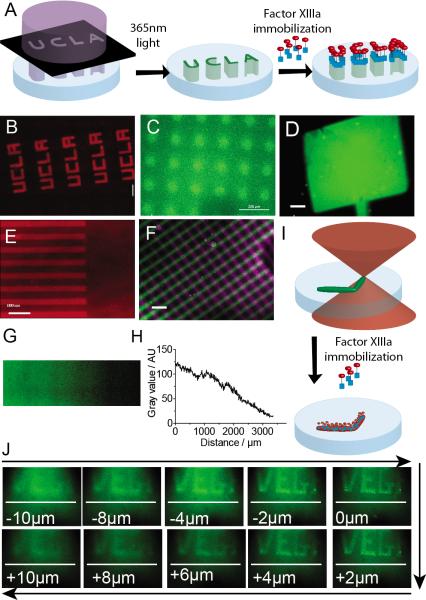
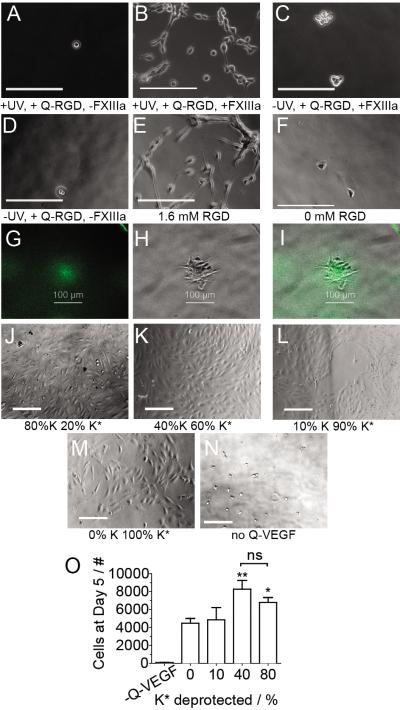
The ability to design artificial extracellular matrices as cell-instructive scaffolds has opened the door to technologies capable of studying the fate of cells in vitro and to guiding tissue repair in vivo. One main component of the design of artificial extracellular matrices is the incorporation of biochemical cues to guide cell phenotype and multicellular organization. The extracellular matrix (ECM) is composed of a heterogeneous mixture of proteins that present a variety of spatially discrete signals to residing cell populations. In contrast, most engineered ECMs do not mimic this heterogeneity. In recent years, photo-deprotection has been used to spatially immobilize signals. However, this approach has been limited mostly to small peptides. Here we combine photo-deprotection with enzymatic reaction to achieve spatially controlled immobilization of active bioactive signals that range from small molecules to large proteins. A peptide substrate for transglutaminase factor XIII (FXIIIa) was caged with a photo-deprotectable group, which was then immobilized to the bulk of a cell-compatible hydrogel. With focused light, the substrate can be deprotected and used to immobilize patterned bioactive signals. This approach offers an innovative strategy to immobilize delicate bioactive signals, such as growth factors, without loss of activity and enables in situ cell manipulation of encapsulated cells.
设计人工细胞外基质作为细胞指导性支架的能力为研究细胞在体外命运和指导体内组织修复的技术打开了大门。人工细胞外基质设计的一个主要组成部分是掺入生物化学线索来指导细胞表型和多细胞组织。细胞外基质 (ECM) 由多种蛋白质组成,这些蛋白质向居住的细胞群体呈现出各种空间离散的信号。相比之下,大多数工程 ECM 并不模仿这种异质性。近年来,光去保护已被用于空间固定信号。然而,这种方法主要局限于小肽。在这里,我们将光去保护与酶反应结合起来,以实现从小分子到大蛋白的活性生物活性信号的空间控制固定。转谷氨酰胺酶因子 XIII (FXIIIa) 的肽底物被带有光去保护基团的笼状化,然后固定在细胞相容水凝胶的主体上。通过聚焦光,可以对底物进行去保护,并用于固定图案化的生物活性信号。这种方法为固定脆弱的生物活性信号(如生长因子)提供了一种创新策略,而不会损失其活性,并能够对封装细胞进行原位细胞操作。