Department of Anthropology, University of British Columbia, 6303 NW Marine Drive, Vancouver, BC, Canada.
Implement Sci. 2014 Jan 8;9:6. doi: 10.1186/1748-5908-9-6.
Despite considerable efforts, engaging staff to lead quality improvement activities in practice settings is a persistent challenge. At British Columbia Children's Hospital (BCCH), the pediatric intensive care unit (PICU) undertook a new phase of quality improvement actions based on the Community of Practice (CoP) model with Participatory Action Research (PAR). This approach aims to mobilize the PICU 'community' as a whole with a focus on practice; namely, to create a 'community of practice' to support reflection, learning, and innovation in everyday work.
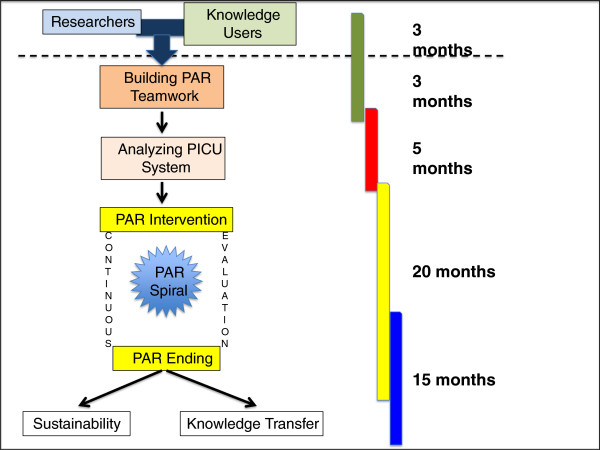
An iterative two-stage PAR process using mixed methods has been developed among the PICU CoP to describe the environment (stage 1) and implement specific interventions (stage 2). Stage 1 is ethnographic description of the unit's care practice. Surveys, interviews, focus groups, and direct observations describe the clinical staff's experiences and perspectives around bedside care and quality endeavors in the PICU. Contrasts and comparisons across participants, time and activities help understanding the PICU culture and experience. Stage 2 is a succession of PAR spirals, using results from phase 1 to set up specific interventions aimed at building the staff's capability to conduct QI projects while acquiring appropriate technical skills and leadership capacity (primary outcome). Team communication, information, and interaction will be enhanced through a knowledge exchange (KE) and a wireless network of iPADs.
Lack of leadership at the staff level in order to improve daily practice is a recognized challenge that faces many hospitals. We believe that the PAR approach within a highly motivated CoP is a sound method to create the social dynamic and cultural context within which clinical teams can grow, reflect, innovate and feel proud to better serve patients.
尽管付出了相当大的努力,让员工在实践环境中领导质量改进活动仍然是一个持续存在的挑战。在不列颠哥伦比亚省儿童医院(BCCH),儿科重症监护病房(PICU)采用了基于实践社区(CoP)模型和参与式行动研究(PAR)的新质量改进阶段。这种方法旨在动员整个 PICU“社区”,重点关注实践,即创建一个“实践社区”,以支持日常工作中的反思、学习和创新。
在 PICU CoP 中已经开发了一种迭代的两阶段 PAR 过程,采用混合方法来描述环境(第 1 阶段)和实施具体干预措施(第 2 阶段)。第 1 阶段是对单位护理实践的民族志描述。调查、访谈、焦点小组和直接观察描述了临床工作人员在 PICU 床边护理和质量工作方面的经验和观点。参与者、时间和活动之间的对比和比较有助于理解 PICU 文化和体验。第 2 阶段是一系列 PAR 螺旋,利用第 1 阶段的结果来制定具体干预措施,旨在建立员工进行质量改进项目的能力,同时获得适当的技术技能和领导能力(主要结果)。通过知识交流(KE)和 iPad 无线网络,将增强团队沟通、信息和互动。
缺乏基层员工领导能力以改善日常实践是许多医院面临的公认挑战。我们相信,在高度积极的 CoP 中,PAR 方法是一种合理的方法,可以创造出社会动态和文化背景,使临床团队能够成长、反思、创新,并为更好地为患者服务而感到自豪。