Department of General and Transplant Surgery, University Hospital of Heidelberg, Heidelberg, Germany; Department of Surgery, Graduate School of Medicine, Kyoto University, Kyoto, Japan.
Cancer Med. 2013 Dec;2(6):862-71. doi: 10.1002/cam4.150. Epub 2013 Oct 22.
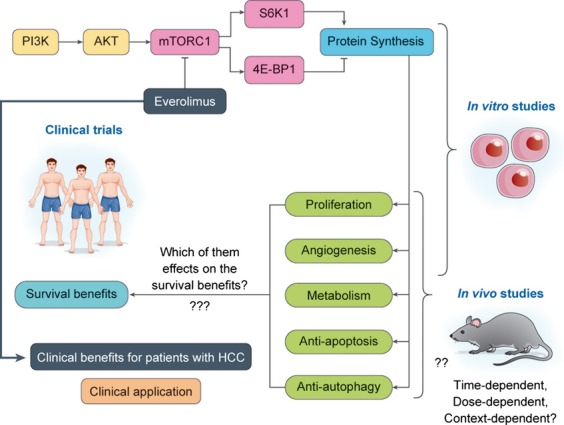
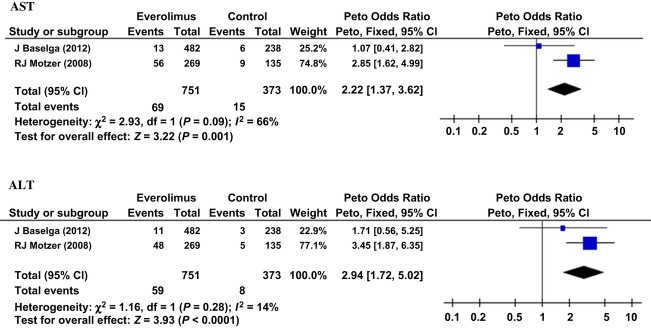
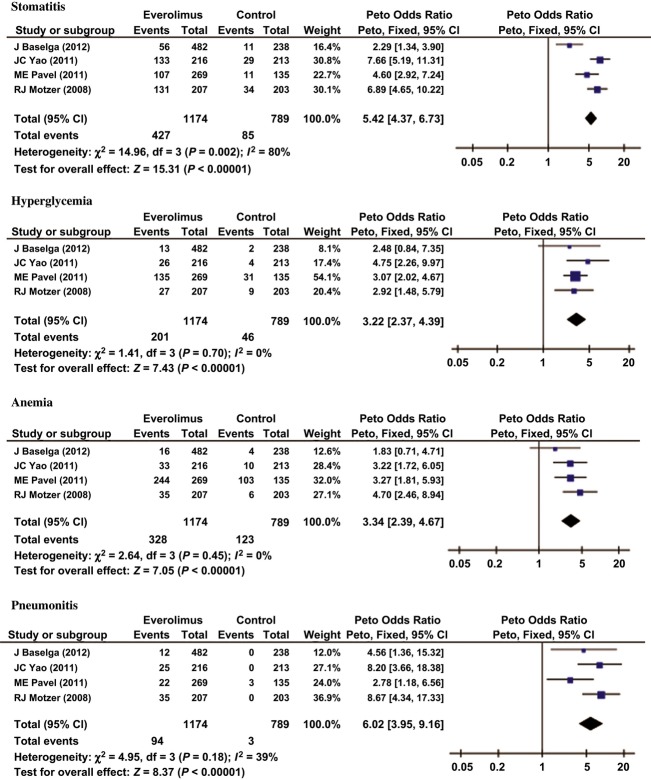
Everolimus is an orally administrated mammalian target of rapamycin (mTOR) inhibitor. Several large-scale randomized controlled trials (RCTs) have demonstrated the survival benefits of everolimus at the dose of 10 mg/day for solid cancers. Furthermore, mTOR-inhibitor-based immunosuppression is associated with survival benefits for patients with hepatocellular carcinoma (HCC) who have received liver transplantation. However, a low rate of tumor reduction and some adverse events have been pointed out. This review summarizes the antitumor effects and adverse events of everolimus and evaluates its possible application in advanced HCC. For the meta-analysis of adverse events, we used the RCTs for solid cancers. The odds ratios of adverse events were calculated using the Peto method. Manypreclinical studies demonstrated that everolimus had antitumor effects such as antiproliferation and antiangiogenesis. However, some differences in the effects were observed among in vivo animal studies for HCC treatment. Meanwhile, clinical studies demonstrated that the response rate of single-agent everolimus was low, though survival benefits could be expected. The meta-analysis revealed the odds ratios (95% confidence interval [CI]) of stomatitis: 5.42 [4.31-6.73], hyperglycemia: 3.22 [2.37-4.39], anemia: 3.34 [2.37-4.67], pneumonitis: 6.02 [3.95-9.16], aspartate aminotransferase levels: 2.22 [1.37-3.62], and serum alanine aminotransferase levels: 2.94 [1.72-5.02], respectively. Everolimus at the dose of 10 mg/day significantly increased the risk of the adverse events. In order to enable its application to the standard conventional therapies of HCC, further studies are required to enhance the antitumor effects and manage the adverse events of everolimus.
依维莫司是一种口服哺乳动物雷帕霉素靶蛋白(mTOR)抑制剂。几项大型随机对照试验(RCT)表明,依维莫司每天 10mg 的剂量可使实体瘤患者获益。此外,基于 mTOR 抑制剂的免疫抑制与接受肝移植的肝细胞癌(HCC)患者的生存获益相关。然而,其肿瘤缩小率较低且存在一些不良反应。本综述总结了依维莫司的抗肿瘤作用和不良反应,并评估了其在晚期 HCC 中的可能应用。对于不良反应的荟萃分析,我们使用了实体瘤的 RCT。使用 Peto 方法计算不良反应的比值比。许多临床前研究表明,依维莫司具有抗肿瘤作用,如抗增殖和抗血管生成。然而,在 HCC 治疗的体内动物研究中观察到了一些效果差异。同时,临床研究表明,单药依维莫司的缓解率较低,但可预期生存获益。荟萃分析显示,不良反应的比值比(95%置信区间[CI])为:口腔炎:5.42 [4.31-6.73],高血糖:3.22 [2.37-4.39],贫血:3.34 [2.37-4.67],肺炎:6.02 [3.95-9.16],天门冬氨酸氨基转移酶水平:2.22 [1.37-3.62]和血清丙氨酸氨基转移酶水平:2.94 [1.72-5.02]。依维莫司每天 10mg 的剂量显著增加了不良反应的风险。为了使依维莫司能够应用于 HCC 的标准常规疗法,需要进一步研究以增强其抗肿瘤作用并管理依维莫司的不良反应。