Key Laboratory of Carcinogenesis and Translational Research (Ministry of Education), Departments of Biochemistry and Molecular Biology, Peking University Cancer Hospital & Institute, Beijing, China.
Key Laboratory of Carcinogenesis and Translational Research (Ministry of Education), Departments of Epidemiology, Peking University Cancer Hospital & Institute, Beijing, China.
PLoS One. 2014 Jan 3;9(1):e85187. doi: 10.1371/journal.pone.0085187. eCollection 2014.
Tumor necrosis factor-alpha (TNF-a) was related to inflammation and involved in the development of colorectal cancer. Polymorphisms located in TNF-a promoter region, such as 308G/A and 238G/A, could affect the risk of various types of cancer by regulating TNF-a production. In this study, a meta-analysis was performed to investigate the association between common polymorphisms of TNF-a promoter region and colorectal cancer susceptibility.
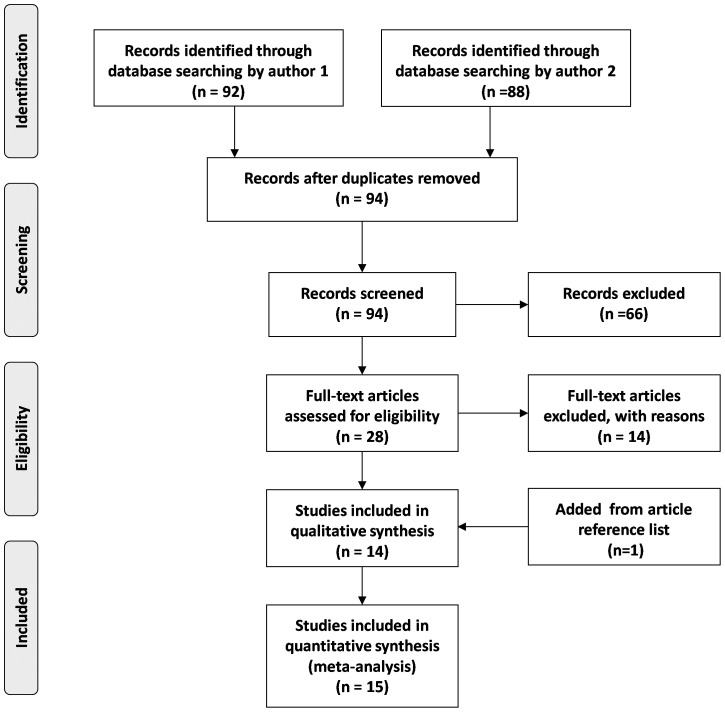
Searching of several databases was performed for all publications on the association between TNF-a polymorphisms and colorectal cancer. Summary odds ratios (ORs) with their 95% confidence intervals (95% CIs) were calculated using random-effects models. Stratified analyses based on ethnicity and control population source were also conducted.
Overall, TNF-a 308A polymorphism showed a significant association with increased risk of colorectal cancer in worldwide populations under homozygote comparison [AA vs. GG, OR (95% CI) = 1.46 (1.07-1.97)] other than heterozygote comparison [AG vs. GG, OR (95% CI) = 1.05 (0.93-1.19)]. TNF-a 238A was not associated with colorectal cancer risk under homozygote or heterozygote comparisons. In stratified analysis, significant association was observed only in Western populations [AA vs. GG, OR (95% CI) = 1.39 (1.01-1.91)] other than in Eastern populations under homozygote comparison. No significant difference was observed between population-based subgroup and hospital-based subgroup.
TNF-a 308A was moderately associated with an increased risk of colorectal cancer in Western populations, and TNF-a 238A polymorphism was not significantly associated with colorectal cancer risk.
肿瘤坏死因子-α(TNF-α)与炎症有关,参与结直肠癌的发生。TNF-α启动子区域的多态性,如 308G/A 和 238G/A,通过调节 TNF-α的产生,可能会影响各种类型癌症的风险。本研究进行了一项荟萃分析,以探讨 TNF-α启动子区域常见多态性与结直肠癌易感性的关系。
对 TNF-α多态性与结直肠癌相关性的所有研究进行了多个数据库的检索。采用随机效应模型计算汇总比值比(OR)及其 95%置信区间(95%CI)。还根据种族和对照人群来源进行了分层分析。
总体而言,TNF-α 308A 多态性在全世界人群中,与杂合子比较[AG 与 GG,OR(95%CI)=1.05(0.93-1.19)]相比,纯合子比较[AA 与 GG,OR(95%CI)=1.46(1.07-1.97)],与结直肠癌风险增加显著相关。TNF-α 238A 多态性在杂合子或纯合子比较中均与结直肠癌风险无关。在分层分析中,仅在西方人群中观察到显著相关性[AA 与 GG,OR(95%CI)=1.39(1.01-1.91)],而在东方人群中纯合子比较则无显著相关性。基于人群的亚组与基于医院的亚组之间无显著差异。
TNF-α 308A 与西方人群结直肠癌风险增加中度相关,TNF-α 238A 多态性与结直肠癌风险无显著相关性。