Bhandari Gajananda Prakash, Angdembe Mirak Raj, Dhimal Meghnath, Neupane Sushma, Bhusal Choplal
Nepal Public Health Foundation, 102/2 Dhara Marg, Maharajgunj, P,O, Box: 11218, Kathmandu-4, Nepal.
BMC Public Health. 2014 Jan 10;14:23. doi: 10.1186/1471-2458-14-23.
The prevalence of Non Communicable Diseases (NCDs) is still unknown in Nepal. The Ministry of Health and Population, Government of Nepal has not yet formulated policy regarding NCDs in the absence of evidence based finding. The study aims to find out the hospital based prevalence of NCDs in Nepal, thus directing the concerned authorities at policy level.
A cross sectional study was conducted to identify the hospital based prevalence of 4 NCDs (cancer, cardiovascular disease, diabetes mellitus and chronic obstructive pulmonary disease), wherein 400 indoor patients admitted during 2009 were randomly selected from each of the 31 selected health institutions which included all non-specialist tertiary level hospitals outside the Kathmandu valley (n = 25), all specialist tertiary level hospitals in the country (n = 3) and 3 non-specialist tertiary level hospitals inside the Kathmandu valley. In case of Kathmandu valley, 3 non-specialist health institutions- one central hospital, one medical college and one private hospital were randomly selected. The main analyses are based on the 28 non-specialist hospitals. Univariate (frequency and percentage) and bivariate (cross-tabulation) analysis were used.
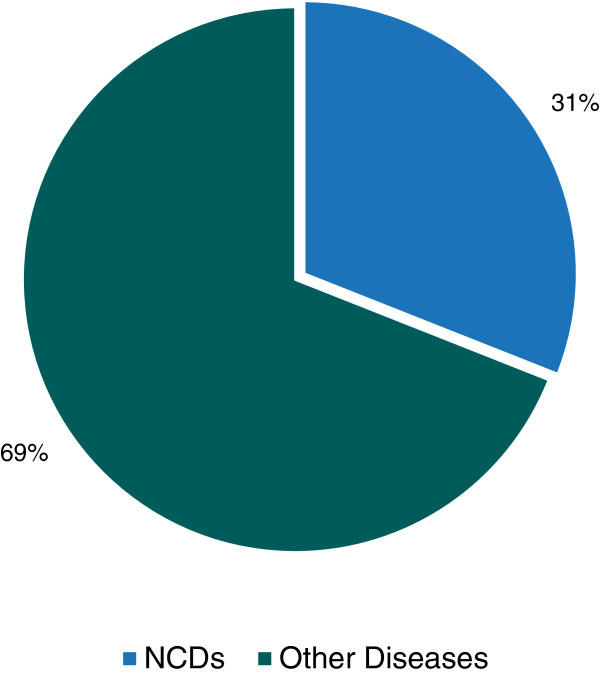
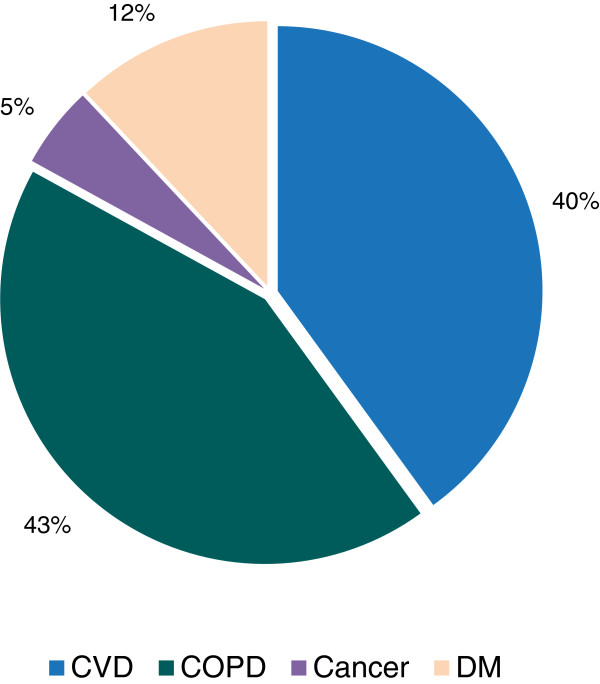
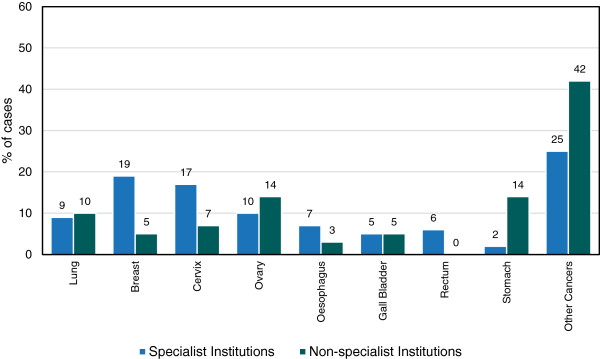
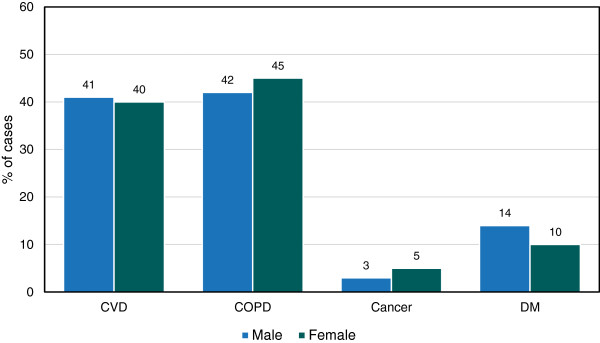
In non-specialist institutions, the hospital based NCD prevalence was 31%. Chronic obstructive pulmonary disease (43%) was the most common NCD followed by cardiovascular disease (40%), diabetes mellitus (12%) and cancer (5%). Ovarian (14%), stomach (14%) and lung cancer (10%) were the main cancers accounting for 38% of distribution. Majority of CVD cases were hypertension (47%) followed by cerebrovascular accident (16%), congestive cardiac failure (11%), ischemic heart disease (7%), rheumatic heart disease (5%) and myocardial infarction (2%). CVD was common in younger age groups while COPD in older age groups. Majority among males (42%) and females (45%) were suffering from COPD.
The study was able to reveal that Nepal is also facing the surging burden of NCDs similar to other developing nations in South East Asia. Furthermore, the study has provided a background data on NCDs in Nepal which should prove useful for the concerned organizations to focus and contribute towards the prevention, control and reduction of NCD burden and its risk factors.
尼泊尔非传染性疾病(NCDs)的患病率仍然未知。尼泊尔卫生与人口部在缺乏循证研究结果的情况下,尚未制定有关非传染性疾病的政策。本研究旨在查明尼泊尔以医院为基础的非传染性疾病患病率,从而为政策层面的相关当局提供指导。
开展了一项横断面研究,以确定4种非传染性疾病(癌症、心血管疾病、糖尿病和慢性阻塞性肺疾病)在医院中的患病率,从31家选定的卫生机构中,随机选取2009年期间收治的400名住院患者,这些机构包括加德满都谷地以外的所有非专科三级医院(n = 25)、该国所有专科三级医院(n = 3)以及加德满都谷地内的3家非专科三级医院。在加德满都谷地,随机选取了3家非专科卫生机构——一家中心医院、一家医学院和一家私立医院。主要分析基于28家非专科医院。采用单变量(频率和百分比)和双变量(交叉表)分析。
在非专科机构中,以医院为基础的非传染性疾病患病率为31%。慢性阻塞性肺疾病(43%)是最常见的非传染性疾病,其次是心血管疾病(40%)、糖尿病(12%)和癌症(5%)。卵巢癌(14%)、胃癌(14%)和肺癌(10%)是主要癌症类型,占分布的38%。大多数心血管疾病病例为高血压(47%),其次是脑血管意外(16%)、充血性心力衰竭(11%)、缺血性心脏病(7%)、风湿性心脏病(5%)和心肌梗死(2%)。心血管疾病在较年轻年龄组中常见,而慢性阻塞性肺疾病在较年长年龄组中常见。男性(42%)和女性(45%)中大多数患有慢性阻塞性肺疾病。
该研究能够揭示,尼泊尔也面临着与东南亚其他发展中国家类似的非传染性疾病负担激增的问题。此外,该研究提供了尼泊尔非传染性疾病的背景数据,这对于相关组织集中精力并为预防、控制和减轻非传染性疾病负担及其危险因素做出贡献应是有用的。