• 文献检索
  • 文档翻译
  • 深度研究
  • 学术资讯
  • Suppr Zotero 插件Zotero 插件
  • 邀请有礼
  • 套餐&价格
  • 历史记录
应用&插件
Suppr Zotero 插件Zotero 插件浏览器插件Mac 客户端Windows 客户端微信小程序
定价
高级版会员购买积分包购买API积分包
服务
文献检索文档翻译深度研究API 文档MCP 服务
关于我们
关于 Suppr公司介绍联系我们用户协议隐私条款
关注我们

Suppr 超能文献

核心技术专利:CN118964589B侵权必究
粤ICP备2023148730 号-1Suppr @ 2026

文献检索

告别复杂PubMed语法,用中文像聊天一样搜索,搜遍4000万医学文献。AI智能推荐,让科研检索更轻松。

立即免费搜索

文件翻译

保留排版,准确专业,支持PDF/Word/PPT等文件格式,支持 12+语言互译。

免费翻译文档

深度研究

AI帮你快速写综述,25分钟生成高质量综述,智能提取关键信息,辅助科研写作。

立即免费体验

基于网络的癌症症状与生活质量支持干预措施的开发及可用性测试

Development and usability testing of a web-based cancer symptom and quality-of-life support intervention.

作者信息

Wolpin S E, Halpenny B, Whitman G, McReynolds J, Stewart M, Lober W B, Berry D L

机构信息

University of Washington, USA

Dana-Farber Cancer Institute, USA.

出版信息

Health Informatics J. 2015 Mar;21(1):10-23. doi: 10.1177/1460458213495744. Epub 2014 Jan 9.

DOI:10.1177/1460458213495744
PMID:24406906
原文链接:https://pmc.ncbi.nlm.nih.gov/articles/PMC4747103/
Abstract

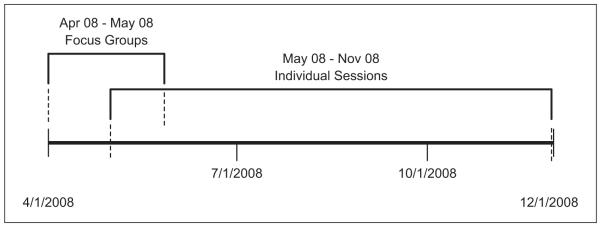
The feasibility and acceptability of computerized screening and patient-reported outcome measures have been demonstrated in the literature. However, patient-centered management of health information entails two challenges: gathering and presenting data using "patient-tailored" methods and supporting "patient-control" of health information. The design and development of many symptom and quality-of-life information systems have not included opportunities for systematically collecting and analyzing user input. As part of a larger clinical trial, the Electronic Self-Report Assessment for Cancer-II project, participatory design approaches were used to build and test new features and interfaces for patient/caregiver users. The research questions centered on patient/caregiver preferences with regard to the following: (a) content, (b) user interface needs, (c) patient-oriented summary, and (d) patient-controlled sharing of information with family, caregivers, and clinicians. Mixed methods were used with an emphasis on qualitative approaches; focus groups and individual usability tests were the primary research methods. Focus group data were content analyzed, while individual usability sessions were assessed with both qualitative and quantitative methods. We identified 12 key patient/caregiver preferences through focus groups with 6 participants. We implemented seven of these preferences during the iterative design process. We deferred development for some of the preferences due to resource constraints. During individual usability testing (n = 8), we were able to identify 65 usability issues ranging from minor user confusion to critical errors that blocked task completion. The participatory development model that we used led to features and design revisions that were patient centered. We are currently evaluating new approaches for the application interface and for future research pathways. We encourage other researchers to adopt user-centered design approaches when building patient-centered technologies.

摘要

计算机化筛查和患者报告结局测量的可行性和可接受性已在文献中得到证实。然而,以患者为中心的健康信息管理面临两个挑战:使用“患者定制”方法收集和呈现数据,以及支持患者对健康信息的“控制”。许多症状和生活质量信息系统的设计和开发并未包含系统收集和分析用户输入的机会。作为一项更大规模临床试验(癌症电子自我报告评估-II项目)的一部分,采用参与式设计方法为患者/护理人员用户构建和测试新功能及界面。研究问题集中在患者/护理人员对以下方面的偏好:(a) 内容,(b) 用户界面需求,(c) 以患者为导向的总结,以及 (d) 与家人、护理人员和临床医生进行患者控制的信息共享。采用了混合方法,重点是定性方法;焦点小组和个体可用性测试是主要研究方法。对焦点小组数据进行了内容分析,而个体可用性测试则采用定性和定量方法进行评估。通过与6名参与者进行焦点小组讨论,我们确定了12项关键的患者/护理人员偏好。在迭代设计过程中,我们实施了其中7项偏好。由于资源限制,我们推迟了部分偏好的开发。在个体可用性测试(n = 8)期间,我们能够识别出65个可用性问题,范围从轻微的用户困惑到阻碍任务完成的严重错误。我们使用的参与式开发模型带来了以患者为中心的功能和设计修订。我们目前正在评估应用界面的新方法以及未来的研究途径。我们鼓励其他研究人员在构建以患者为中心的技术时采用以用户为中心的设计方法。
https://cdn.ncbi.nlm.nih.gov/pmc/blobs/a1cc/4747103/7470a838c117/nihms-755938-f0005.jpg
https://cdn.ncbi.nlm.nih.gov/pmc/blobs/a1cc/4747103/674a1a71d463/nihms-755938-f0001.jpg
https://cdn.ncbi.nlm.nih.gov/pmc/blobs/a1cc/4747103/7550da2a7318/nihms-755938-f0002.jpg
https://cdn.ncbi.nlm.nih.gov/pmc/blobs/a1cc/4747103/bd8aa683fc4e/nihms-755938-f0003.jpg
https://cdn.ncbi.nlm.nih.gov/pmc/blobs/a1cc/4747103/8c66b606a948/nihms-755938-f0004.jpg
https://cdn.ncbi.nlm.nih.gov/pmc/blobs/a1cc/4747103/7470a838c117/nihms-755938-f0005.jpg
https://cdn.ncbi.nlm.nih.gov/pmc/blobs/a1cc/4747103/674a1a71d463/nihms-755938-f0001.jpg
https://cdn.ncbi.nlm.nih.gov/pmc/blobs/a1cc/4747103/7550da2a7318/nihms-755938-f0002.jpg
https://cdn.ncbi.nlm.nih.gov/pmc/blobs/a1cc/4747103/bd8aa683fc4e/nihms-755938-f0003.jpg
https://cdn.ncbi.nlm.nih.gov/pmc/blobs/a1cc/4747103/8c66b606a948/nihms-755938-f0004.jpg
https://cdn.ncbi.nlm.nih.gov/pmc/blobs/a1cc/4747103/7470a838c117/nihms-755938-f0005.jpg

相似文献

1
Development and usability testing of a web-based cancer symptom and quality-of-life support intervention.基于网络的癌症症状与生活质量支持干预措施的开发及可用性测试
Health Informatics J. 2015 Mar;21(1):10-23. doi: 10.1177/1460458213495744. Epub 2014 Jan 9.
2
Development of an integrated e-health tool for people with, or at high risk of, cardiovascular disease: The Consumer Navigation of Electronic Cardiovascular Tools (CONNECT) web application.为心血管疾病患者或高危人群开发综合电子健康工具:电子心血管工具消费者导航(CONNECT)网络应用程序。
Int J Med Inform. 2016 Dec;96:24-37. doi: 10.1016/j.ijmedinf.2016.01.009. Epub 2016 Jan 24.
3
The future of Cochrane Neonatal.考克兰新生儿协作网的未来。
Early Hum Dev. 2020 Nov;150:105191. doi: 10.1016/j.earlhumdev.2020.105191. Epub 2020 Sep 12.
4
Usability testing of an online self-management program for adolescents with juvenile idiopathic arthritis.针对青少年特发性关节炎患者的在线自我管理项目的可用性测试。
J Med Internet Res. 2010 Jul 29;12(3):e30. doi: 10.2196/jmir.1349.
5
A Web-Based Self-Management Support Prototype for Adults With Chronic Kidney Disease (My Kidneys My Health): Co-Design and Usability Testing.一种针对慢性肾脏病成人患者的基于网络的自我管理支持原型(我的肾脏我的健康):协同设计与可用性测试
JMIR Form Res. 2021 Feb 9;5(2):e22220. doi: 10.2196/22220.
6
User-Centered Design of a Web-Based Tool to Support Management of Chemotherapy-Related Toxicities in Cancer Patients.以患者为中心设计基于网络的工具,以支持癌症患者化疗相关毒性的管理。
J Med Internet Res. 2019 Mar 28;21(3):e9958. doi: 10.2196/jmir.9958.
7
A web-based program for informal caregivers of persons with Alzheimer's disease: an iterative user-centered design.一款针对阿尔茨海默病患者非正式照料者的在线程序:以用户为中心的迭代设计。
JMIR Res Protoc. 2014 Sep 15;3(3):e46. doi: 10.2196/resprot.3607.
8
A Web-Based Cancer Self-Management Program (I-Can Manage) Targeting Treatment Toxicities and Health Behaviors: Human-Centered Co-design Approach and Cognitive Think-Aloud Usability Testing.一种针对治疗毒性和健康行为的基于网络的癌症自我管理项目(“我能管理”):以人为本的协同设计方法与认知出声可用性测试
JMIR Cancer. 2023 Jul 21;9:e44914. doi: 10.2196/44914.
9
Adapting an in-person patient-caregiver communication intervention to a tailored web-based format.将面对面的医患沟通干预措施改编为定制的基于网络的格式。
Psychooncology. 2012 Mar;21(3):336-41. doi: 10.1002/pon.1900. Epub 2011 Jan 23.
10
The effectiveness of internet-based e-learning on clinician behavior and patient outcomes: a systematic review protocol.基于互联网的电子学习对临床医生行为和患者结局的有效性:一项系统评价方案。
JBI Database System Rev Implement Rep. 2015 Jan;13(1):52-64. doi: 10.11124/jbisrir-2015-1919.

引用本文的文献

1
Meaningful consumer involvement in cancer care: a systematic review on co-design methods and processes.有意义的消费者参与癌症护理:关于共同设计方法和流程的系统评价。
JNCI Cancer Spectr. 2024 Jul 1;8(4). doi: 10.1093/jncics/pkae048.
2
Usability and feasibility of E-nergEYEze: a blended vision-specific E-health based cognitive behavioral therapy and self-management intervention to reduce fatigue in adults with visual impairment.E-nergEYEze 的可用性和可行性:一种混合的基于视力的特定电子健康的认知行为疗法和自我管理干预,以减少视力障碍成年人的疲劳。
BMC Health Serv Res. 2023 Nov 16;23(1):1271. doi: 10.1186/s12913-023-10193-4.
3

本文引用的文献

1
Combining usability testing with eye-tracking technology: evaluation of a visualization support for antibiotic use in intensive care.将可用性测试与眼动追踪技术相结合:对重症监护中抗生素使用可视化支持的评估。
Stud Health Technol Inform. 2011;169:945-9.
2
A deliberate and rigorous approach to development of patient-centered technologies.以患者为中心的技术开发的深思熟虑和严格的方法。
Semin Oncol Nurs. 2011 Aug;27(3):183-91. doi: 10.1016/j.soncn.2011.04.003.
3
Enhancing patient-provider communication with the electronic self-report assessment for cancer: a randomized trial.
Technology-Based Interventions for Cancer Caregivers: Concept Analysis.
针对癌症护理者的基于技术的干预措施:概念分析
JMIR Cancer. 2021 Nov 16;7(4):e22140. doi: 10.2196/22140.
4
Status and Recommendations of Technological and Data-Driven Innovations in Cancer Care: Focus Group Study.癌症护理中技术和数据驱动创新的现状和建议:焦点小组研究。
J Med Internet Res. 2020 Dec 15;22(12):e22034. doi: 10.2196/22034.
5
Understanding the Experience of Cancer Pain From the Perspective of Patients and Family Caregivers to Inform Design of an In-Home Smart Health System: Multimethod Approach.从患者和家庭护理人员的角度理解癌症疼痛体验,为家庭智能健康系统的设计提供信息:多方法研究。
JMIR Form Res. 2020 Aug 26;4(8):e20836. doi: 10.2196/20836.
6
Listening to the patients: using participatory design in the development of a cardiac telerehabilitation web portal.倾听患者心声:在心脏远程康复门户网站开发中运用参与式设计
Mhealth. 2019 Sep 16;5:33. doi: 10.21037/mhealth.2019.08.06. eCollection 2019.
7
Requirements for an Electronic Health Tool to Support the Process of Help Seeking by Caregivers of Functionally Impaired Older Adults: Co-Design Approach.支持功能受损老年人照顾者寻求帮助过程的电子健康工具要求:协同设计方法
JMIR Aging. 2019 Jun 7;2(1):e12327. doi: 10.2196/12327.
8
Patients and Caregivers Rate the PAINReportIt Wireless Internet-Enabled Tablet as a Method for Reporting Pain During End-of-Life Cancer Care.患者和护理人员将 PAINReportIt 无线互联网平板电脑评为一种在癌症临终关怀期间报告疼痛的方法。
Cancer Nurs. 2020 Sep/Oct;43(5):419-424. doi: 10.1097/NCC.0000000000000743.
9
The Importance of Systematically Reporting and Reflecting on eHealth Development: Participatory Development Process of a Virtual Reality Application for Forensic Mental Health Care.系统报告和反思电子健康发展的重要性:用于法医精神卫生保健的虚拟现实应用程序的参与式开发过程
J Med Internet Res. 2019 Aug 19;21(8):e12972. doi: 10.2196/12972.
10
Usability Challenges for Health and Wellness Mobile Apps: Mixed-Methods Study Among mHealth Experts and Consumers.健康与健身移动应用程序的可用性挑战:移动健康专家和消费者的混合方法研究。
JMIR Mhealth Uhealth. 2019 Jan 30;7(1):e12160. doi: 10.2196/12160.
利用癌症电子自评评估增强医患沟通:一项随机试验。
J Clin Oncol. 2011 Mar 10;29(8):1029-35. doi: 10.1200/JCO.2010.30.3909. Epub 2011 Jan 31.
4
Assessing the acceptability and usability of an interactive serious game in aiding treatment decisions for patients with localized prostate cancer.评估一款交互式严肃游戏在协助局限性前列腺癌患者做出治疗决策方面的可接受性和可用性。
J Med Internet Res. 2011 Jan 12;13(1):e4. doi: 10.2196/jmir.1519.
5
Acceptability of an Electronic Self-Report Assessment Program for patients with cancer.癌症患者对电子自我报告评估程序的可接受性。
Comput Inform Nurs. 2008 Nov-Dec;26(6):332-8. doi: 10.1097/01.NCN.0000336464.79692.6a.
6
The importance of usability testing in the development of an internet-based smoking cessation treatment resource.可用性测试在基于互联网的戒烟治疗资源开发中的重要性。
Nicotine Tob Res. 2006 Dec;8 Suppl 1:S87-93. doi: 10.1080/14622200601048189.
7
Distributed health assessment and intervention research software framework.分布式健康评估与干预研究软件框架
AMIA Annu Symp Proc. 2005;2005:940.
8
Computer and World Wide Web accessibility by visually disabled patients: problems and solutions.视力障碍患者使用计算机和万维网的情况:问题与解决方案。
Surv Ophthalmol. 2005 Jul-Aug;50(4):394-405. doi: 10.1016/j.survophthal.2005.04.004.
9
Computerized symptom and quality-of-life assessment for patients with cancer part II: acceptability and usability.癌症患者的计算机化症状与生活质量评估 第二部分:可接受性与可用性
Oncol Nurs Forum. 2004 Sep 17;31(5):E84-9. doi: 10.1188/04.ONF.E84-E89. Print 2004 Sep.
10
Computerized symptom and quality-of-life assessment for patients with cancer part I: development and pilot testing.癌症患者的计算机化症状与生活质量评估 第一部分:开发与初步测试
Oncol Nurs Forum. 2004 Sep 17;31(5):E75-83. doi: 10.1188/04.ONF.E75-E83. Print 2004 Sep.