Department of Geriatrics, the Second Affiliated Hospital of Harbin Medical University, Harbin, Heilongjiang, China.
Department of Pharmacy, the Fourth Affiliated Hospital of Harbin Medical University, Harbin, Heilongjiang, China.
PLoS One. 2014 Jan 7;9(1):e85570. doi: 10.1371/journal.pone.0085570. eCollection 2014.
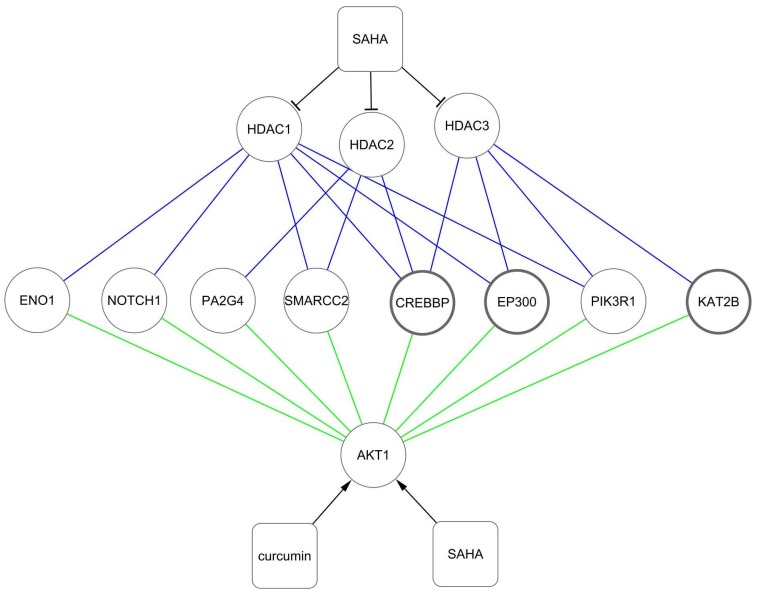
With the trend of an increasing aged population worldwide, Alzheimer's disease (AD), an age-related neurodegenerative disorder, as one of the major causes of dementia in elderly people is of growing concern. Despite the many hard efforts attempted during the past several decades in trying to elucidate the pathological mechanisms underlying AD and putting forward potential therapeutic strategies, there is still a lack of effective treatments for AD. The efficacy of many potential therapeutic drugs for AD is of main concern in clinical practice. For example, large bodies of evidence show that the anti-tumor histone deacetylase (HDAC) inhibitor, suberoylanilidehydroxamic acid (SAHA), may be of benefit for the treatment of AD; however, its extensive inhibition of HDACs makes it a poor therapeutic. Moreover, the natural flavonoid, curcumin, may also have a potential therapeutic benefit against AD; however, it is plagued by low bioavailability. Therefore, the integrative effects of SAHA and curcumin were investigated as a protection against amyloid-beta neurotoxicity in vitro. We hypothesized that at low doses their synergistic effect would improve therapeutic selectivity, based on experiments that showed that at low concentrations SAHA and curcumin could provide comprehensive protection against Aβ25-35-induced neuronal damage in PC12 cells, strongly implying potent synergism. Furthermore, network analysis suggested that the possible mechanism underlying their synergistic action might be derived from restoration of the damaged functional link between Akt and the CBP/p300 pathway, which plays a crucial role in the pathological development of AD. Thus, our findings provided a feasible avenue for the application of a synergistic drug combination, SAHA and curcumin, in the treatment of AD.
随着全球人口老龄化趋势的加剧,阿尔茨海默病(AD)作为老年人痴呆症的主要病因之一,越来越受到关注。尽管在过去几十年中,人们为阐明 AD 的病理机制并提出潜在的治疗策略做出了许多努力,但仍缺乏有效的 AD 治疗方法。许多潜在的 AD 治疗药物的疗效在临床实践中受到关注。例如,大量证据表明,抗肿瘤组蛋白去乙酰化酶(HDAC)抑制剂,丁氧羰基磺胺肟酸(SAHA)可能有益于 AD 的治疗;然而,它对 HDAC 的广泛抑制使其成为一种较差的治疗药物。此外,天然类黄酮姜黄素也可能对 AD 有潜在的治疗益处;然而,它受到生物利用度低的困扰。因此,研究了 SAHA 和姜黄素的综合作用,以作为体外对抗淀粉样β神经毒性的保护作用。我们假设,在低剂量下,它们的协同作用将提高治疗的选择性,这是基于实验表明,在低浓度下,SAHA 和姜黄素可以为 PC12 细胞中 Aβ25-35 诱导的神经元损伤提供全面的保护,强烈暗示了强大的协同作用。此外,网络分析表明,它们协同作用的可能机制可能源于 Akt 和 CBP/p300 通路之间受损的功能联系的恢复,该通路在 AD 的病理发展中起着至关重要的作用。因此,我们的研究结果为协同药物组合 SAHA 和姜黄素在 AD 治疗中的应用提供了一种可行的途径。