Federal Budget Institution of Science "Central Research Institute for Epidemiology", Moscow, Russia ; Department of Bioengineering and Bioinformatics, M.V. Lomonosov Moscow State University, Moscow, Russia.
Department of Bioengineering and Bioinformatics, M.V. Lomonosov Moscow State University, Moscow, Russia.
PLoS Genet. 2014 Jan;10(1):e1004037. doi: 10.1371/journal.pgen.1004037. Epub 2014 Jan 9.
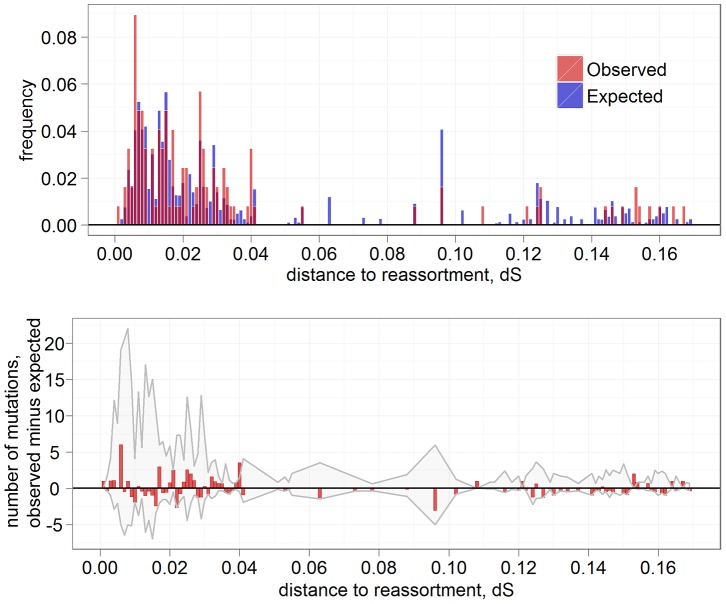
Reassortments and point mutations are two major contributors to diversity of Influenza A virus; however, the link between these two processes is unclear. It has been suggested that reassortments provoke a temporary increase in the rate of amino acid changes as the viral proteins adapt to new genetic environment, but this phenomenon has not been studied systematically. Here, we use a phylogenetic approach to infer the reassortment events between the 8 segments of influenza A H3N2 virus since its emergence in humans in 1968. We then study the amino acid replacements that occurred in genes encoded in each segment subsequent to reassortments. In five out of eight genes (NA, M1, HA, PB1 and NS1), the reassortment events led to a transient increase in the rate of amino acid replacements on the descendant phylogenetic branches. In NA and HA, the replacements following reassortments were enriched with parallel and/or reversing replacements; in contrast, the replacements at sites responsible for differences between antigenic clusters (in HA) and at sites under positive selection (in NA) were underrepresented among them. Post-reassortment adaptive walks contribute to adaptive evolution in Influenza A: in NA, an average reassortment event causes at least 2.1 amino acid replacements in a reassorted gene, with, on average, 0.43 amino acid replacements per evolving post-reassortment lineage; and at least ~9% of all amino acid replacements are provoked by reassortments.
重配和点突变是导致甲型流感病毒多样性的两个主要因素;然而,这两个过程之间的联系尚不清楚。有人认为,重配会导致病毒蛋白适应新的遗传环境时氨基酸变化率暂时增加,但这一现象尚未得到系统研究。在这里,我们使用系统发育方法推断自 1968 年人类出现以来甲型 H3N2 流感病毒 8 个片段之间的重配事件。然后,我们研究了重配后每个片段编码基因中发生的氨基酸替换。在 8 个基因中的 5 个(NA、M1、HA、PB1 和 NS1)中,重配事件导致后代分支上氨基酸替换率的短暂增加。在 NA 和 HA 中,重配后的替换与平行和/或反向替换富集;相比之下,在抗原簇之间差异(在 HA)和正选择(在 NA)负责的位点上的替换在其中代表性不足。重配后的适应性进化有助于甲型流感的适应性进化:在 NA 中,平均每次重配事件会导致重配基因中至少 2.1 个氨基酸替换,每个进化后的重配谱系平均有 0.43 个氨基酸替换;至少有~9%的氨基酸替换是由重配引起的。