Brawner Bridgette M, Teitelman Anne M, Bevilacqua Amanda W, Jemmott Loretta Sweet
Center for Health Equity Research, Center for Global Women's Health, University of Pennsylvania School of Nursing, Philadelphia, United States.
Glob Adv Health Med. 2013 Sep;2(5):100-8. doi: 10.7453/gahmj.2013.059.
Women and adolescent girls bear a significant burden of the global HIV pandemic. Both behavioral and biomedical prevention approaches have been shown to be effective. In order to foster the most effective combination HIV-prevention approaches for women and girls, it is imperative to understand the unique biological, social, and structural considerations that increase vulnerability to acquiring HIV within this population.
The purpose of this article is to propose novel ideas for personalized biobehavioral HIV prevention for women and adolescent girls. The central argument is that we must transcend unilevel solutions for HIV prevention toward comprehensive, multilevel combination HIV prevention packages to actualize personalized biobehavioral HIV prevention. Our hope is to foster transnational dialogue among researchers, practitioners, educators, and policy makers toward the actualization of the proposed recommendations.
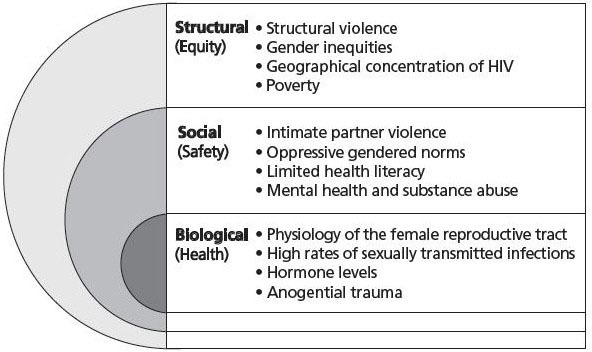
We present a commentary organized to review biological, social, and structural factors that increase vulnerability to HIV acquisition among women and adolescent girls. The overview is followed by recommendations to curb HIV rates in the target population in a sustainable manner.
The physiology of the lower female reproductive system biologically increases HIV risk among women and girls. Social (eg, intimate partner violence) and structural (eg, gender inequality) factors exacerbate this risk by increasing the likelihood of viral exposure. Our recommendations for personalized biobehavioral HIV prevention are to (1) create innovative mechanisms for personalized HIV risk-reduction assessments; (2) develop mathematical models of local epidemics; (3) prepare personalized, evidence-based combination HIV risk-reduction packages; (4) structure gender equity into society; and (5) eliminate violence (both physical and structural) against women and girls.
Generalized programs and interventions may not have universal, transnational, and crosscultural implications. Personalized biobehavioral strategies are needed to comprehensively address vulnerabilities at biological, social, and structural levels.
妇女和少女承受着全球艾滋病流行的重大负担。行为预防和生物医学预防方法均已证明有效。为了促进针对妇女和女孩的最有效的艾滋病预防方法组合,必须了解增加该人群感染艾滋病易感性的独特生物学、社会和结构因素。
本文旨在为妇女和少女的个性化生物行为艾滋病预防提出新想法。核心论点是,我们必须超越单一层次的艾滋病预防解决方案,转向全面、多层次的艾滋病预防组合方案,以实现个性化生物行为艾滋病预防。我们希望促进研究人员、从业者、教育工作者和政策制定者之间的跨国对话,以实现所提出的建议。
我们发表一篇评论文章,回顾增加妇女和少女感染艾滋病易感性的生物学、社会和结构因素。概述之后是关于以可持续方式降低目标人群艾滋病感染率的建议。
女性下生殖道的生理结构在生物学上增加了妇女和女孩感染艾滋病的风险。社会因素(如亲密伴侣暴力)和结构因素(如性别不平等)通过增加病毒暴露的可能性加剧了这种风险。我们关于个性化生物行为艾滋病预防的建议是:(1)创建个性化艾滋病风险降低评估的创新机制;(2)建立当地流行病的数学模型;(3)制定个性化、基于证据的艾滋病风险降低组合方案;(4)在社会中构建性别平等;(5)消除针对妇女和女孩的暴力(包括身体暴力和结构性暴力)。
通用的项目和干预措施可能没有普遍、跨国和跨文化的影响。需要个性化生物行为策略来全面解决生物学、社会和结构层面的脆弱性问题。