Department of Neurosurgery and Brain and Nerve Research Laboratory, The First Affiliated Hospital of Soochow University, Suzhou, China.
Cancer Sci. 2014 Mar;105(3):265-71. doi: 10.1111/cas.12351. Epub 2014 Feb 11.
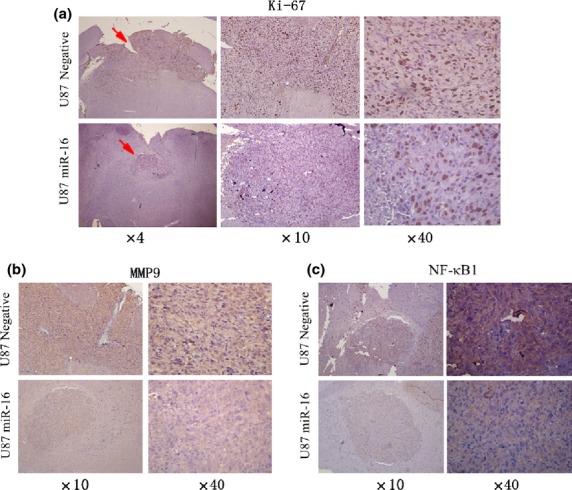
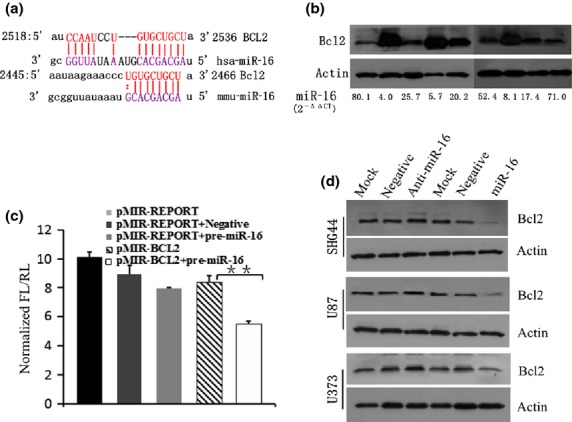
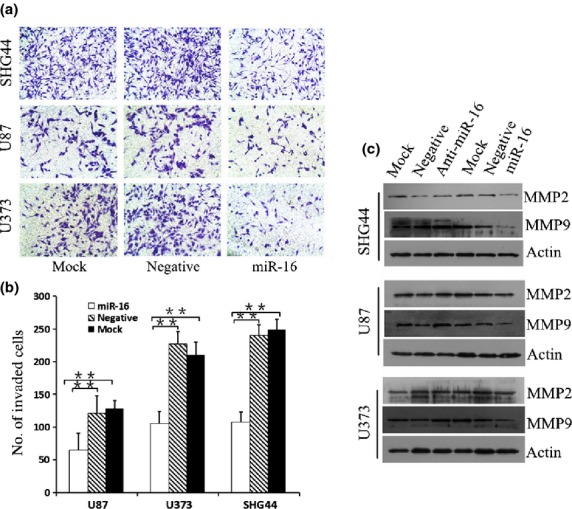
Recent studies have identified a class of small non-coding RNA molecules, named microRNA (miRNA), that is dysregulated in malignant brain glioblastoma. Substantial data have indicated that miRNA-16 (miR-16) plays a significant role in tumors of various origins. This miRNA has been linked to various aspects of carcinogenesis, including cell apoptosis and migration. However, the molecular functions of miR-16 in gliomagenesis are largely unknown. We have shown that the expression of miR-16 in human brain glioma tissues was lower than in non-cancerous brain tissues, and that the expression of miR-16 decreased with increasing degrees of malignancy. Our data suggest that the expression of miR-16 and nuclear factor (NF)-κB1 was negatively correlated with glioma levels. MicroRNA-16 decreased glioma malignancy by downregulating NF-κB1 and MMP9, and led to suppressed invasiveness of human glioma cell lines SHG44, U87, and U373. Our results also indicated that upregulation of miR-16 promoted apoptosis by suppressing BCL2 expression. Finally, the upregulation of miR-16 in a nude mice model of human glioma resulted in significant suppression of glioma growth and invasiveness. Taken together, our experiments have validated the important role of miR-16 as a tumor suppressor gene in glioma growth and invasiveness, and revealed a novel mechanism of miR-16-mediated regulation in glioma growth and invasiveness through inhibition of BCL2 and the NF-κB1/MMP-9 signaling pathway. Therefore, our experiments suggest the possible future use of miR-16 as a therapeutic target in gliomas.
最近的研究已经确定了一类小的非编码 RNA 分子,命名为 microRNA (miRNA),它们在恶性脑胶质瘤中失调。大量数据表明,miRNA-16 (miR-16) 在各种起源的肿瘤中都发挥着重要作用。这种 miRNA 与癌症发生的各个方面有关,包括细胞凋亡和迁移。然而,miR-16 在胶质瘤发生中的分子功能在很大程度上是未知的。我们已经表明,miR-16 在人脑胶质瘤组织中的表达低于非癌性脑组织,并且随着恶性程度的增加,miR-16 的表达降低。我们的数据表明,miR-16 的表达与核因子 (NF)-κB1 的表达呈负相关,与胶质瘤的水平呈负相关。miR-16 通过下调 NF-κB1 和 MMP9 降低了胶质瘤的恶性程度,导致人胶质瘤细胞系 SHG44、U87 和 U373 的侵袭性降低。我们的结果还表明,miR-16 的上调通过抑制 BCL2 的表达促进了细胞凋亡。最后,miR-16 在人胶质瘤裸鼠模型中的上调导致了胶质瘤生长和侵袭性的显著抑制。总之,我们的实验验证了 miR-16 作为胶质瘤生长和侵袭性的肿瘤抑制基因的重要作用,并揭示了 miR-16 通过抑制 BCL2 和 NF-κB1/MMP-9 信号通路介导胶质瘤生长和侵袭性的新机制。因此,我们的实验表明 miR-16 作为治疗靶点在胶质瘤中的应用具有潜在的可能性。