Cabantchik Zvi Ioav, Munnich Arnold, Youdim Moussa B, Devos David
Department of Biological Chemistry, Adelina and Massimo Della Pergola Chair, Alexander Silberman Institute of Life Sciences, Hebrew University of Jerusalem Givat Ram, Jerusalem, Israel.
Clinical Research Unit, Medical Genetic Clinic and Research Unit INSERM 781, Hôpital Necker-Enfants Malades and Université Paris V René Descartes Paris, France.
Front Pharmacol. 2013 Dec 31;4:167. doi: 10.3389/fphar.2013.00167.
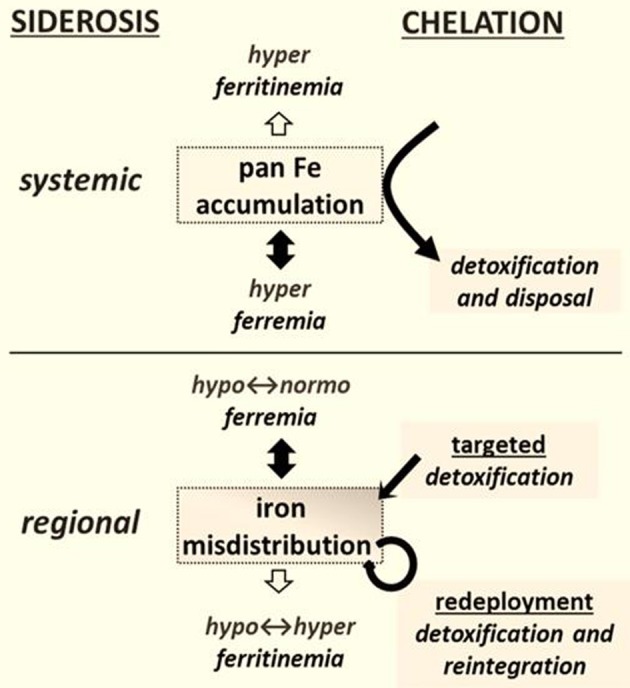
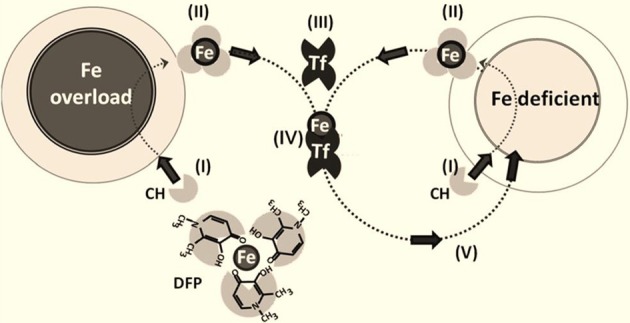
The traditional role of iron chelation therapy has been to reduce body iron burden via chelation of excess metal from organs and fluids and its excretion via biliary-fecal and/or urinary routes. In their present use for hemosiderosis, chelation regimens might not be suitable for treating disorders of iron maldistribution, as those are characterized by toxic islands of siderosis appearing in a background of normal or subnormal iron levels (e.g., sideroblastic anemias, neuro- and cardio-siderosis in Friedreich ataxia- and neurosiderosis in Parkinson's disease). We aimed at clearing local siderosis from aberrant labile metal that promotes oxidative damage, without interfering with essential local functions or with hematological iron-associated properties. For this purpose we introduced a conservative mode of iron chelation of dual activity, one based on scavenging labile metal but also redeploying it to cell acceptors or to physiological transferrin. The "scavenging and redeployment" mode of action was designed both for correcting aberrant iron distribution and also for minimizing/preventing systemic loss of chelated metal. We first examine cell models that recapitulate iron maldistribution and associated dysfunctions identified with Friedreich ataxia and Parkinson's disease and use them to explore the ability of the double-acting agent deferiprone, an orally active chelator, to mediate iron scavenging and redeployment and thereby causing functional improvement. We subsequently evaluate the concept in translational models of disease and finally assess its therapeutic potential in prospective double-blind pilot clinical trials. We claim that any chelator applied to diseases of regional siderosis, cardiac, neuronal or endocrine ought to preserve both systemic and regional iron levels. The proposed deferiprone-based therapy has provided a paradigm for treating regional types of siderosis without affecting hematological parameters and systemic functions.
铁螯合疗法的传统作用是通过螯合器官和体液中过量的金属并通过胆汁-粪便和/或尿液途径将其排出,从而减轻体内铁负荷。在目前用于治疗血色素沉着症时,螯合方案可能不适用于治疗铁分布异常的疾病,因为这些疾病的特征是在正常或低于正常铁水平的背景下出现铁沉着的毒性岛(例如,铁粒幼细胞性贫血、弗里德赖希共济失调中的神经和心脏铁沉着症以及帕金森病中的神经铁沉着症)。我们的目标是清除促进氧化损伤的异常不稳定金属导致的局部铁沉着,同时不干扰基本的局部功能或血液学中铁相关的特性。为此,我们引入了一种具有双重活性的保守铁螯合模式,一种基于清除不稳定金属,但同时也将其重新部署到细胞受体或生理转铁蛋白中。“清除和重新部署”的作用模式旨在纠正异常的铁分布,同时最小化/防止螯合金属的全身损失。我们首先研究细胞模型,这些模型概括了弗里德赖希共济失调和帕金森病中发现的铁分布异常及相关功能障碍,并利用它们来探索口服活性螯合剂去铁酮这种双效药物介导铁清除和重新部署从而改善功能的能力。随后,我们在疾病的转化模型中评估这一概念,最后在前瞻性双盲试点临床试验中评估其治疗潜力。我们认为,任何应用于心脏、神经或内分泌等局部铁沉着症的螯合剂都应保持全身和局部的铁水平。所提出的基于去铁酮的疗法为治疗局部性铁沉着症提供了一个范例,而不影响血液学参数和全身功能。