Programa de Farmacologia, Instituto Nacional de Câncer, Rio de Janeiro, RJ, Brazil.
Departamento de Genética, Universidade Federal do Rio Grande do Sul, Porto Alegre, RS, Brazil.
PLoS One. 2014 Jan 10;9(1):e83472. doi: 10.1371/journal.pone.0083472. eCollection 2014.
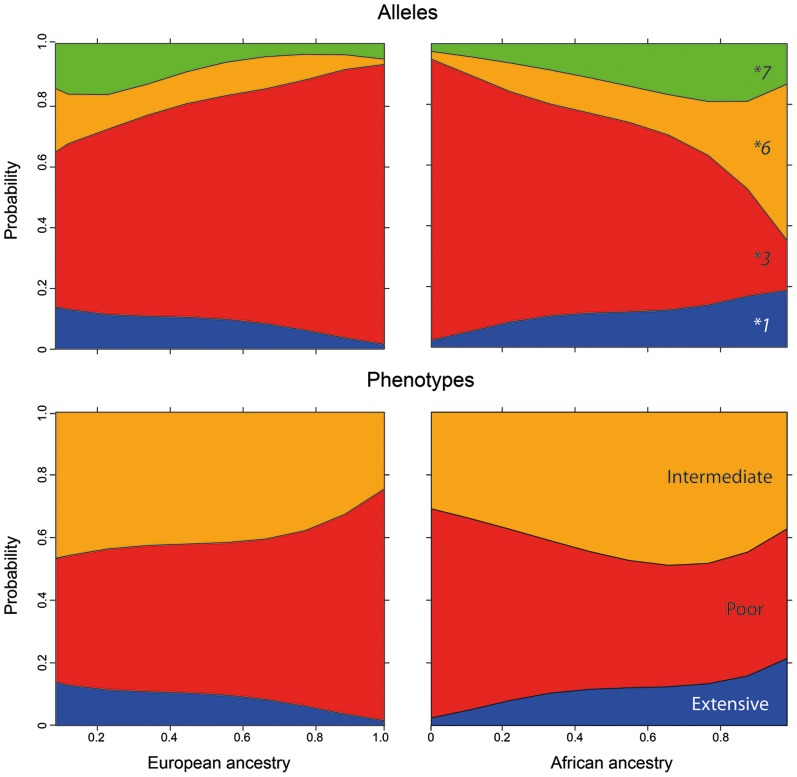
The influence of self-reported "race/color", geographical origin and genetic ancestry on the distribution of three functional CYP3A5 polymorphisms, their imputed haplotypes and inferred phenotypes was examined in 909 healthy, adult Brazilians, self-identified as White, Brown or Black ("race/color" categories of the Brazilian census). The cohort was genotyped for CYP3A53 (rs776746), CYP3A56 (rs10264272) and CYP3A57 (rs41303343), CYP3A5 haplotypes were imputed and CYP3A5 metabolizer phenotypes were inferred according to the number of defective CYP3A5 alleles. Estimates of the individual proportions of Amerindian, African and European ancestry were available for the entire cohort. Multinomial log-linear regression models were applied to infer the statistical association between the distribution of CYP3A5 alleles, haplotypes and phenotypes (response variables), and self-reported Color, geographical region and ancestry (explanatory variables). We found that Color per se or in combination with geographical region associates significantly with the distribution of CYP3A5 variant alleles and CYP3A5 metabolizer phenotypes, whereas geographical region per se influences the frequency distribution of CYP3A5 variant alleles. The odds of having the default CYP3A53 allele and the poor metabolizer phenotype increases continuously with the increase of European ancestry and decrease of African ancestry. The opposite trend is observed in relation to CYP3A56, CYP3A57, the default CYP3A5*1 allele, and both the extensive and intermediate phenotypes. No significant effect of Amerindian ancestry on the distribution of CYP3A5 alleles or phenotypes was observed. In conclusion, this study strongly supports the notion that the intrinsic heterogeneity of the Brazilian population must be acknowledged in the design and interpretation of pharmacogenomic studies, and dealt with as a continuous variable, rather than proportioned in arbitrary categories that do not capture the diversity of the population. The relevance of this work extrapolates the Brazilian borders, and extends to other admixed peoples of the Americas, with ancestral roots in Europe, Africa and the American continent.
本研究旨在 909 名自认为是白种人、棕种人或黑种人的巴西健康成年人中,探讨自我报告的“种族/肤色”、地理起源和遗传祖先对三种功能性 CYP3A5 多态性、推测的单倍型及其推断表型分布的影响。该队列针对 CYP3A53(rs776746)、CYP3A56(rs10264272)和 CYP3A57(rs41303343)进行基因分型,根据缺陷 CYP3A5 等位基因的数量推测 CYP3A5 单倍型,并推断 CYP3A5 代谢表型。整个队列都可以获得个体美洲印第安人、非洲人和欧洲祖先比例的估计值。应用多项逻辑线性回归模型推断 CYP3A5 等位基因、单倍型和表型(因变量)的分布与自我报告的肤色、地理区域和祖先(解释变量)之间的统计学关联。我们发现,肤色本身或与地理区域结合与 CYP3A5 变异等位基因和 CYP3A5 代谢表型的分布显著相关,而地理区域本身影响 CYP3A5 变异等位基因的频率分布。默认 CYP3A53 等位基因和差代谢表型的出现几率随着欧洲祖先的增加和非洲祖先的减少而持续增加。相反的趋势见于 CYP3A56、CYP3A57、默认 CYP3A5*1 等位基因以及广泛和中间表型。未观察到美洲印第安人祖先对 CYP3A5 等位基因或表型分布有显著影响。总之,本研究强烈支持这样一种观点,即在设计和解释药物基因组学研究时,必须承认巴西人群的固有异质性,并将其视为连续变量,而不是按照不反映人群多样性的任意类别进行划分。这项工作的意义超出了巴西的范围,并延伸到其他具有欧洲、非洲和美洲大陆祖先根源的美洲混血人群。