Roswell Park Cancer Institute, Department of Health Behavior, Elm & Carlton Streets Buffalo, New York 14263, USA.
Harm Reduct J. 2014 Jan 17;11:2. doi: 10.1186/1477-7517-11-2.
Research demonstrates that tobacco packaging elements (including health warning labels, descriptive characteristics, and corporate branding) are associated with knowledge of health risks and product appeal with cigarettes. Yet, little research has assessed this with smokeless tobacco (SLT) packaging. This study evaluates the association between three SLT packaging elements with knowledge of health risks and perceptions of novelty and appeal. Additionally, we assess how effects of these messages may differ across age groups, including youth (14-17 years), young adults (18-25 years), and older adults (26-65 years).
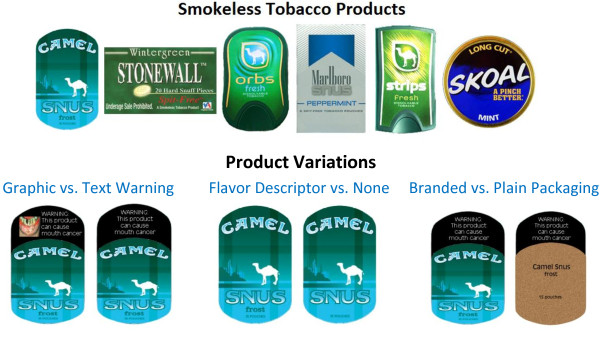
1000 participants were administered a web-based survey in 2010 and shown three sets of SLT packs in random order, varied by descriptor (flavor descriptor vs. none), warning label format (graphic vs. text), and corporate branding (branded vs. plain packaging). Participants rated the packs compared with "no difference" on appeal, novelty, and risk perceptions associated with product use. Chi-square tests were used to test for significant differences in pack selections. Multinomial regression was employed to evaluate the association between effects of packaging elements and participant age.
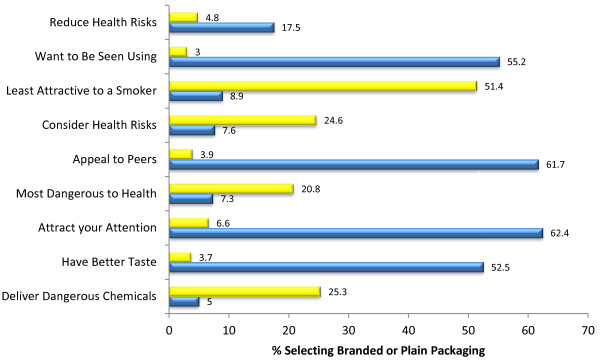
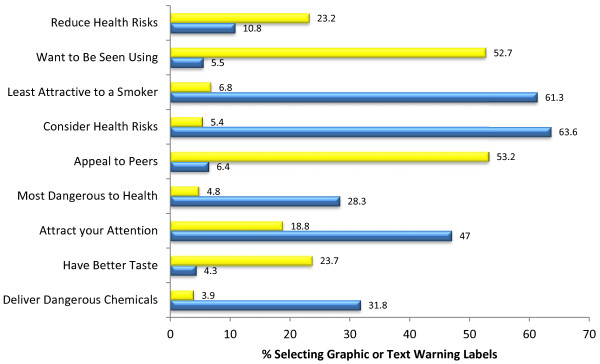
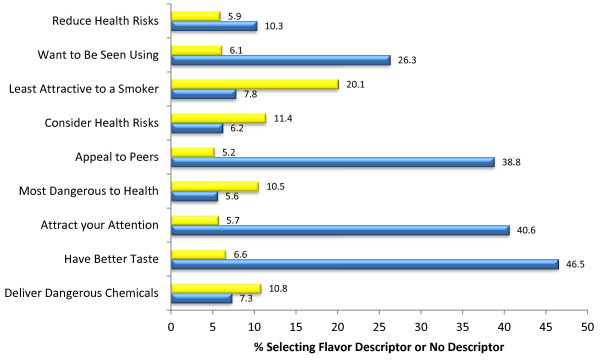
More respondents selected the pack with the graphic warning label as the pack to make them consider the health risks associated with SLT use, attract their attention, and be least attractive to a smoker. The product with the text warning label was the product someone their age would want to be seen using and would appeal to peers. The SLT pack with the flavor descriptor was not associated with health risks associated with product use. The pack with corporate branding was selected as more appealing, to attract attention, and one they would want to be seen using; the plain pack was less attractive to smokers. Youth and young adults were more likely to indicate that pack elements affected their perceptions of appeal and risk associated with SLT products.
These results suggest that SLT pack characteristics have a measurable effect on perceptions of health risk and product appeal. Future research should assess these findings in the context of harm reduction. Specifically, research is needed to determine whether pack elements on SLT products can effectively convey risk and harm.
研究表明,烟草包装元素(包括健康警示标签、描述性特征和公司品牌)与香烟的健康风险知识和产品吸引力有关。然而,很少有研究评估过无烟烟草(SLT)包装。本研究评估了三种 SLT 包装元素与健康风险知识和新颖性及吸引力感知之间的关系。此外,我们评估了这些信息的影响在不同年龄组(包括 14-17 岁的青少年、18-25 岁的年轻人和 26-65 岁的成年人)之间可能存在的差异。
2010 年,1000 名参与者接受了一项基于网络的调查,并以随机顺序展示了三组 SLT 包装,包装的描述符(口味描述符与无描述符)、警示标签格式(图形与文本)和公司品牌(有品牌与无品牌)各不相同。参与者对包装进行了评价,与“无差异”相比,他们评价了包装在吸引力、新颖性和与产品使用相关的风险感知方面的差异。卡方检验用于检验包装选择的显著差异。采用多项回归分析评价包装元素与参与者年龄之间的关联。
更多的受访者选择了带有图形警示标签的包装,认为该包装会让他们考虑与 SLT 使用相关的健康风险,吸引他们的注意力,并且对吸烟者的吸引力最小。带有文本警示标签的产品是他们这个年龄段的人希望被看到使用的产品,并且会吸引同龄人。带有口味描述符的 SLT 包装与产品使用相关的健康风险无关。带有公司品牌的包装被选为更具吸引力、更能吸引注意力且他们希望被看到使用的产品;无品牌的包装对吸烟者的吸引力较小。青少年和年轻人更有可能表示包装元素会影响他们对 SLT 产品吸引力和风险的感知。
这些结果表明,SLT 包装特征对健康风险和产品吸引力的感知有一定的影响。未来的研究应该在减少伤害的背景下评估这些发现。具体来说,需要研究 SLT 产品上的包装元素是否能有效地传达风险和危害。