Znojek-Tymborowska Justyna, Kęska Rafał, Paradowski Przemysław T, Witoński Dariusz
Department of Reconstructive Surgery and Arthroscopy of the Knee Joint, Medical University, Radliński Hospital, Drewnowska 75, 91-002 Łódź, Poland ; The 21st Military Spa and Rehabilitation Hospital, Rzewuskiego 8, 28-100 Busko-Zdrój, Poland.
Department of Reconstructive Surgery and Arthroscopy of the Knee Joint, Medical University, Radliński Hospital, Drewnowska 75, 91-002 Łódź, Poland.
Acta Ortop Bras. 2013;21(5):262-5. doi: 10.1590/S1413-78522013000500004.
The aim of the study was to assess the effect of different types of anesthesia on pain intensity in early postoperative period.
A total of 87 patients (77 women, 10 men) scheduled for total knee arthroplasty (TKA) were assigned to receive either subarachnoid anesthesia alone or in combination with local soft tissue anesthesia, local soft tissue anesthesia and femoral nerve block and pre-emptive infiltration together with local soft tissue anesthesia. We assessed the pain intensity, opioid consumption, knee joint mobility, and complications of surgery.
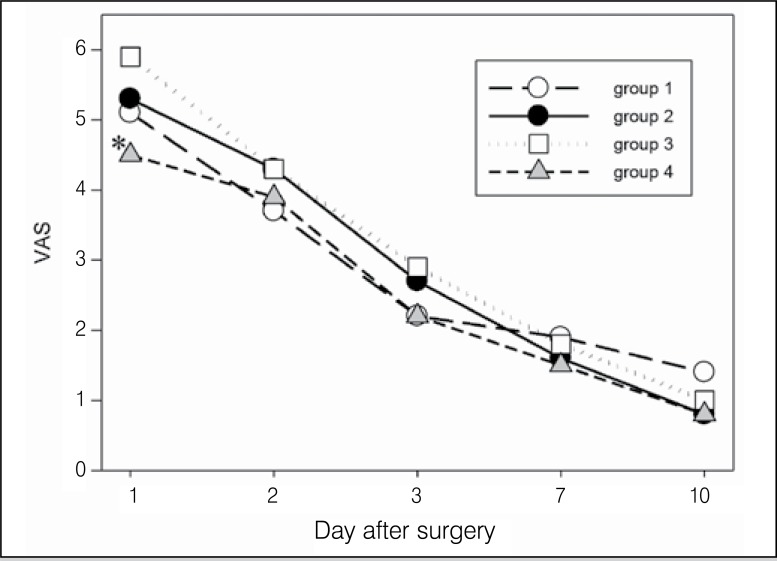
Subjects with pre-emptive infiltration and local soft tissue anesthesia had lower pain intensity on the first postoperative day compared to those with soft tissue anesthesia and femoral nerve block (P=0.012, effect size 0.68). Subjects who received pre-emptive infiltration and local soft-tissue anesthesia had the greatest range of motion in the operated knee at discharge (mean 90 grades [SD 7], P=0.01 compared to those who received subarachnoid anesthesia alone, and P=0.001 compared to those with subarachnoid together with soft tissue anesthesia).
Despite the differences in postoperative pain and knee mobility, the results obtained throughout the postoperative period do not enable us to favour neither local nor regional infiltration anesthesia in TKA. Level of Evidence II, Prospective Comparative Study.
本研究旨在评估不同类型麻醉对术后早期疼痛强度的影响。
总共87例计划接受全膝关节置换术(TKA)的患者(77名女性,10名男性)被分配接受单纯蛛网膜下腔麻醉或联合局部软组织麻醉、局部软组织麻醉与股神经阻滞以及与局部软组织麻醉联合的超前浸润麻醉。我们评估了疼痛强度、阿片类药物消耗量、膝关节活动度和手术并发症。
与接受软组织麻醉和股神经阻滞的患者相比,接受超前浸润和局部软组织麻醉的患者在术后第一天疼痛强度更低(P = 0.012,效应大小0.68)。接受超前浸润和局部软组织麻醉的患者在出院时手术膝关节的活动范围最大(平均90度[标准差7],与单纯接受蛛网膜下腔麻醉的患者相比P = 0.01,与接受蛛网膜下腔麻醉联合软组织麻醉的患者相比P = 0.001)。
尽管术后疼痛和膝关节活动度存在差异,但整个术后期间获得的结果并不能使我们在全膝关节置换术中倾向于局部或区域浸润麻醉。证据等级II,前瞻性比较研究。