BMC Gastroenterol. 2013 Oct 25;13:154. doi: 10.1186/1471-230X-13-154.
The prevalence of esophageal neoplasia in head and neck (H&N) cancer patients is not low; however, routine esophageal surveillance is not included in staging of newly-diagnosed H&N cancers. We aimed to investigate the risk factors for synchronous esophageal neoplasia and the impact of endoscopy on management of H&N cancer patients.
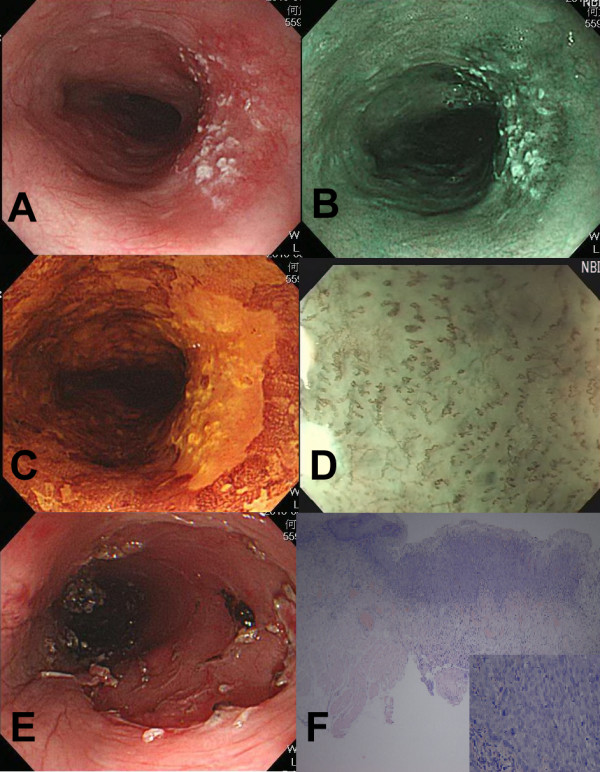
A total of 129 newly diagnosed H&N cancer patients who underwent endoscopy with white-light imaging, narrow-band imaging (NBI) with magnifying endoscopy (ME), and chromoendoscopy with 1.5% Lugol's solution, before definite treatment were enrolled prospectively.
60 esophageal lesions were biopsied from 53 (41.1%) patients, including 11 low-grade, 14 high-grade intraepithelial neoplasia and 12 invasive carcinoma in 30 (23.3%) patients. Alcohol consumption [odds ratio (OR) 5.90, 95% confidence interval (CI) 1.23-26.44], advanced stage (stage III and IV) of index H&N cancers (OR 2.98, 95% CI 1.11-7.99), and lower body mass index (BMI) (every 1-kg/m2 increment with OR 0.87, 95% CI 0.76-0.99) were independent risk factors for synchronous esophageal neoplasia. NBI with ME was the ideal screening tool (sensitivity, specificity, and accuracy of 97.3%, 94.1%, and 96.3%, respectively, for detection of dysplastic and cancerous esophageal lesions). The treatment strategy was modified after endoscopy in 20 (15.5%) patients. The number needed to screen was 6.45 (95% CI 4.60-10.90).
NBI-ME surveillance of esophagus should be done in newly-diagnosed H&N cancer patients, especially those with alcohol drinking, lower BMI, and advanced stage of primary tumor.
头颈部(H&N)癌症患者的食管肿瘤患病率不低;然而,新诊断的 H&N 癌症分期并不包括常规食管监测。我们旨在研究同步性食管肿瘤的危险因素以及内镜检查对 H&N 癌症患者治疗的影响。
共前瞻性纳入 129 例新诊断的 H&N 癌症患者,他们在明确治疗前均接受了白光成像、窄带成像(NBI)放大内镜(ME)和 1.5%卢戈氏液染色内镜检查。
53 例(41.1%)患者的 60 个食管病变接受了活检,其中 30 例(23.3%)患者中包括 11 个低级别、14 个高级别上皮内瘤变和 12 个浸润性癌。饮酒史(比值比[OR] 5.90,95%置信区间[CI] 1.23-26.44)、H&N 癌症的晚期(III 和 IV 期)(OR 2.98,95%CI 1.11-7.99)和较低的体重指数(BMI)(每增加 1-kg/m2,OR 0.87,95%CI 0.76-0.99)是同步性食管肿瘤的独立危险因素。NBI-ME 是理想的筛查工具(检测异型增生和癌性食管病变的敏感性、特异性和准确性分别为 97.3%、94.1%和 96.3%)。20 例(15.5%)患者在接受内镜检查后修改了治疗策略。筛查所需的例数为 6.45(95%CI 4.60-10.90)。
应在新诊断的 H&N 癌症患者中进行食管 NBI-ME 监测,特别是那些有饮酒史、BMI 较低和肿瘤原发灶晚期的患者。