• 文献检索
  • 文档翻译
  • 深度研究
  • 学术资讯
  • Suppr Zotero 插件Zotero 插件
  • 邀请有礼
  • 套餐&价格
  • 历史记录
应用&插件
Suppr Zotero 插件Zotero 插件浏览器插件Mac 客户端Windows 客户端微信小程序
定价
高级版会员购买积分包购买API积分包
服务
文献检索文档翻译深度研究API 文档MCP 服务
关于我们
关于 Suppr公司介绍联系我们用户协议隐私条款
关注我们

Suppr 超能文献

核心技术专利:CN118964589B侵权必究
粤ICP备2023148730 号-1Suppr @ 2026

文献检索

告别复杂PubMed语法,用中文像聊天一样搜索,搜遍4000万医学文献。AI智能推荐,让科研检索更轻松。

立即免费搜索

文件翻译

保留排版,准确专业,支持PDF/Word/PPT等文件格式,支持 12+语言互译。

免费翻译文档

深度研究

AI帮你快速写综述,25分钟生成高质量综述,智能提取关键信息,辅助科研写作。

立即免费体验

轻度创伤性脑损伤后睡眠障碍的恢复先于抑郁和焦虑的恢复:一项为期6周的随访研究。

Recovery from sleep disturbance precedes that of depression and anxiety following mild traumatic brain injury: a 6-week follow-up study.

作者信息

Ma Hon-Ping, Ou Ju-Chi, Yeh Chun-Ting, Wu Dean, Tsai Shin-Han, Chiu Wen-Ta, Hu Chaur-Jong

机构信息

Department of Emergency Medicine, Shuang Ho Hospital, Taipei Medical University, New Taipei City, Taiwan.

出版信息

BMJ Open. 2014 Jan 23;4(1):e004205. doi: 10.1136/bmjopen-2013-004205.

DOI:10.1136/bmjopen-2013-004205
PMID:24459040
原文链接:https://pmc.ncbi.nlm.nih.gov/articles/PMC3902386/
Abstract

OBJECTIVES

The detailed course of mental disorders at the acute and subacute stages of mild traumatic brain injury (mTBI), especially with regard to recovery from sleep disturbances, has not been well characterised. The aim of this study was to determine the course of depression, anxiety and sleep disturbance, following an mTBI.

SETTING

We recruited patients with mTBI from three university hospitals in Taipei and healthy participants as control group for this study.

PARTICIPANTS

100 patients with mTBI (35 men) who were older than 20 years, with a Glasgow Coma Scale score of 13-15 and loss of consciousness for <30 min, completed the baseline and 6-week follow-up assessments. 137 controls (47 men) without TBI were recruited in the study. None of the participants had a history of cerebrovascular disease, mental retardation, previous TBI, epilepsy or severe systemic medical illness.

PRIMARY OUTCOME MEASURES

The Beck Anxiety Inventory (BAI), the Beck Depression Inventory II (BDI), the Epworth Sleepiness Scale (ESS) and the Pittsburgh Sleep Quality Index (PSQI) were assessed for the patients with mTBI at baseline and 6 weeks after mTBI and for the controls.

RESULTS

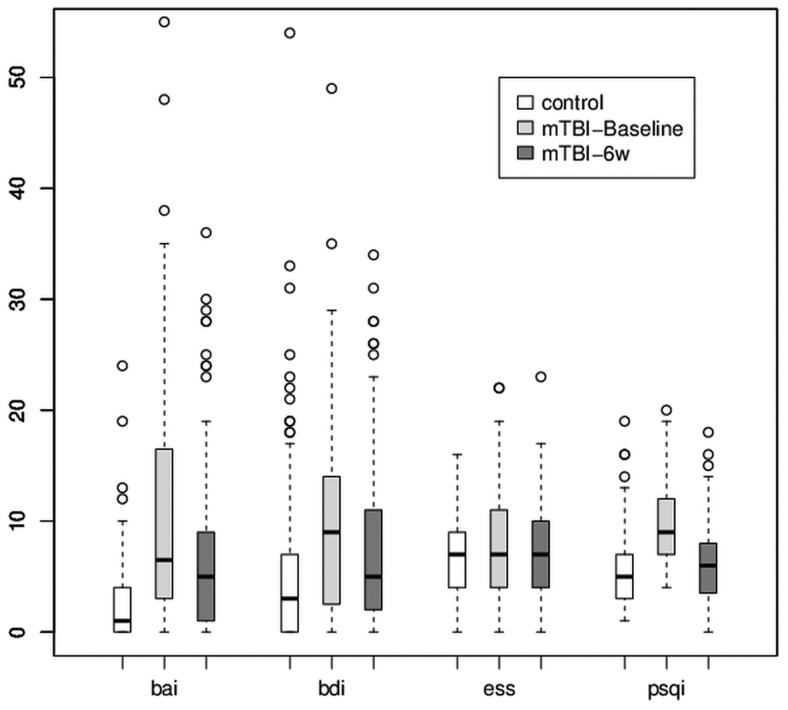
The ESS scores were not significantly different between the mTBI at baseline or at 6 weeks after mTBI and controls. Although the BAI, BDI and PSQI scores of the mTBI group were significantly different than those of the control group at baseline, all had improved significantly 6 weeks later. However, only the PSQI score improved to a level that was not significantly different from that of the control group.

CONCLUSIONS

Daytime sleepiness is not affected by mTBI. However, mTBI causes depression and anxiety and diminished sleep quality. Although all these conditions improve significantly within 6 weeks post-mTBI, only sleep quality improves to a pre-mTBI level. Thus, recovery from mTBI-induced sleep disturbance occurs more rapidly than that of mTBI-induced depression and anxiety.

摘要

目的

轻度创伤性脑损伤(mTBI)急性和亚急性阶段精神障碍的详细病程,尤其是从睡眠障碍中恢复的情况,尚未得到充分描述。本研究的目的是确定mTBI后抑郁、焦虑和睡眠障碍的病程。

设置

我们从台北的三家大学医院招募了mTBI患者,并招募健康参与者作为本研究的对照组。

参与者

100例年龄超过20岁、格拉斯哥昏迷量表评分为13 - 15分且意识丧失<30分钟的mTBI患者(35名男性)完成了基线和6周随访评估。本研究招募了137名无TBI的对照组(47名男性)。所有参与者均无脑血管疾病、智力发育迟缓、既往TBI、癫痫或严重全身性内科疾病史。

主要结局指标

对mTBI患者在基线时、mTBI后6周以及对照组进行贝克焦虑量表(BAI)、贝克抑郁量表第二版(BDI)、爱泼华嗜睡量表(ESS)和匹兹堡睡眠质量指数(PSQI)评估。

结果

mTBI患者基线时或mTBI后6周时的ESS评分与对照组无显著差异。虽然mTBI组的BAI、BDI和PSQI评分在基线时与对照组有显著差异,但6周后均有显著改善。然而,只有PSQI评分改善到与对照组无显著差异的水平。

结论

白天嗜睡不受mTBI影响。然而,mTBI会导致抑郁、焦虑并降低睡眠质量。虽然所有这些情况在mTBI后6周内均有显著改善,但只有睡眠质量改善到mTBI前的水平。因此,mTBI引起的睡眠障碍的恢复比mTBI引起的抑郁和焦虑恢复得更快。
https://cdn.ncbi.nlm.nih.gov/pmc/blobs/b83d/3902386/a9f5a658b76b/bmjopen2013004205f01.jpg

相似文献

1
Recovery from sleep disturbance precedes that of depression and anxiety following mild traumatic brain injury: a 6-week follow-up study.轻度创伤性脑损伤后睡眠障碍的恢复先于抑郁和焦虑的恢复:一项为期6周的随访研究。
BMJ Open. 2014 Jan 23;4(1):e004205. doi: 10.1136/bmjopen-2013-004205.
2
Psychometric Evaluation of Anxiety, Depression, and Sleep Quality after a Mild Traumatic Brain Injury: A Longitudinal Study.轻度创伤性脑损伤后焦虑、抑郁和睡眠质量的心理计量学评估:一项纵向研究。
Behav Neurol. 2019 Apr 14;2019:4364592. doi: 10.1155/2019/4364592. eCollection 2019.
3
PERIOD3 polymorphism is associated with sleep quality recovery after a mild traumatic brain injury.PERIOD3基因多态性与轻度创伤性脑损伤后的睡眠质量恢复有关。
J Neurol Sci. 2015 Nov 15;358(1-2):385-9. doi: 10.1016/j.jns.2015.09.376. Epub 2015 Oct 4.
4
Depressive symptoms predict the quality of sleep in patients with partial epilepsy--A combined retrospective and prospective study.抑郁症状可预测部分性癫痫患者的睡眠质量——一项回顾性与前瞻性相结合的研究。
Epilepsy Behav. 2015 Jun;47:104-10. doi: 10.1016/j.yebeh.2015.04.021. Epub 2015 May 13.
5
Are NREM sleep characteristics associated to subjective sleep complaints after mild traumatic brain injury?轻度创伤性脑损伤后,非快速眼动睡眠特征与主观睡眠主诉有关联吗?
Sleep Med. 2015 Apr;16(4):534-9. doi: 10.1016/j.sleep.2014.12.002. Epub 2015 Jan 9.
6
The spectrum of neurobehavioral sequelae after repetitive mild traumatic brain injury: a novel mouse model of chronic traumatic encephalopathy.重复性轻度创伤性脑损伤后神经行为后遗症谱:一种慢性创伤性脑病的新型小鼠模型
J Neurotrauma. 2014 Jul 1;31(13):1211-24. doi: 10.1089/neu.2013.3255. Epub 2014 Jun 12.
7
Sleep duration and sleep quality following acute mild traumatic brain injury: a propensity score analysis.
Behav Neurol. 2015;2015:378726. doi: 10.1155/2015/378726. Epub 2015 Mar 17.
8
Sleep quality, pain, anxiety, depression and quality of life in patients with frozen shoulder1.肩周炎患者的睡眠质量、疼痛、焦虑、抑郁及生活质量1
J Back Musculoskelet Rehabil. 2019;32(2):287-291. doi: 10.3233/BMR-171010.
9
The Association of Apolipoprotein E Allele 4 Polymorphism with the Recovery of Sleep Disturbance after Mild Traumatic Brain Injury.载脂蛋白E等位基因4多态性与轻度创伤性脑损伤后睡眠障碍恢复的相关性
Acta Neurol Taiwan. 2017 Mar 15;26(1):13-19.
10
Subjective sleep disturbance in Chinese adults with epilepsy: Associations with affective symptoms.中国癫痫成年患者的主观睡眠障碍:与情感症状的关联
Epilepsy Res. 2017 Sep;135:150-157. doi: 10.1016/j.eplepsyres.2017.06.014. Epub 2017 Jul 1.

引用本文的文献

1
Incidence of anxiety after traumatic brain injury: a systematic review and meta-analysis.颅脑创伤后焦虑的发生率:系统评价和荟萃分析。
BMC Neurol. 2024 Aug 22;24(1):293. doi: 10.1186/s12883-024-03791-0.
2
Investigating the relationship between mild traumatic brain injury and Alzheimer's disease and related dementias: a systematic review.探究轻度创伤性脑损伤与阿尔茨海默病及相关痴呆症之间的关系:一项系统综述。
J Neurol. 2022 Sep;269(9):4635-4645. doi: 10.1007/s00415-022-11186-9. Epub 2022 Jun 1.
3
The Prevalence and Stability of Sleep-Wake Disturbance and Fatigue throughout the First Year after Mild Traumatic Brain Injury.

本文引用的文献

1
The genetics of insomnia--evidence for epigenetic mechanisms?失眠的遗传学——表观遗传机制的证据?
Sleep Med Rev. 2014 Jun;18(3):225-35. doi: 10.1016/j.smrv.2013.05.002. Epub 2013 Aug 7.
2
Repetitive traumatic brain injury (or concussion) increases severity of sleep disturbance among deployed military personnel.重复性创伤性脑损伤(或脑震荡)会增加部署中的军事人员睡眠障碍的严重程度。
Sleep. 2013 Jun 1;36(6):941-6. doi: 10.5665/sleep.2730.
3
Long-term outcomes after uncomplicated mild traumatic brain injury: a comparison with trauma controls.
轻度创伤性脑损伤后一年中睡眠-觉醒障碍和疲劳的发生率和稳定性。
J Neurotrauma. 2020 Dec 1;37(23):2528-2541. doi: 10.1089/neu.2019.6898. Epub 2020 Jul 8.
4
Psychometric Evaluation of Anxiety, Depression, and Sleep Quality after a Mild Traumatic Brain Injury: A Longitudinal Study.轻度创伤性脑损伤后焦虑、抑郁和睡眠质量的心理计量学评估:一项纵向研究。
Behav Neurol. 2019 Apr 14;2019:4364592. doi: 10.1155/2019/4364592. eCollection 2019.
5
Update on Insomnia after Mild Traumatic Brain Injury.轻度创伤性脑损伤后失眠的最新情况
Brain Sci. 2018 Dec 13;8(12):223. doi: 10.3390/brainsci8120223.
6
Sleep Disturbances in Traumatic Brain Injury: A Meta-Analysis.创伤性脑损伤中的睡眠障碍:一项荟萃分析。
J Clin Sleep Med. 2016 Mar;12(3):419-28. doi: 10.5664/jcsm.5598.
7
Sleep duration and sleep quality following acute mild traumatic brain injury: a propensity score analysis.
Behav Neurol. 2015;2015:378726. doi: 10.1155/2015/378726. Epub 2015 Mar 17.
单纯轻度创伤性脑损伤后的长期预后:与创伤对照的比较。
J Neurotrauma. 2011 Jun;28(6):937-46. doi: 10.1089/neu.2010.1516. Epub 2011 May 25.
4
Insomnia as a predictor of depression: a meta-analytic evaluation of longitudinal epidemiological studies.失眠作为抑郁的预测因子:纵向流行病学研究的荟萃分析评价。
J Affect Disord. 2011 Dec;135(1-3):10-9. doi: 10.1016/j.jad.2011.01.011. Epub 2011 Feb 5.
5
Sleep disturbance and melatonin levels following traumatic brain injury.创伤性脑损伤后睡眠障碍和褪黑素水平。
Neurology. 2010 May 25;74(21):1732-8. doi: 10.1212/WNL.0b013e3181e0438b.
6
The psychiatric sequelae of traumatic injury.创伤后精神后遗症。
Am J Psychiatry. 2010 Mar;167(3):312-20. doi: 10.1176/appi.ajp.2009.09050617. Epub 2010 Jan 4.
7
An integrated review of recovery after mild traumatic brain injury (MTBI): implications for clinical management.轻度创伤性脑损伤(MTBI)后恢复的综合综述:对临床管理的启示
Clin Neuropsychol. 2009 Nov;23(8):1368-90. doi: 10.1080/13854040903074652.
8
Traumatic brain injury and sleep disturbance: a review of current research.创伤性脑损伤与睡眠障碍:当前研究综述
J Head Trauma Rehabil. 2009 May-Jun;24(3):155-65. doi: 10.1097/HTR.0b013e3181a0b281.
9
Mild traumatic brain injury in U.S. Soldiers returning from Iraq.从伊拉克回国的美国士兵中的轻度创伤性脑损伤。
N Engl J Med. 2008 Jan 31;358(5):453-63. doi: 10.1056/NEJMoa072972. Epub 2008 Jan 30.
10
Sleep following sport-related concussions.与运动相关的脑震荡后的睡眠
Sleep Med. 2009 Jan;10(1):35-46. doi: 10.1016/j.sleep.2007.11.023. Epub 2008 Jan 28.