Ali Sajid, Gladieux Pierre, Leconte Marc, Gautier Angélique, Justesen Annemarie F, Hovmøller Mogens S, Enjalbert Jérôme, de Vallavieille-Pope Claude
INRA UR 1290 BIOGER-CPP, Thiverval-Grignon, France ; Institute of Biotechnology and Genetic Engineering, the University of Agriculture, Peshawar, Pakistan ; Department of Agroecology, Aarhus University, Slagelse, Denmark.
UMR 8079 Ecologie Systematique Evolution, Univ. Paris-Sud., CNRS-F, Orsay, France ; Department of Plant and Microbial Biology, University of California, Berkeley, Berkeley, California, United States of America.
PLoS Pathog. 2014 Jan;10(1):e1003903. doi: 10.1371/journal.ppat.1003903. Epub 2014 Jan 23.
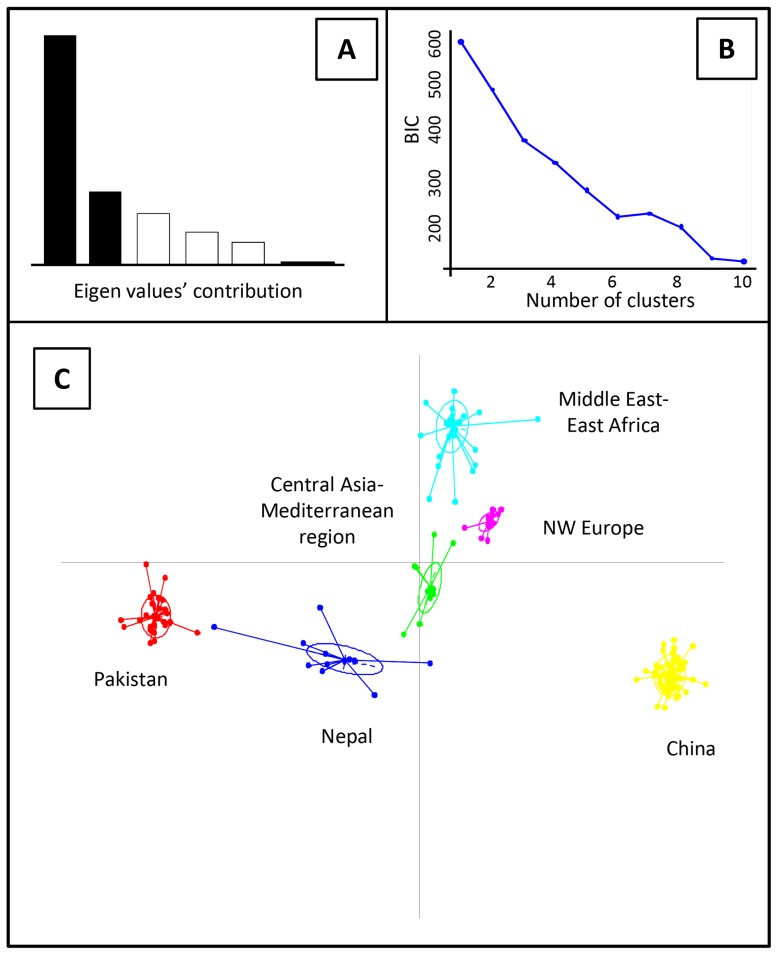
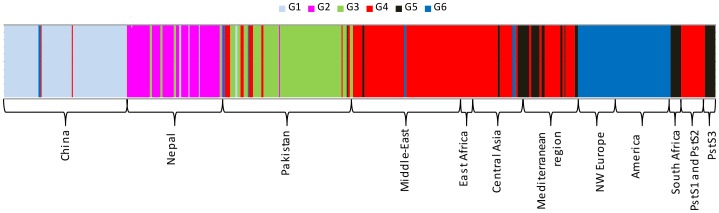
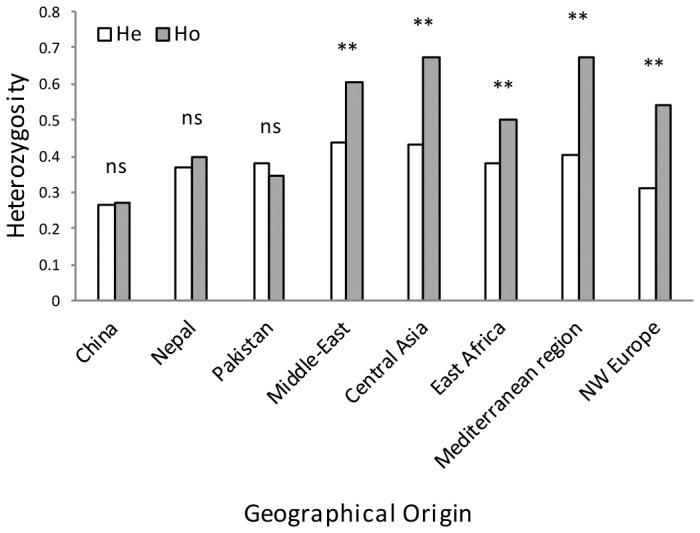
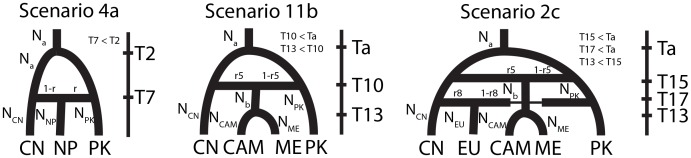
Analyses of large-scale population structure of pathogens enable the identification of migration patterns, diversity reservoirs or longevity of populations, the understanding of current evolutionary trajectories and the anticipation of future ones. This is particularly important for long-distance migrating fungal pathogens such as Puccinia striiformis f.sp. tritici (PST), capable of rapid spread to new regions and crop varieties. Although a range of recent PST invasions at continental scales are well documented, the worldwide population structure and the center of origin of the pathogen were still unknown. In this study, we used multilocus microsatellite genotyping to infer worldwide population structure of PST and the origin of new invasions based on 409 isolates representative of distribution of the fungus on six continents. Bayesian and multivariate clustering methods partitioned the set of multilocus genotypes into six distinct genetic groups associated with their geographical origin. Analyses of linkage disequilibrium and genotypic diversity indicated a strong regional heterogeneity in levels of recombination, with clear signatures of recombination in the Himalayan (Nepal and Pakistan) and near-Himalayan regions (China) and a predominant clonal population structure in other regions. The higher genotypic diversity, recombinant population structure and high sexual reproduction ability in the Himalayan and neighboring regions suggests this area as the putative center of origin of PST. We used clustering methods and approximate Bayesian computation (ABC) to compare different competing scenarios describing ancestral relationship among ancestral populations and more recently founded populations. Our analyses confirmed the Middle East-East Africa as the most likely source of newly spreading, high-temperature-adapted strains; Europe as the source of South American, North American and Australian populations; and Mediterranean-Central Asian populations as the origin of South African populations. Although most geographic populations are not markedly affected by recent dispersal events, this study emphasizes the influence of human activities on recent long-distance spread of the pathogen.
对病原体大规模种群结构的分析有助于识别迁移模式、种群的多样性储存库或寿命,理解当前的进化轨迹并预测未来的轨迹。这对于长距离迁移的真菌病原体尤为重要,例如条锈菌小麦专化型(PST),它能够迅速传播到新的地区和作物品种。尽管最近在大陆尺度上有一系列PST入侵事件有详细记录,但该病原体的全球种群结构和起源中心仍然未知。在本研究中,我们使用多位点微卫星基因分型,基于代表该真菌在六大洲分布的409个分离株,推断PST的全球种群结构和新入侵的起源。贝叶斯和多变量聚类方法将多位点基因型集划分为六个不同的遗传组,这些遗传组与其地理起源相关。连锁不平衡和基因型多样性分析表明,重组水平存在强烈的区域异质性,在喜马拉雅地区(尼泊尔和巴基斯坦)和近喜马拉雅地区(中国)有明显的重组特征,而在其他地区则以克隆种群结构为主。喜马拉雅及周边地区较高的基因型多样性、重组种群结构和高有性繁殖能力表明该地区是PST的假定起源中心。我们使用聚类方法和近似贝叶斯计算(ABC)来比较描述祖先种群和最近建立种群之间祖先关系的不同竞争情景。我们的分析证实中东 - 东非是新传播的、适应高温菌株的最可能来源;欧洲是南美、北美和澳大利亚种群的来源;地中海 - 中亚种群是南非种群的起源。尽管大多数地理种群没有受到近期扩散事件的明显影响,但这项研究强调了人类活动对该病原体近期长距离传播的影响。