Raes An K, De Houwer Jan, De Schryver Maarten, Brass Marcel, Kalisch Raffael
Ghent University, Ghent, Belgium ; Erasmus University Rotterdam, Rotterdam, The Netherlands.
Ghent University, Ghent, Belgium.
PLoS One. 2014 Jan 23;9(1):e84888. doi: 10.1371/journal.pone.0084888. eCollection 2014.
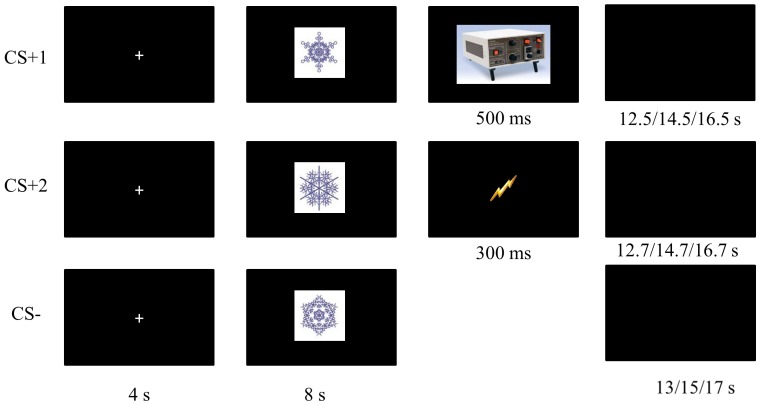
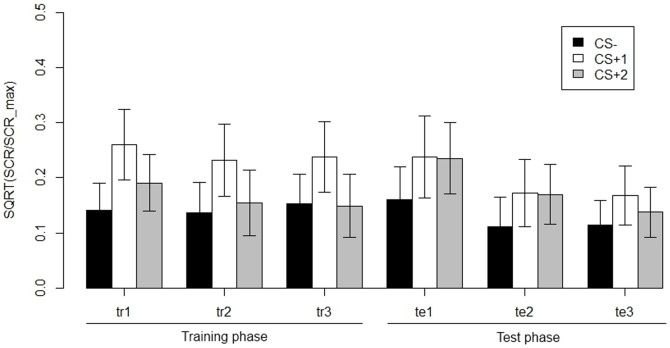
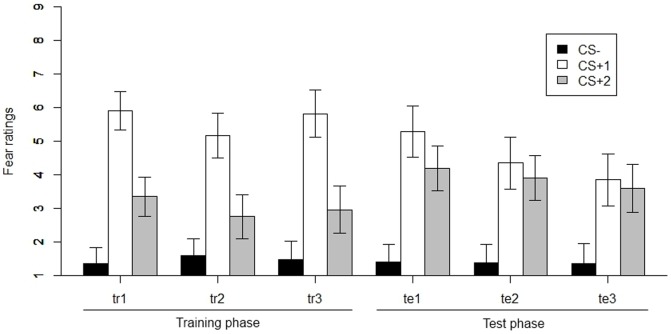
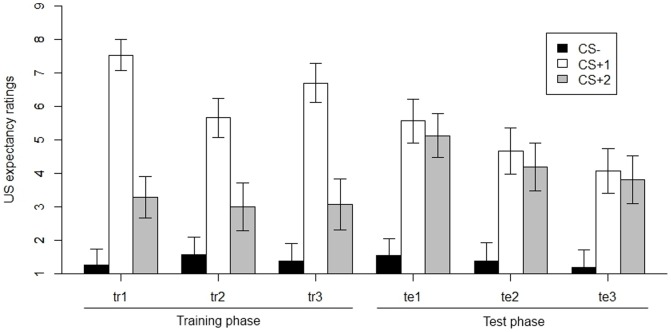
Previous research showed that instructions about CS-US pairings can lead to fear of the CS even when the pairings are never presented. In the present study, we examined whether the experience of CS-US pairings adds to the effect of instructions by comparing instructed conditioning with and without actual CS-US pairings in a within-subject design. Thirty-two participants saw three fractals as CSs (CS(+)1, CS(+)2, CS(-)) and received electric shocks as USs. Before the start of a so-called training phase, participants were instructed that both CS(+)1 and CS(+)2 would be followed by the US, but only CS(+)1 was actually paired with the US. The absence of the US after CS(+)2 was explained in such a way that participants would not doubt the instructions about the CS(+)2-US relation. After the training phase, a test phase was carried out. In this phase, participants expected the US after both CS(+)s but none of the CS(+)s was actually paired with the US. During test, self-reported fear was initially higher for CS(+)1 than for CS(+)2, which indicates that the experience of actual CS-US pairings adds to instructions about these pairings. On the other hand, the CS(+)s elicited similar skin conductance responses and US expectancies. Theoretical and clinical implications are discussed.
先前的研究表明,即使从未呈现过条件刺激(CS)与非条件刺激(US)的配对,关于CS-US配对的指示也会导致对CS的恐惧。在本研究中,我们通过在被试内设计中比较有实际CS-US配对和无实际CS-US配对的指示性条件作用,来检验CS-US配对的经历是否会增强指示的效果。32名参与者将三个分形图案视为CS(CS(+)1、CS(+)2、CS(-)),并将电击视为US。在所谓的训练阶段开始前,参与者被告知CS(+)1和CS(+)2之后都会跟随着US,但只有CS(+)1实际与US配对。对于CS(+)2之后没有出现US的情况,我们进行了解释,以使参与者不会怀疑关于CS(+)2-US关系的指示。训练阶段结束后,进行了测试阶段。在这个阶段,参与者预期两个CS(+)之后都会出现US,但实际上没有一个CS(+)与US配对。在测试过程中,自我报告的恐惧最初CS(+)1比CS(+)2更高,这表明实际CS-US配对的经历增强了关于这些配对的指示。另一方面,CS(+)引发了相似的皮肤电反应和对US的预期。我们讨论了理论和临床意义。