Laboratory of Cognitive Neuroscience, Brain Mind Institute, School of Life Sciences, École Polytechnique Fédérale de Lausanne (EPFL), Lausanne, Switzerland.
Laboratory of Movement Analysis and Measurement, Institute of Bioengineering, École Polytechnique Fédérale de Lausanne (EPFL), Lausanne, Switzerland.
PLoS One. 2014 Jan 21;9(1):e85560. doi: 10.1371/journal.pone.0085560. eCollection 2014.
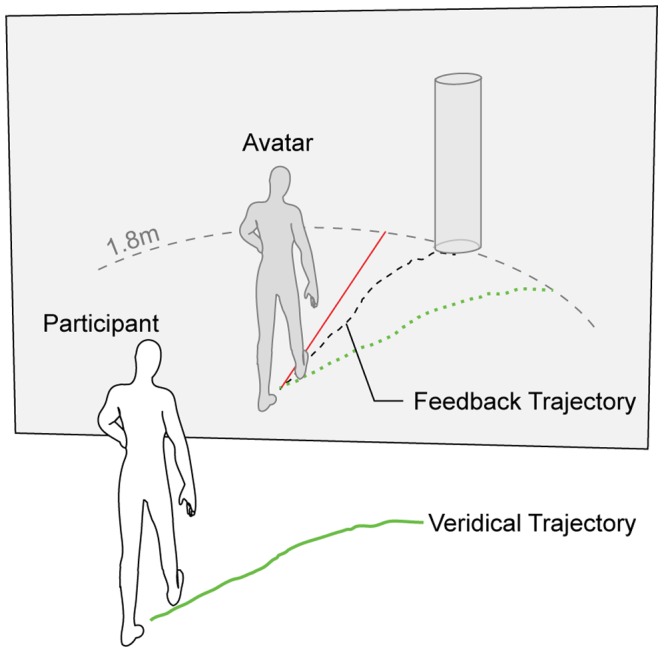
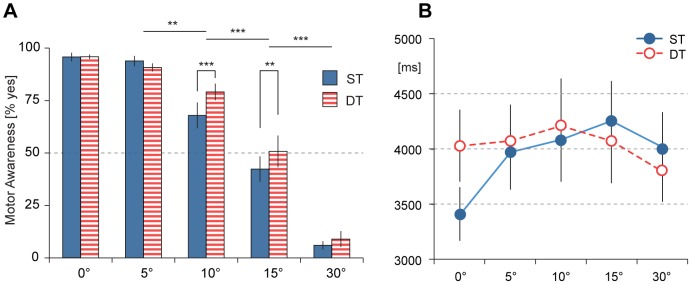
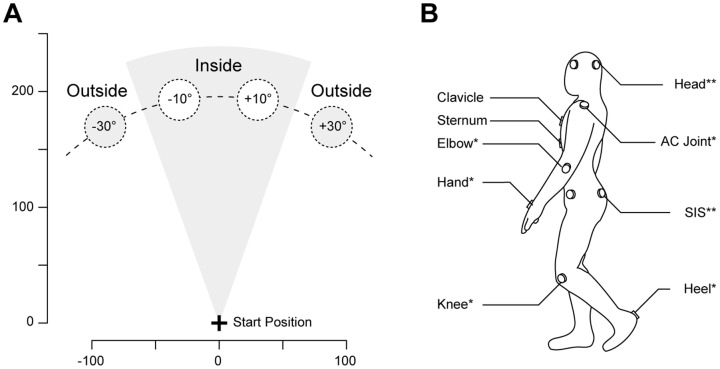
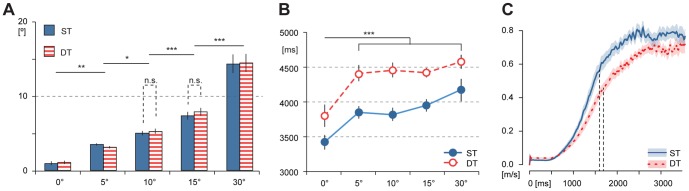
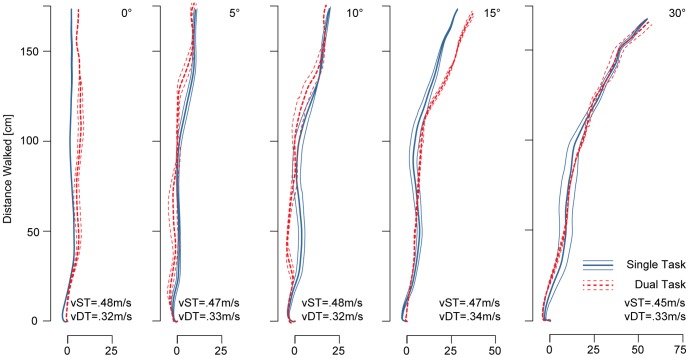
The primary purpose of this study was to investigate the effects of cognitive loading on movement kinematics and trajectory formation during goal-directed walking in a virtual reality (VR) environment. The secondary objective was to measure how participants corrected their trajectories for perturbed feedback and how participants' awareness of such perturbations changed under cognitive loading. We asked 14 healthy young adults to walk towards four different target locations in a VR environment while their movements were tracked and played back in real-time on a large projection screen. In 75% of all trials we introduced angular deviations of ±5° to ±30° between the veridical walking trajectory and the visual feedback. Participants performed a second experimental block under cognitive load (serial-7 subtraction, counter-balanced across participants). We measured walking kinematics (joint-angles, velocity profiles) and motor performance (end-point-compensation, trajectory-deviations). Motor awareness was determined by asking participants to rate the veracity of the feedback after every trial. In-line with previous findings in natural settings, participants displayed stereotypical walking trajectories in a VR environment. Our results extend these findings as they demonstrate that taxing cognitive resources did not affect trajectory formation and deviations although it interfered with the participants' movement kinematics, in particular walking velocity. Additionally, we report that motor awareness was selectively impaired by the secondary task in trials with high perceptual uncertainty. Compared with data on eye and arm movements our findings lend support to the hypothesis that the central nervous system (CNS) uses common mechanisms to govern goal-directed movements, including locomotion. We discuss our results with respect to the use of VR methods in gait control and rehabilitation.
本研究的主要目的是探究认知负荷对虚拟现实(VR)环境中目标导向行走时运动运动学和轨迹形成的影响。次要目的是测量参与者如何针对受扰反馈校正其轨迹,以及在认知负荷下参与者对这种干扰的意识如何变化。我们要求 14 名健康的年轻人在 VR 环境中朝着四个不同的目标位置行走,同时实时跟踪并在大型投影屏幕上播放他们的运动。在所有试验的 75%中,我们在真实行走轨迹和视觉反馈之间引入了±5°至±30°的角度偏差。参与者在认知负荷下(序列-7 减法,参与者之间平衡)执行第二个实验块。我们测量了行走运动学(关节角度、速度曲线)和运动表现(端点补偿、轨迹偏差)。运动意识通过让参与者在每次试验后对反馈的真实性进行评分来确定。与自然环境中的先前发现一致,参与者在 VR 环境中表现出典型的行走轨迹。我们的结果扩展了这些发现,因为它们表明,尽管认知资源的负担会干扰参与者的运动运动学,特别是行走速度,但不会影响轨迹形成和偏差。此外,我们报告说,在具有高感知不确定性的试验中,次要任务会选择性地损害运动意识。与眼动和手臂运动的数据相比,我们的发现支持了这样一种假设,即中枢神经系统(CNS)使用共同的机制来控制目标导向的运动,包括行走。我们根据 VR 方法在步态控制和康复中的应用讨论了我们的结果。