Ongkeko Weg M, Burton Doug, Kiang Alan, Abhold Eric, Kuo Selena Z, Rahimy Elham, Yang Meng, Hoffman Robert M, Wang-Rodriguez Jessica, Deftos Leonard J
Division of Otolaryngology-Head and Neck Surgery, Department of Surgery, University of California San Diego, La Jolla, California, United States of America.
Department of Medicine, Veterans Administration San Diego Healthcare System, University of California San Diego, La Jolla, California, United States of America.
PLoS One. 2014 Jan 22;9(1):e85803. doi: 10.1371/journal.pone.0085803. eCollection 2014.
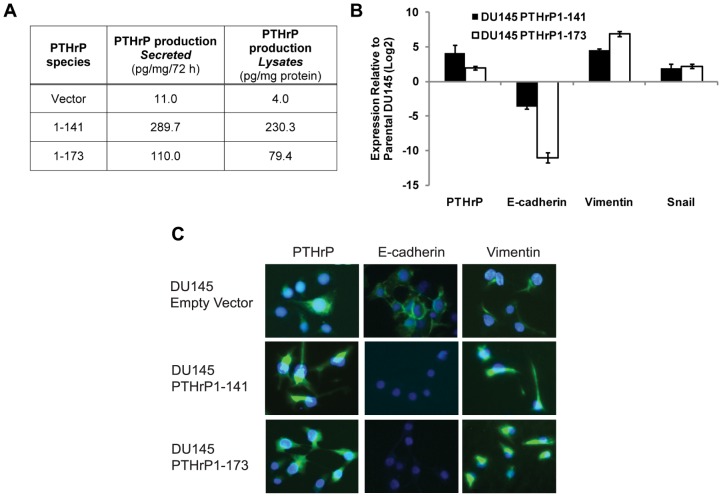
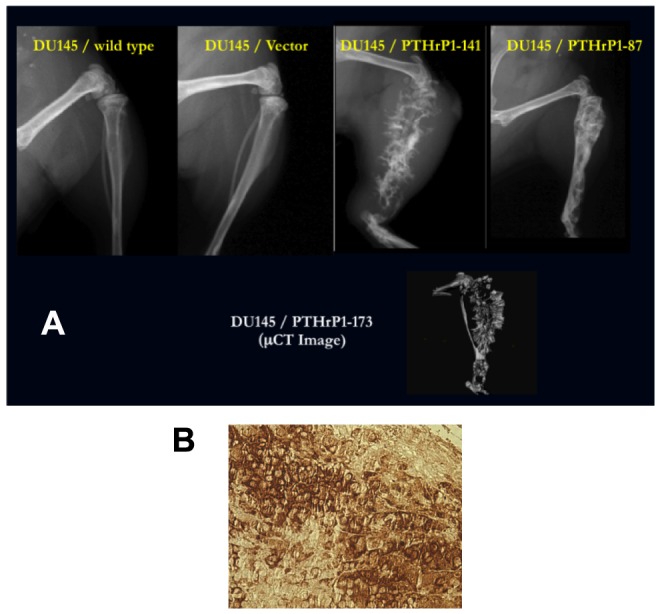
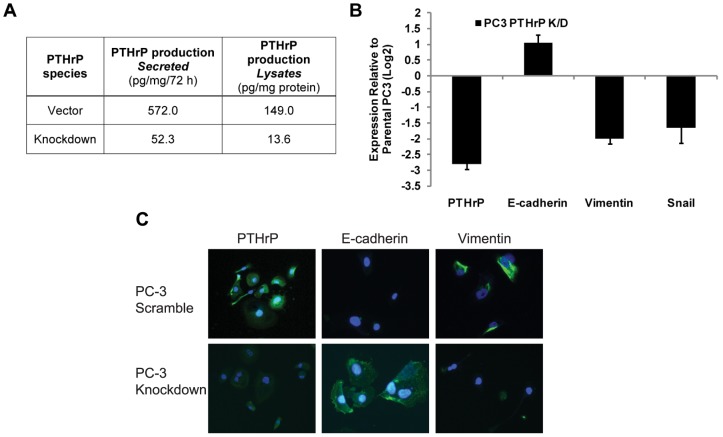
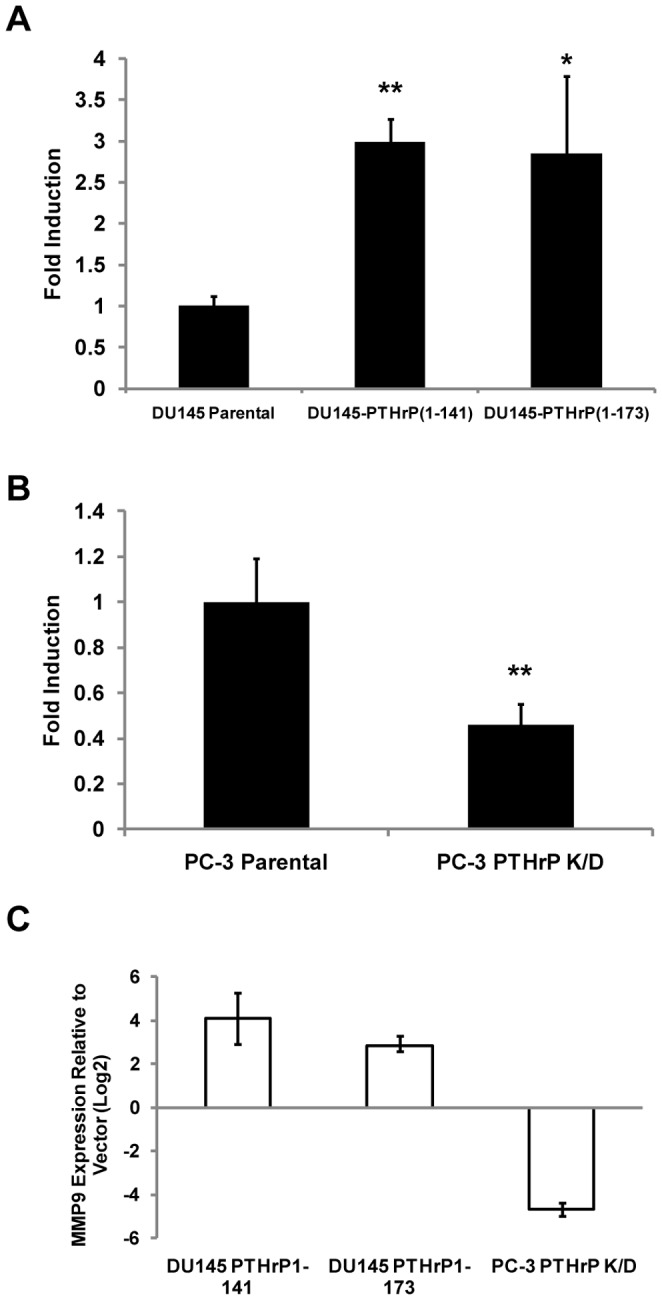
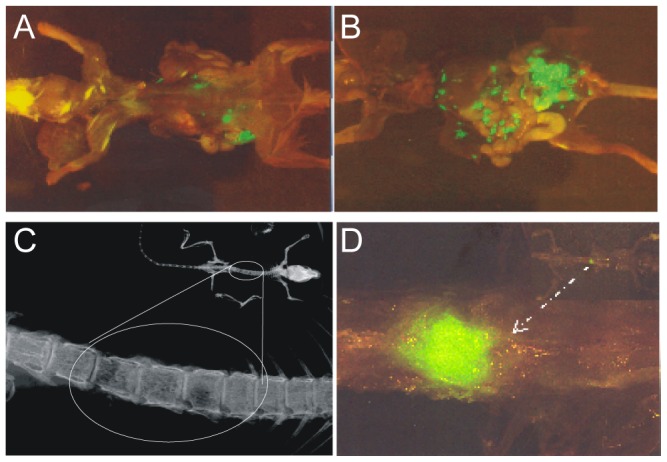
Parathyroid hormone-related protein (PTHrP) possesses a variety of physiological and developmental functions and is also known to facilitate the progression of many common cancers, notably their skeletal invasion, primarily by increasing bone resorption. The purpose of this study was to determine whether PTHrP could promote epithelial-to-mesenchymal transition (EMT), a process implicated in cancer stem cells that is critically involved in cancer invasion and metastasis. EMT was observed in DU 145 prostate cancer cells stably overexpressing either the 1-141 or 1-173 isoform of PTHrP, where there was upregulation of Snail and vimentin and downregulation of E-cadherin relative to parental DU 145. By contrast, the opposite effect was observed in PC-3 prostate cancer cells where high levels of PTHrP were knocked-down via lentiviral siRNA transduction. Increased tumor progression was observed in PTHrP-overexpressing DU 145 cells while decreased progression was observed in PTHrP-knockdown PC-3 cells. PTHrP-overexpressing DU 145 formed larger tumors when implanted orthoptopically into nude mice and in one case resulted in spinal metastasis, an effect not observed among mice injected with parental DU 145 cells. PTHrP-overexpressing DU 145 cells also caused significant bone destruction when injected into the tibiae of nude mice, while parental DU 145 cells caused little to no destruction of bone. Together, these results suggest that PTHrP may work through EMT to promote an aggressive and metastatic phenotype in prostate cancer, a pathway of importance in cancer stem cells. Thus, continued efforts to elucidate the pathways involved in PTHrP-induced EMT as well as to develop ways to specifically target PTHrP signaling may lead to more effective therapies for prostate cancer.
甲状旁腺激素相关蛋白(PTHrP)具有多种生理和发育功能,并且已知它主要通过增加骨吸收来促进许多常见癌症的进展,尤其是其骨骼侵袭。本研究的目的是确定PTHrP是否能促进上皮-间质转化(EMT),这一过程与癌症干细胞有关,在癌症侵袭和转移中起关键作用。在稳定过表达PTHrP 1-141或1-173异构体的DU 145前列腺癌细胞中观察到了EMT,相对于亲本DU 145细胞,Snail和波形蛋白上调,E-钙黏蛋白下调。相比之下,在通过慢病毒siRNA转导敲低高水平PTHrP的PC-3前列腺癌细胞中观察到了相反的效果。在过表达PTHrP的DU 145细胞中观察到肿瘤进展增加,而在敲低PTHrP的PC-3细胞中观察到进展减少。将过表达PTHrP的DU 145原位植入裸鼠体内时形成了更大的肿瘤,并且在一个案例中导致了脊柱转移,而注射亲本DU 145细胞的小鼠中未观察到这种效果。将过表达PTHrP的DU 145细胞注射到裸鼠胫骨中时也会导致明显的骨破坏,而亲本DU 145细胞对骨的破坏很小或没有破坏。总之,这些结果表明PTHrP可能通过EMT发挥作用,以促进前列腺癌的侵袭性和转移表型,这是癌症干细胞中的一条重要途径。因此,继续努力阐明PTHrP诱导的EMT所涉及的途径以及开发特异性靶向PTHrP信号传导的方法可能会带来更有效的前列腺癌治疗方法。