Baumann-Pickering Simone, Roch Marie A, Brownell Robert L, Simonis Anne E, McDonald Mark A, Solsona-Berga Alba, Oleson Erin M, Wiggins Sean M, Hildebrand John A
Scripps Institution of Oceanography, University of California, San Diego, La Jolla, California, United States of America.
Scripps Institution of Oceanography, University of California, San Diego, La Jolla, California, United States of America ; Department of Computer Science, San Diego State University, San Diego, California, United States of America.
PLoS One. 2014 Jan 22;9(1):e86072. doi: 10.1371/journal.pone.0086072. eCollection 2014.
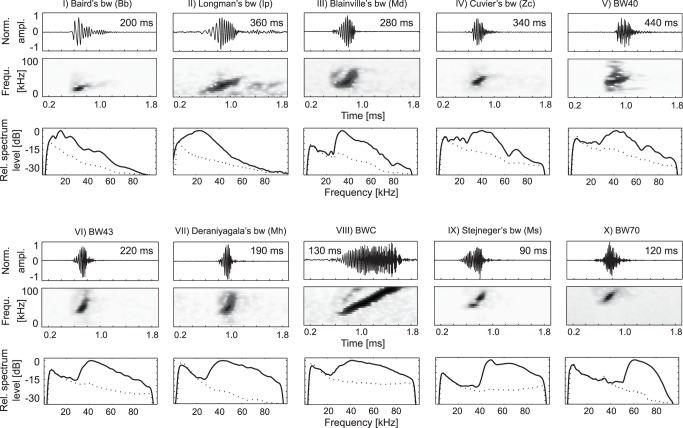
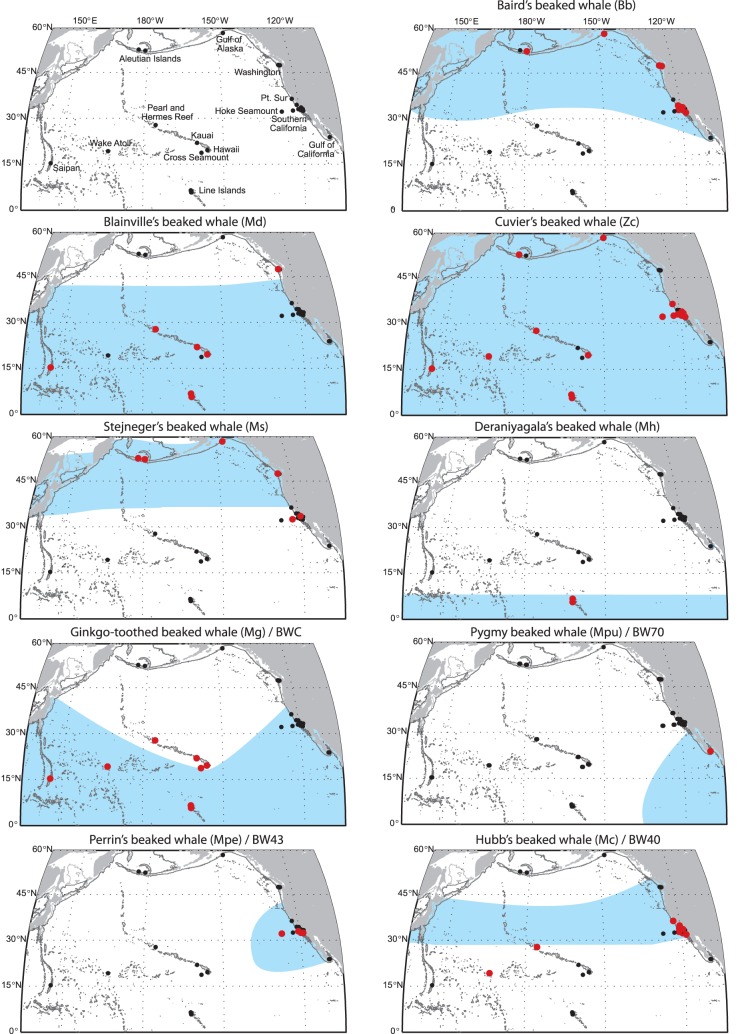
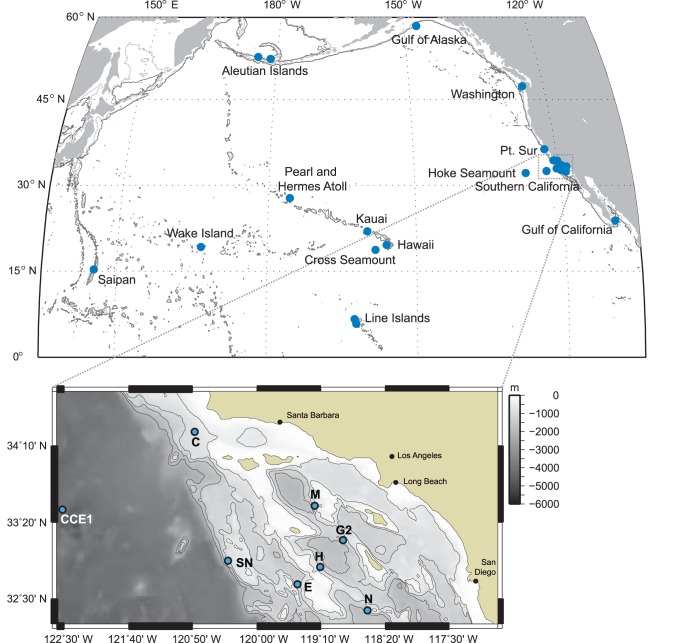
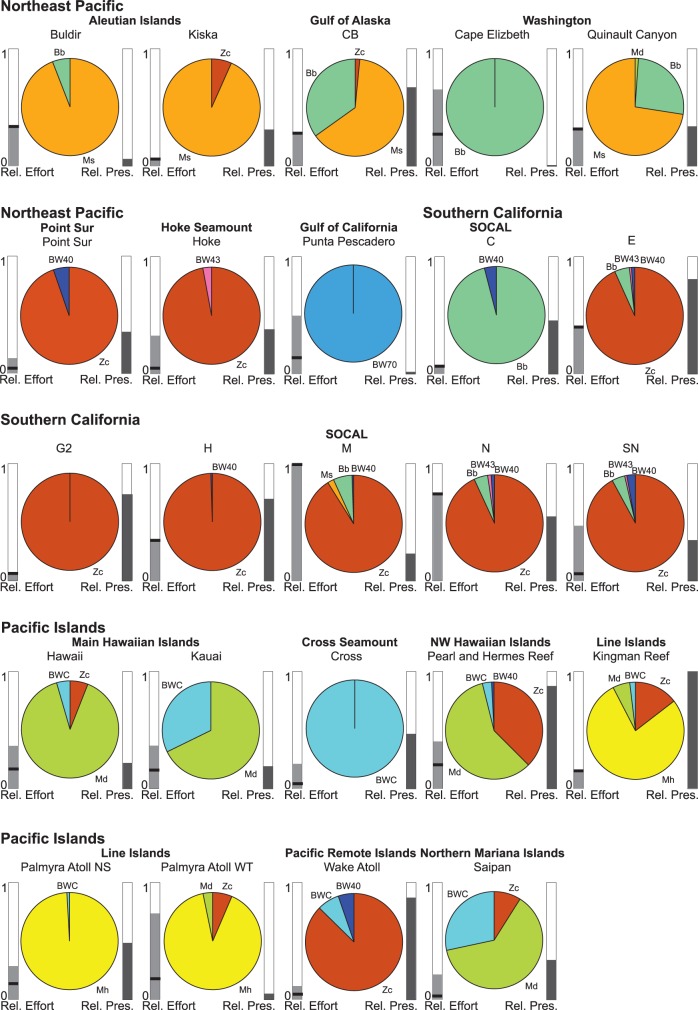
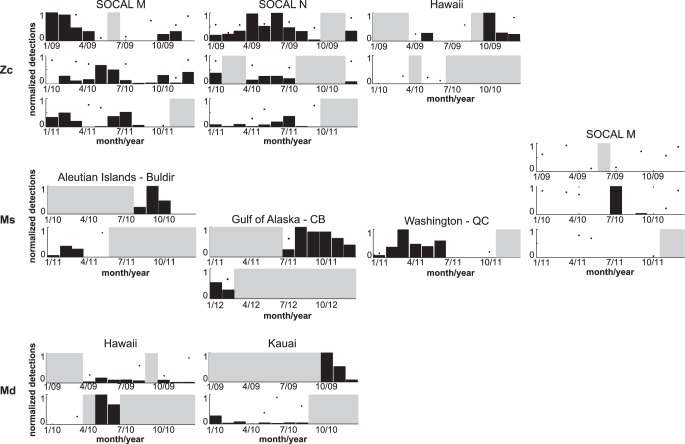
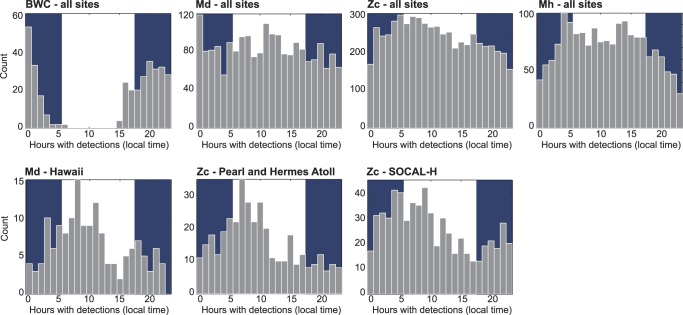
At least ten species of beaked whales inhabit the North Pacific, but little is known about their abundance, ecology, and behavior, as they are elusive and difficult to distinguish visually at sea. Six of these species produce known species-specific frequency modulated (FM) echolocation pulses: Baird's, Blainville's, Cuvier's, Deraniyagala's, Longman's, and Stejneger's beaked whales. Additionally, one described FM pulse (BWC) from Cross Seamount, Hawai'i, and three unknown FM pulse types (BW40, BW43, BW70) have been identified from almost 11 cumulative years of autonomous recordings at 24 sites throughout the North Pacific. Most sites had a dominant FM pulse type with other types being either absent or limited. There was not a strong seasonal influence on the occurrence of these signals at any site, but longer time series may reveal smaller, consistent fluctuations. Only the species producing BWC signals, detected throughout the Pacific Islands region, consistently showed a diel cycle with nocturnal foraging. By comparing stranding and sighting information with acoustic findings, we hypothesize that BWC signals are produced by ginkgo-toothed beaked whales. BW43 signal encounters were restricted to Southern California and may be produced by Perrin's beaked whale, known only from Californian waters. BW70 signals were detected in the southern Gulf of California, which is prime habitat for Pygmy beaked whales. Hubb's beaked whale may have produced the BW40 signals encountered off central and southern California; however, these signals were also recorded off Pearl and Hermes Reef and Wake Atoll, which are well south of their known range.
至少有十种喙鲸栖息在北太平洋,但由于它们难以捉摸且在海上很难通过视觉区分,所以人们对它们的数量、生态和行为知之甚少。其中六种喙鲸会发出已知的物种特异性调频(FM)回声定位脉冲:贝氏喙鲸、布兰氏喙鲸、居维叶喙鲸、德氏喙鲸、朗曼氏喙鲸和史氏喙鲸。此外,从夏威夷十字海山记录到一种已描述的FM脉冲(BWC),并且在北太平洋24个地点近11年的累计自主记录中识别出三种未知的FM脉冲类型(BW40、BW43、BW70)。大多数地点有一种占主导地位的FM脉冲类型,其他类型要么不存在,要么数量有限。在任何地点,这些信号的出现都没有受到强烈的季节性影响,但更长的时间序列可能会揭示出较小的、持续的波动。只有在太平洋岛屿地区都能检测到的发出BWC信号的物种,始终表现出夜间觅食的昼夜循环。通过将搁浅和目击信息与声学研究结果进行比较,我们推测BWC信号是由银杏齿喙鲸发出的。BW43信号仅在南加利福尼亚被记录到,可能是由仅在加利福尼亚海域被发现的佩氏喙鲸发出的。在加利福尼亚湾南部检测到了BW70信号,该区域是小喙鲸的主要栖息地。哈氏喙鲸可能是在加利福尼亚中部和南部海域记录到的BW40信号的发出者;然而,在珍珠和赫尔墨斯礁以及威克岛也记录到了这些信号,而这些地点远在它们已知分布范围的南部。