Department of Physiology, School of Medicine, Fukuoka University, Fukuoka 814-0180, Japan.
J Gen Physiol. 2014 Feb;143(2):183-201. doi: 10.1085/jgp.201311033.
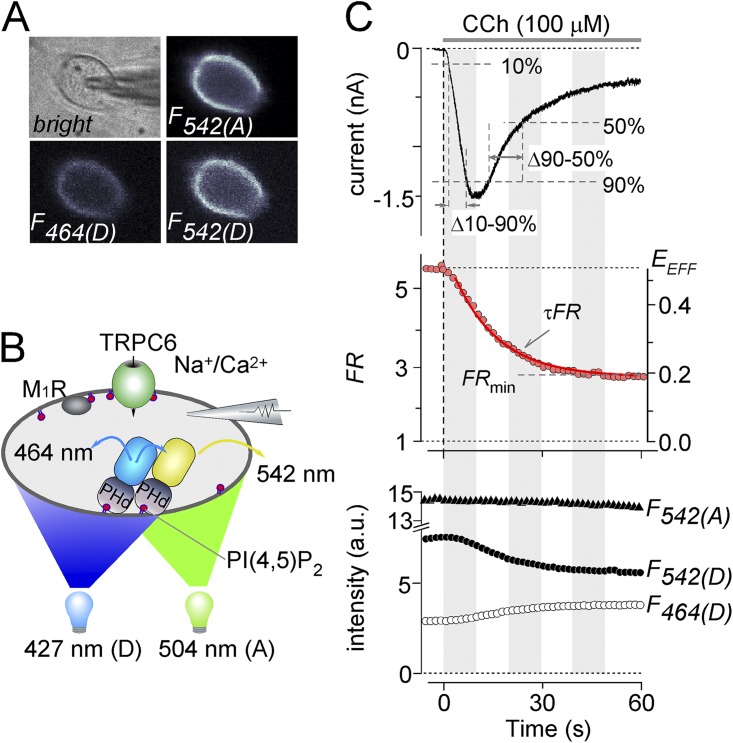
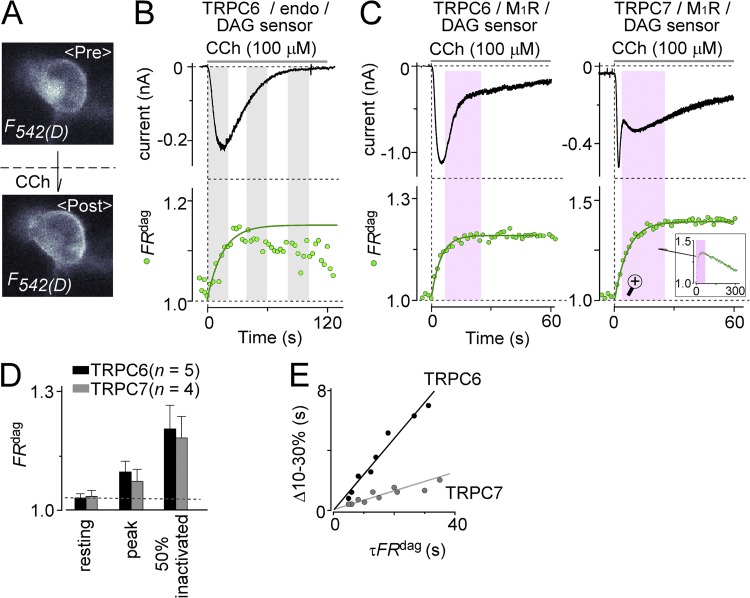
Transient receptor potential classical (or canonical) (TRPC)3, TRPC6, and TRPC7 are a subfamily of TRPC channels activated by diacylglycerol (DAG) produced through the hydrolysis of phosphatidylinositol 4,5-bisphosphate (PI(4,5)P2) by phospholipase C (PLC). PI(4,5)P2 depletion by a heterologously expressed phosphatase inhibits TRPC3, TRPC6, and TRPC7 activity independently of DAG; however, the physiological role of PI(4,5)P2 reduction on channel activity remains unclear. We used Förster resonance energy transfer (FRET) to measure PI(4,5)P2 or DAG dynamics concurrently with TRPC6 or TRPC7 currents after agonist stimulation of receptors that couple to Gq and thereby activate PLC. Measurements made at different levels of receptor activation revealed a correlation between the kinetics of PI(4,5)P2 reduction and those of receptor-operated TRPC6 and TRPC7 current activation and inactivation. In contrast, DAG production correlated with channel activation but not inactivation; moreover, the time course of channel inactivation was unchanged in protein kinase C-insensitive mutants. These results suggest that inactivation of receptor-operated TRPC currents is primarily mediated by the dissociation of PI(4,5)P2. We determined the functional dissociation constant of PI(4,5)P2 to TRPC channels using FRET of the PLCδ Pleckstrin homology domain (PHd), which binds PI(4,5)P2, and used this constant to fit our experimental data to a model in which channel gating is controlled by PI(4,5)P2 and DAG. This model predicted similar FRET dynamics of the PHd to measured FRET in either human embryonic kidney cells or smooth muscle cells, whereas a model lacking PI(4,5)P2 regulation failed to reproduce the experimental data, confirming the inhibitory role of PI(4,5)P2 depletion on TRPC currents. Our model also explains various PLC-dependent characteristics of channel activity, including limitation of maximum open probability, shortening of the peak time, and the bell-shaped response of total current. In conclusion, our studies demonstrate a fundamental role for PI(4,5)P2 in regulating TRPC6 and TRPC7 activity triggered by PLC-coupled receptor stimulation.
瞬时受体电位经典型(或经典型)(TRPC)3、TRPC6 和 TRPC7 是由二酰基甘油(DAG)激活的 TRPC 通道亚家族,通过磷脂酶 C(PLC)水解磷脂酰肌醇 4,5-二磷酸(PI(4,5)P2)产生。通过异源表达的磷酸酶耗竭 PI(4,5)P2 可独立于 DAG 抑制 TRPC3、TRPC6 和 TRPC7 活性;然而,PI(4,5)P2 减少对通道活性的生理作用仍不清楚。我们使用荧光共振能量转移(FRET)在激动剂刺激偶联 Gq 并激活 PLC 的受体后,同时测量 PI(4,5)P2 或 DAG 动力学与 TRPC6 或 TRPC7 电流。在不同水平的受体激活下进行的测量揭示了 PI(4,5)P2 减少的动力学与受体操纵的 TRPC6 和 TRPC7 电流激活和失活的动力学之间的相关性。相比之下,DAG 的产生与通道激活相关,但与失活无关;此外,蛋白激酶 C 不敏感突变体中的通道失活时间过程不变。这些结果表明,受体操纵的 TRPC 电流的失活主要由 PI(4,5)P2 的解离介导。我们使用 PLCδ pleckstrin 同源结构域(PHd)的 FRET 确定了 PI(4,5)P2 与 TRPC 通道的功能解离常数,并用该常数拟合我们的实验数据,得到一个模型,其中通道门控由 PI(4,5)P2 和 DAG 控制。该模型预测了 PHd 的 FRET 动力学与在人胚胎肾细胞或平滑肌细胞中测量的 FRET 相似,而缺乏 PI(4,5)P2 调节的模型无法重现实验数据,从而证实了 PI(4,5)P2 耗竭对 TRPC 电流的抑制作用。我们的模型还解释了通道活性的各种 PLC 依赖性特征,包括最大开放概率的限制、峰值时间的缩短以及总电流的钟形响应。总之,我们的研究证明了 PI(4,5)P2 在调节由 PLC 偶联受体刺激触发的 TRPC6 和 TRPC7 活性中的基本作用。