Department of Microbiology, Immunology and Molecular Genetics, Eli & Edythe Broad Center of Regenerative Medicine and Stem Cell Research, University of California at Los Angeles, Los Angeles, CA 90095, USA.
Mork Family Department of Chemical Engineering and Materials Science, University of Southern California, Los Angeles, CA 90089, USA.
Viruses. 2014 Jan 27;6(2):428-47. doi: 10.3390/v6020428.
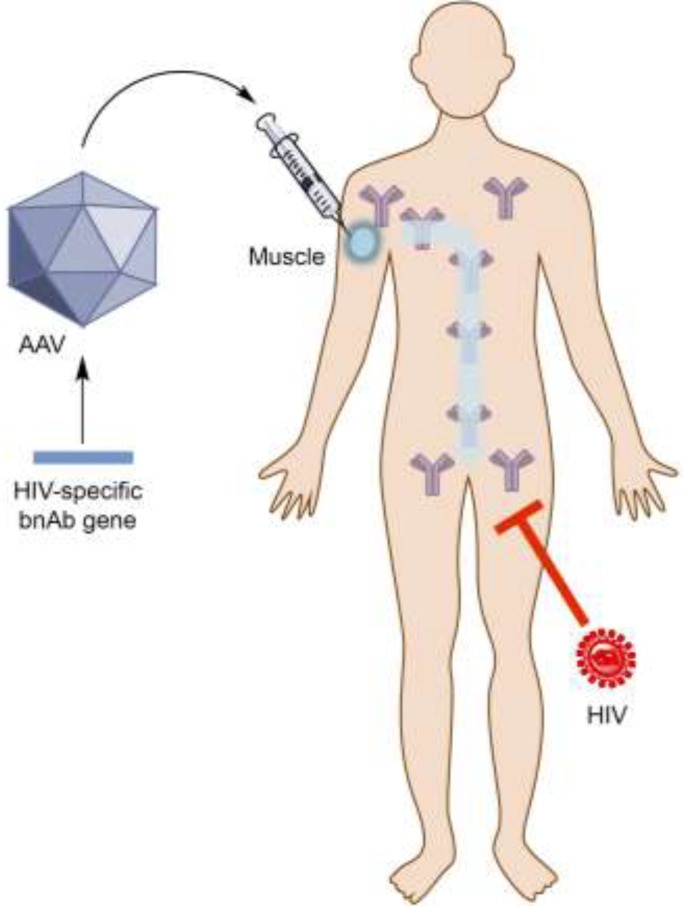
Despite tremendous efforts over the course of many years, the quest for an effective HIV vaccine by the classical method of active immunization remains largely elusive. However, two recent studies in mice and macaques have now demonstrated a new strategy designated as Vectored ImmunoProphylaxis (VIP), which involves passive immunization by viral vector-mediated delivery of genes encoding broadly neutralizing antibodies (bnAbs) for in vivo expression. Robust protection against virus infection was observed in preclinical settings when animals were given VIP to express monoclonal neutralizing antibodies. This unorthodox approach raises new promise for combating the ongoing global HIV pandemic. In this article, we survey the status of antibody gene transfer, review the revolutionary progress on isolation of extremely bnAbs, detail VIP experiments against HIV and its related virus conduced in humanized mice and macaque monkeys, and discuss the pros and cons of VIP and its opportunities and challenges towards clinical applications to control HIV/AIDS endemics.
尽管多年来付出了巨大努力,但通过经典的主动免疫方法来寻找有效的 HIV 疫苗仍然难以实现。然而,最近在小鼠和恒河猴中的两项研究表明了一种新的策略,称为载体免疫预防(Vectored ImmunoProphylaxis,VIP),它涉及通过病毒载体介导的基因传递来进行被动免疫,这些基因编码广泛中和抗体(broadly neutralizing antibodies,bnAbs)以进行体内表达。在临床前研究中,当动物接受 VIP 以表达单克隆中和抗体时,观察到对病毒感染的强大保护。这种非传统的方法为应对持续的全球 HIV 大流行带来了新的希望。在本文中,我们调查了抗体基因转移的现状,回顾了分离极其 bnAbs 的革命性进展,详细介绍了 VIP 实验在人类化小鼠和恒河猴中针对 HIV 及其相关病毒的实验,并讨论了 VIP 的优缺点以及 VIP 向控制 HIV/AIDS 流行的临床应用的机遇和挑战。