Yu Chuan-Hang, Yu Cheng-Chia
School of Dentistry, Chung Shan Medical University, Taichung, Taiwan ; Department of Dentistry, Chung Shan Medical University Hospital, Taichung, Taiwan.
School of Dentistry, Chung Shan Medical University, Taichung, Taiwan ; Department of Dentistry, Chung Shan Medical University Hospital, Taichung, Taiwan ; Institute of Oral Sciences, Chung Shan Medical University, Taichung, Taiwan.
PLoS One. 2014 Jan 24;9(1):e87129. doi: 10.1371/journal.pone.0087129. eCollection 2014.
Head and neck cancer (HNC) ranks the fourth leading malignancy and cancer death in male population in Taiwan. Despite recent therapeutic advances, the prognosis for HNC patients is still dismal. New strategies are urgently needed to improve the chemosensitization to conventional chemotherapeutic drugs and clinical responses of HNC patients. Studies have demonstrated that topical 5-aminolevulinic acid-mediated photodynamic therapy (ALA-PDT) is being used in the treatment of various human premalignant and malignant lesions with some encouraging clinical outcomes. However, the molecular mechanisms of ALA-PDT in the therapeutic effect in HNC tumorigenesis and whether ALA-PDT as chemosensitizer for HNC treatment remain unclear. Accumulating data support cancer stem cells (CSCs) contributes chemo-resistance in HNC. Based on the previous studies, the purpose of the study is to investigate the effect of ALA-PDT on CSCs and chemosensitization property in HNC.
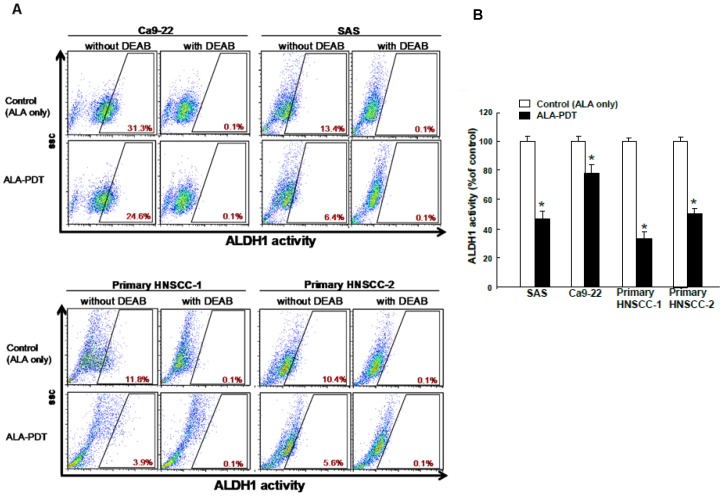
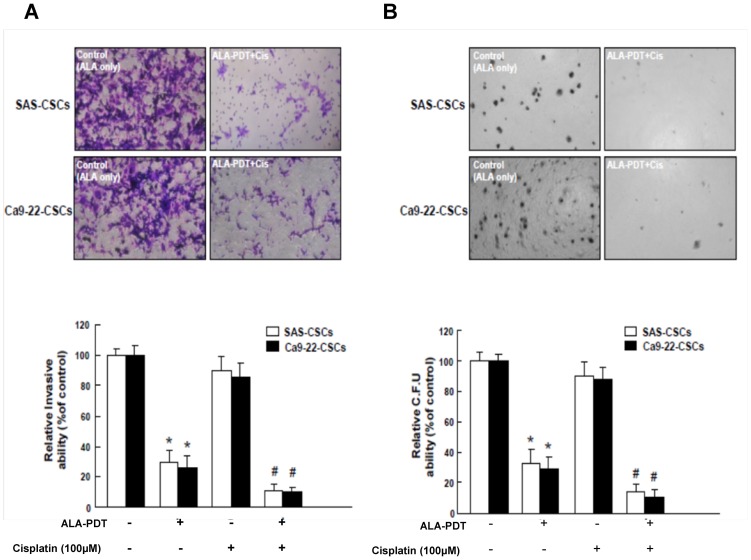
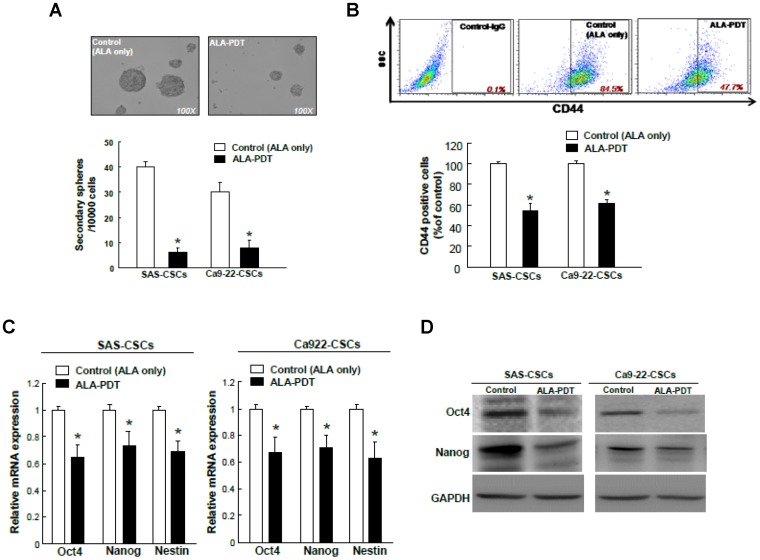
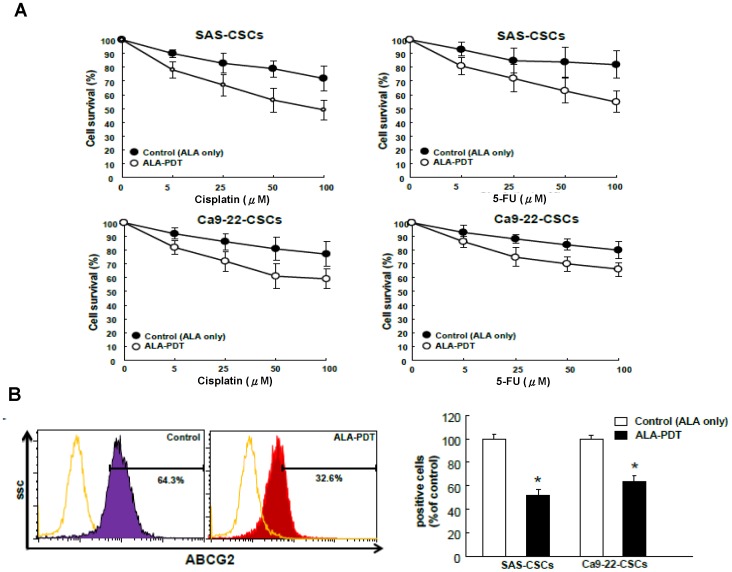
METHODOLOGY/PRINCIPAL FINDING: CSCs marker ALDH1 activity of HNC cells with ALA-PDT treatment as assessed by the Aldefluor assay flow cytometry analysis. Secondary Sphere-forming self-renewal, stemness markers expression, and invasiveness of HNC-CSCs with ALA-PDT treatment were presented. We observed that the treatment of ALA-PDT significantly down-regulated the ALDH1 activity and CD44 positivity of HNC-CSCs. Moreover, ALA-PDT reduced self-renewal property and stemness signatures expression (Oct4 and Nanog) in sphere-forming HNC-CSCs. ALA-PDT sensitized highly tumorigenic HNC-CSCs to conventional chemotherapies. Lastly, synergistic effect of ALA-PDT and Cisplatin treatment attenuated invasiveness/colongenicity property in HNC-CSCs.
CONCLUSION/SIGNIFICANCE: Our results provide insights into the clinical prospect of ALA-PDT as a potential chemo-adjuvant therapy against head and neck cancer through eliminating CSCs property.
头颈癌(HNC)是台湾男性人群中第四大常见恶性肿瘤及癌症死亡原因。尽管近期治疗取得了进展,但HNC患者的预后仍然不佳。迫切需要新的策略来提高对传统化疗药物的化学敏感性以及HNC患者的临床反应。研究表明,局部5-氨基乙酰丙酸介导的光动力疗法(ALA-PDT)正在用于治疗各种人类癌前和恶性病变,并取得了一些令人鼓舞的临床结果。然而,ALA-PDT在HNC肿瘤发生治疗效果中的分子机制以及ALA-PDT是否可作为HNC治疗的化学增敏剂仍不清楚。越来越多的数据支持癌症干细胞(CSCs)在HNC中产生化疗耐药性。基于先前的研究,本研究的目的是探讨ALA-PDT对HNC中CSCs的影响及其化学增敏特性。
方法/主要发现:通过Aldefluor检测流式细胞术分析评估ALA-PDT处理的HNC细胞的CSCs标志物ALDH1活性。呈现了ALA-PDT处理的HNC-CSCs的二次成球自我更新、干性标志物表达和侵袭性。我们观察到,ALA-PDT处理显著下调了HNC-CSCs的ALDH1活性和CD44阳性率。此外,ALA-PDT降低了成球HNC-CSCs的自我更新特性和干性标志物表达(Oct4和Nanog)。ALA-PDT使高致瘤性的HNC-CSCs对传统化疗敏感。最后,ALA-PDT和顺铂联合治疗的协同作用减弱了HNC-CSCs的侵袭性/克隆形成特性。
结论/意义:我们的结果为ALA-PDT作为一种潜在的化疗辅助疗法通过消除CSCs特性治疗头颈癌的临床前景提供了见解。