Macha Muzafar A, Seshacharyulu Parthasarathy, Krishn Shiv Ram, Pai Priya, Rachagani Satyanarayana, Jain Maneesh, Batra Surinder K
Department of Biochemistry and Molecular Biology, Eppley Institute for Research in Cancer and Allied Diseases, University of Nebraska Medical Center, Omaha, Nebraska, 68198-5870, USA.
Curr Pharm Des. 2014;20(33):5287-97. doi: 10.2174/1381612820666140128213117.
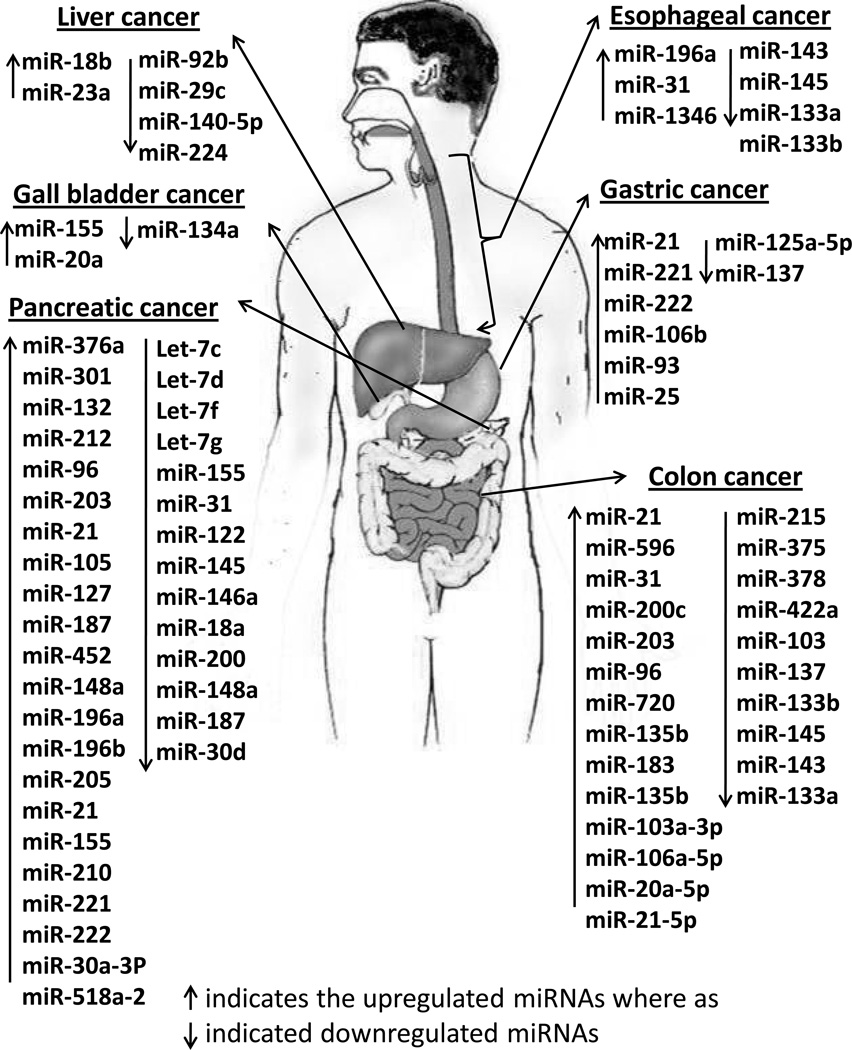
Gastrointestinal (GI) cancers remain one of the most common malignancies and are the second common cause of cancer deaths worldwide. The limited effectiveness of therapy for patients with advanced stage and recurrent disease is a reflection of an incomplete understanding of the molecular basis of GI carcinogenesis. Major advancements have improved our understanding of pathology and pathogenesis of GI cancers, but high mortality rates, unfavorable prognosis and lack of clinical predictive biomarkers provide an impetus to investigate new sensitive and specific diagnostic and prognostic markers for GI cancers. MicroRNAs (miRNAs) are short (19-24 nucleotides) noncoding RNA molecules that regulate gene expression at the posttranscriptional level thus playing an important role in modulating various biological processes including, but not limited to developmental processes, proliferation, apoptosis, metabolism, differentiation, epithelial-mechenchymal transition and are involved in the initiation and progression of various human cancers. Unique miRNA expression profiles have been observed in various cancer types at different stages, suggesting their potential as diagnostic and prognostic biomarkers. Due to their tumor-specific and tissue-specific expression profiles, stability, robust clinical assays for detection in serum as well as in formalin-fixed tissue samples, miRNAs have emerged as attractive candidates for diagnostic and prognostic applications. This review summarizes recent research supporting the utility of miRNAs as novel diagnostic and prognostic tools for GI cancers.
胃肠道(GI)癌症仍然是最常见的恶性肿瘤之一,并且是全球癌症死亡的第二大常见原因。对于晚期和复发性疾病患者,治疗效果有限,这反映出我们对胃肠道癌发生的分子基础理解不完整。重大进展提高了我们对胃肠道癌症病理和发病机制的认识,但高死亡率、不良预后以及缺乏临床预测生物标志物促使人们去研究用于胃肠道癌症的新的敏感且特异的诊断和预后标志物。微小RNA(miRNA)是短(19 - 24个核苷酸)的非编码RNA分子,它们在转录后水平调节基因表达,因此在调节各种生物学过程中发挥重要作用,这些过程包括但不限于发育过程、增殖、凋亡、代谢、分化、上皮 - 间质转化,并且参与各种人类癌症的发生和发展。在不同阶段的各种癌症类型中都观察到了独特的miRNA表达谱型,这表明它们作为诊断和预后生物标志物的潜力。由于其肿瘤特异性和组织特异性表达谱型、稳定性、在血清以及福尔马林固定组织样本中进行检测的强大临床检测方法,miRNA已成为诊断和预后应用中具有吸引力的候选物。这篇综述总结了最近支持miRNA作为胃肠道癌症新型诊断和预后工具的研究。